The Persistence of Inflation
11th October, 2023
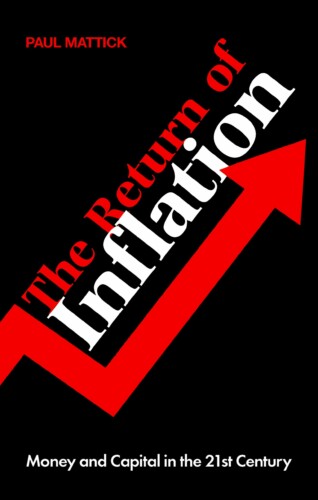
Inflation is a hot topic right now, and there is much debate about its significance and persistence. In this blog, Paul Mattick writes about this phenomenon, as well as what caused him to write his book, The Return of Inflation: Money and Capital in the 21st Century.
***
An obvious danger with a book about a phenomenon of current interest is that the phenomenon may develop in unexpected ways between the moment the book is written and the time of publication. I certainly was conscious of this when I started to write The Return of Inflation, taking as a focus the worldwide surge in price levels that began to alarm economic officials in 2021. What, for instance, if “Team Temporary”—those who argued that the inflation had been produced not by the many years of government spending after the Great Recession and the COVID crisis but by such particular events as pandemic-produced supply problems and the war in Ukraine—were correct? What if the problem simply went away? Or, whatever its causes, what if the economists directing fiscal and monetary policy succeeded in taming the problem altogether?
In the event, no revision or afterword has been necessary. Inflation has moderated in the central economic areas, though it is still pretty wild in many nations, but it is still well above the target numbers favored by the authorities. Those authorities themselves confess that they don’t know what is going to happen and therefore what steps they should take, torn as they are between fear of provoking a serious recession by constricting the supply of debt and allowing inflation to flourish by letting credit run freely. Economists have amply confirmed an idea basic to the book: they themselves stress their ignorance about the functioning of the economic system and their inability to predict how it will develop. As Nobel laureate Paul Krugman, considering the future course of American inflation, put it recently, “Don’t ask economists. … My own view? I don’t know.” Economists as a group, according to Krugman, can tell us neither where the inflation rate is going nor where it should go—2 percent? 3 percent? 4 percent?—for a healthy economy. In the last option, he leans toward joining what Financial Times’s John Plunder identifies as “a growing chorus arguing for raising inflation targets” This is not unreasonable “if, as former Bank of England chief economist Andy Haldane has argued, we are witnessing a shift upwards in the global equilibrium price level”—i.e., if higher prices are just here to stay.
Indeed, as my book argues, the current inflation is only the most recent manifestation of a tendency at work in capitalism since the 1940s. For the most part, contemporary writers on economics treat recessions or episodes of financial instability as individual events, rather than as examples of recurring phenomena. While it is common to compare the current inflation to that of the 1970s, the idea that it reflects a general condition of the postwar economy does not arise. I suspect that it is my effort to treat it this way that explains why—so far!—I have not had to revise the arguments in The Return of Inflation. In fact, the anomaly to be explained is not the current upward movement of prices, but the apparent absence of inflation during the preceding decade—a mystery for economists of the time, though today relatively undiscussed.
The reason for the economists’ perplexity is the peculiar understanding of money basic to contemporary economics, along with other odd features of that putative science. From the point of view of contemporary theory, the capitalist economy is constituted by the exchange of goods among individual owners; money is thought of simply as a means for simplifying these exchanges. This is obviously not true: Capital is money invested to make more money, and goods are only produced insofar as this primary aim is achieved. Money is essential to the operation of the system, and such monetary disturbances as inflation and deflation are aspects of systemic problems. An understanding of today’s inflation, then, requires an understanding of the dynamics of contemporary capitalism. This, ultimately, is what I have tried to sketch in my book; the persistence of inflation suggests that I have gotten at least a good part of it right!
– Paul Mattick
Paul Mattick is Emeritus Professor of Philosophy at Adelphi University, New York. He is the author of Business as Usual (Reaktion, 2012) and Theory as Critique: Essays on Capital (2019), and editor of Reaktion’s Field Notes series. He is the former editor of the International Journal of Political Economy, and lives in San Francisco.
You can buy The Return of Inflation from our online shop now.