In Memory of Esther Rantzen
1st October, 2026
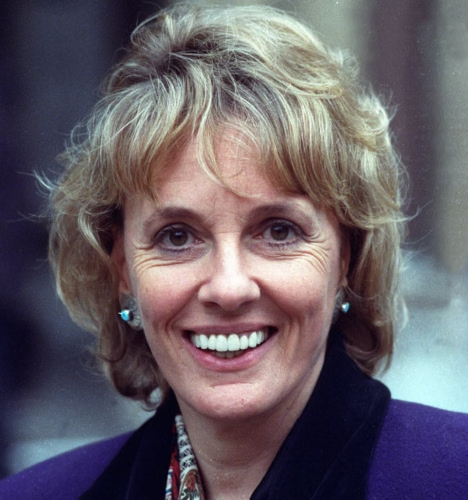
I am deeply saddened that Esther never lived to see her wish fulfilled: that she, and others like her, could have an assisted death in Britain. Instead people who are terminally ill and suffering are faced with the choice of carrying on till the last in pain or going abroad to have it in Switzerland but earlier than they would have wished so that they are fit enough to travel.
When Esther Rantzen – whom I knew personally from both television work with her & campaigning on assisted dying – learned she had untreatable cancer, she took the remarkable step of turning her last eighteen months into high profile efforts for assisted dying to be legalised.
She knew full well it would not happen in time to help her but it would be of massive comfort to others who would one day be terminally ill and would want the option of palliative care or assisted dying in their own home, a choice that they are denied at present, as she herself was.
I was shocked that some people accused her of bad faith for living longer than the six months she was diagnosed initially – how dare she! – whereas critics have forgotten that the six month diagnosis means a person is eligible for an assisted dying application, not that one has to take it…and she is an example of how, if the Bill is passed, those who will fight on till the pain become unbearable and only then apply for it,
In the event, she died at home, but her wish was that she would be among the last not to have the options of how best to die, a wish that was unfulfilled following the defeat of the assisted dying Bill recently.
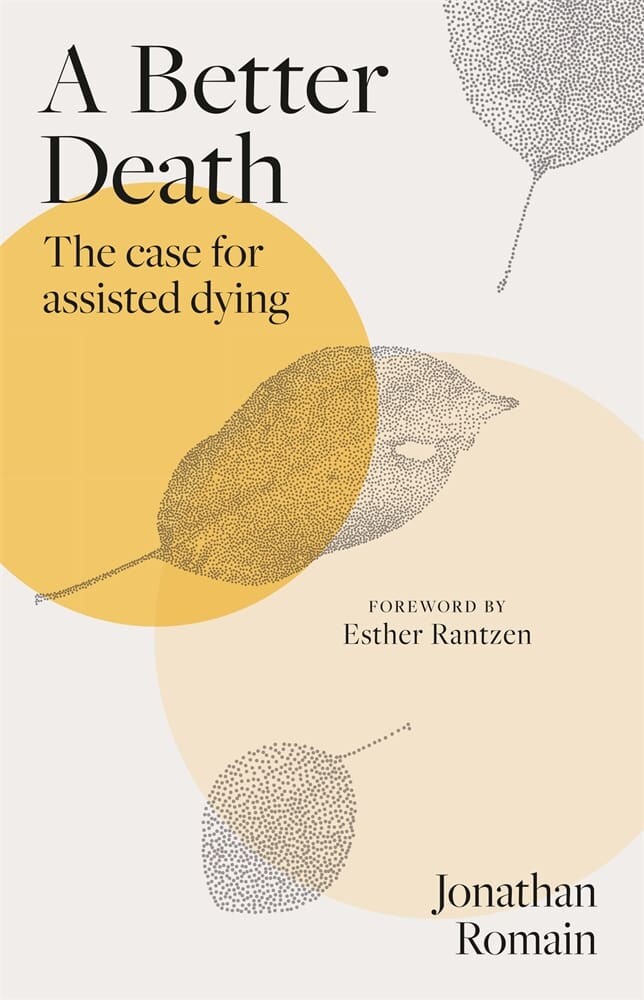
Before she died, she wrote a foreword for the book I have written – A Better Death: The Case for Assisted Dying (Reaktion Books) – expressing her regret at the current ban on assisted dying and her hope it will be permitted. Her full text, one of the last articles she wrote, is below.
– Rabbi Dr Jonathan Romain MBE
Chair, Religious Alliance for Dignity in Dying
A Better Death: The Case for Assisted Dying
Jonathan Romain
Foreword by Esther Rantzen
For most of my life, I thought I was immortal. Perhaps I inherited that confidence from my mother, who feared certain things, like spiders when she visited my sister in Australia and who can blame her, but the idea of her own death never crossed her mind. She lived a happy and active life until her last illness at the age of ninety-four, so her confidence stood her in very good stead. In a way I let her down by receiving my diagnosis of stage four lung cancer when I was a spring chicken of eighty-two, and suddenly for the first time I had to contemplate my own death as a reality and probably happening quite soon. Which meant all kinds of decisions.
I decided to make the diagnosis public by making a personal statement to Press Association. As I said at the time, with any number of hospital appointments and scans it was certain to come out anyway, and I had no desire to adopt some unconvincing disguise as I skulked around various hospital reception areas. Although I was quite flattered when someone in a lift recognized me and addressed me as Angela Rippon. Slightly more complimentary than when interviewers refer to me as Dame Edna, which often happens.
One of the other things I did early on was to ring a local doctor and ask if they were linked to a hospice in the area. I have made a programme about dying well, called “How to Have a Good Death”, and although it revealed a number of shortcomings in the way we handle terminal illness in hospitals and the community, there was not a single complaint about hospices. The doctor I spoke to, who was obviously having a bad day, started by accusing me of “catastrophising”. But then they did put me in touch with a hospice in a nearby town which I visited, and whose team is still in touch with me offering very helpful advice and support. Hospices are wonderful. As they depend upon charitable donations, we should all support them. Even those among us who are immortal, or still think we are. The next thing I did was to sign up with Dignitas. My late husband, the award-winning documentary-maker Desmond Wilcox, had followed the stories of terminally ill people who had gone to Switzerland to obtain swift and merciful deaths, and Desi and I both agreed that was definitely preferable to leaving loved ones with last and lasting memories of us dying in agony. So that was a choice I made years ago, even in my blithe immortal days.
When Amol Rajan and Nick Robinson saw my statement and interviewed me for their new podcast, I happened to mention that I was a member of Dignitas and might “buzz off” to Zurich. And when Amol asked me what law I would change if I were Prime Minister, I told him the current criminal law prohibiting assisted dying was a cruel mess and needed urgent reform. To my astonishment, the BBC’s Today programme decided to include those thoughts in the Radio Four programme, and Nick interviewed me on the show which is one of the most influential platforms in the country. And suddenly everything in my quiet, country life changed.
I never anticipated how far and how fast things would change. It obviously hit a national nerve, the media were filled with discussions, and with personal experiences. The last parliamentary debate in 2015 had resulted in a huge majority against legalizing assisted dying, but since then many other countries around the world had reformed their own laws, and the vast majority of the British public in every survey said they were strongly in favour of change. Hardly surprising, since any of us who have watched someone we love begging to be allowed to die know how cruel the current law can be. Including, I believe, Sir Keir Starmer.
I know Sir Keir slightly, having worked with him when he was DPP to improve the way we bring child abusers to justice. So I was delighted when, before the last election but when Labour was already tipped to win, among the sudden flurry of interviews was one which gave me the opportunity to speak to Sir Keir about the urgent need for another debate about assisted dying. In our phone conversation Sir Keir told me that if he were elected, and if in the new Parliament a private member’s Bill were put forward, he would give it time for a proper debate and a free vote. He did so not because he was being over kind to me, as some opponents have claimed, but because as DPP he had dealt with cases where loving bereaved relatives had been investigated by the police. He had tried to protect grieving families by incorporating guidelines stating that compassion should be recognized and respected by the police. But still the law was a mess, and he knew it.
He also told me how deeply-felt both sides of the debate are, so a vote must not be on party lines, but free. He said he hoped that I would still be alive to hear the debate. I thanked him but said I doubted that was possible. I did not then realize how far the new miracle cancer drugs can extend lives, and that mine could hold my cancer back from continuing to spread for months. So when the Labour party did indeed win the election, and Kim Leadbeater MP came top of the private members’ ballot and decided to make this her issue, Sir Keir was as good as his word and gave it ample time for debate. And I was still around to hear it!
Kim Leadbeater’s decision has plunged her into a furnace of on-line insult and abuse, but she is courageous and utterly committed to making a difference, and introducing her Bill she set the tone. It was solemn, respectful, filled with important information, and was won. At long last, after twenty years debating it, with careful precautions, assisted dying could be legalized. We terminally ill patients will have the choice, not between life and death, but, as one of the doctor MP’s said in the debate, between death and death.
Very important points were made in the excellent, moving debate during the second reading of the Bill. Many of the MP’s had held meetings in their constituencies, listening to the evidence of the people they represent. Many were health care practitioners with their own professional experience to contribute. Everyone is determined that nobody should be coerced or pressured into asking to die, and that precautions must be put into the new law to protect individuals and ensure it is genuinely their own choice. There are of course, as Sir Keir said, extremely strong opinions on both sides of the debate. Some disabled people are campaigning against any change, because they fear that they will be pressured to end their lives, which is a terrible reflection of the way they are treated, not valued as they deserve. As I write, Kim’s committee is carefully considering the right way to ensure the vulnerable are properly protected, without over-complicating the process.
However, one of the sadder aspects of the public debate, especially in the media, is the part played in it by religion. Many of the arguments put forward against the Bill come from people whose views are based upon their religious beliefs, but who claim otherwise. Of course those whose faith prohibits assisted dying, such as Catholics, Muslims, Orthodox Jews and Evangelical Christians, have a perfect right to make their case. But was the Catholic Archbishop of Westminster exceeding his spiritual role and plunging into politics when he instructed Catholics to lobby their own MP’s against the Bill? Do religious people have the right to deny the choice to others who do not share their beliefs? Why do so many people who oppose the new Bill on religious grounds fail to reveal the truth, that no precautions contained in the new Bill would ever be enough for them. They are just against it.
So to read the caring, humane views put forward by Rabbi Jonathan Romain was a huge relief. Obviously as he is in favour of changing the law, it is unsurprising that I welcome his contribution to the debate. But he is also fair-minded and bases his arguments on real evidence. So although I may not survive long enough to read this book, even miracle drugs have their limits, I completely trust him to deal with this sensitive issue extremely well. Thank you so much Rabbi Romain for entering this debate, I know it has not been easy, but your intervention has been crucial in setting the balance straight. I hope I will be given the time to read this book. But even if I have gone by the time it is finished and published, when you read this, I trust you, the reader, to use your new choice well. And perhaps we’ll meet on the other side and you can tell me the difference this has made to your loving friends and family, and of course, to you.
– Esther Rantzen, 1940-2026