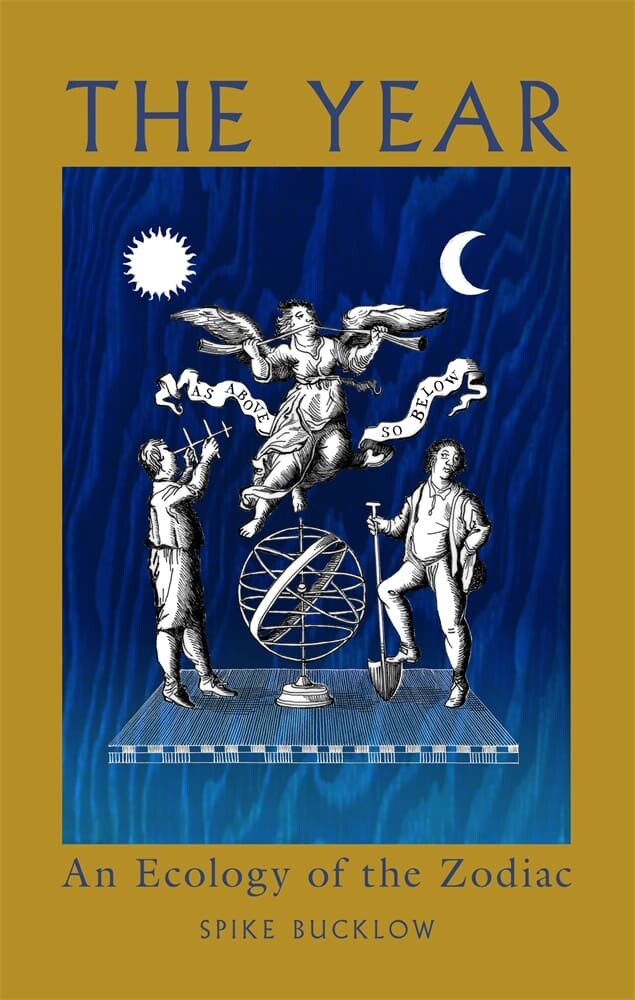
The Year: How the Zodiac Still Holds Relevance
8th June, 2026
In this blog, author Spike Bucklow talks about the inspiration behind his book, The Year: An Ecology of the Zodiac, and its importance in today’s world.
***
The Year, An Ecology of the Zodiac is nature writing focussed on the nature of time rather than the nature of any particular creature or habitat. After all, time is part of the context that every single creature and every single natural habitat must navigate its way through. Time contains all events, from the wind’s pollination of oaks, the germination of acorns and the growth of saplings to, centuries later, the recycling of fallen trees by insects and fungi. Some events we notice, others we don’t, but all are necessary to maintain the balance of nature.
In the modern world, our basic unit of time is minutes but, researching The Year, I started to recognise the wisdom of those who, 4,000 years ago, privileged months. Minutes might be appropriate for keeping track of meeting durations or train departures, but considering how plants grow and how animals respond to their worlds, the month seems to be exactly the right unit of time for keeping track of nature. And, researching The Year, my respect for the wisdom embedded in words also grew; the word ‘consider’, for example, literally means ‘to dwell with the stars’. The word embodies the ancient ways of thinking that connected the zodiac to the natural world and can, even today, connect the rhythms of heaven to the Earthly cycles studied by ecology.
I wrote The Year over the course of several years, with at least one eye constantly following the progression of months. Writing it was fun, and the result is a book of twelve chapters; one per month, per zodiac sign, or per traditional grouping of stars. The twelve chapters are arranged in four groups of three, with each chapter telling the beginning, middle or end of each season’s story. And the four seasons themselves are the expression of the living Earth’s relationship with sunlight and darkness. Spring is when light dominates over darkness – the days are longer than nights – and light is increasing. Summer is when light still dominates but light is decreasing and the days start drawing in. Autumn is when darkness dominates – nights are longer than days – and light is decreasing. Winter is when darkness still dominates but light is increasing and the days start growing again. The seasons are book-ended alternately by solstices, which are turning points, and equinoxes, which are points of balance between light and dark.
All of nature’s Earthly activities are coordinated to these heaven-set rhythms of sunlight and darkness. So, each of the twelve chapters features individual plants and animals whose lives illustrate the natural events that, together, sustain the whole cycle of life. Since that cycle repeats, The Year could have started with any month, and it could now be read starting at any chapter. But a book has to start somewhere and, unlike the western calendar which starts in January, it follows the example of Chaucer’s Canterbury Tales and starts in April, when the natural world seems to wake up after its winter’s slumber.
So, for example, Chapter One relates the events of March-April, or the month of Aries. This particular zodiac sign is ruled by the planet Mars, the god of war who gave his name to the month of March. In nature, it’s the story of life’s courageous emergence in the teeth of frosts, of blade-like daffodil shoots rising up like the tips of spears held by the Spartoi, the mythical warriors of Ancient Greek, born from dragons’ teeth (Apollodorus, Library, III, 4). According to Shakespeare, these brave daffodils ‘come before the swallow dares’ (Winter’s Tale, IV, iv).
Each zodiac sign is not only ruled by a planet, but also by one of the four elements – fire, air, water or earth – and Aries is governed by fire. The month of March-April starts after the Spring equinox, when the balance of power tips in favour of light, after six months of domination by darkness. So, Chapter One uses the example of the Maple tree to consider how fire – from the steadily strengthening Sun – rekindles emerging life. In the wild, the Maple tree repairs damages caused by winter storms with a combination of fire and ice, the Sun pulling sap up the tree and the frost freezing it over wounds. Where branches broke, the exposed sap turns into a thick syrup or crystalline crust that protects the wound and allows the healing to begin.
Chapter Two looks at how April-May – or Taurus, a sign governed by earth and ruled by Venus – consolidates life’s tentative emergence with its beautiful proliferation of flowers and blossom. The following chapters track nature’s continued unfolding in the light and then its enfolding into the dark and mysterious realms that lie beneath the Earth’s apparently lifeless wintry surface. The book finishes with an Epilogue, entitled ‘Next Year’, which addresses how nature is responding to climate change. Throughout, the book complements modern scientific ecological details – like natural Maple syrup production – with mythological and poetic details – including those from Apollodorus and Shakespeare – and climate change is approached through the lens of Ovid’s Metamorphosis.
The Year, An Ecology of the Zodiac puts modern science and ancient wisdom – or objective nature and human nature – on an equal footing. Those aspects of life have become tragically estranged, and I hope that re-acquainting them can to help us find our own places in an ever-changing world.
– Spike Bucklow
Spike Bucklow is the author of numerous books on artists, and their materials and methods, including Children of Mercury: The Lives of the Painters (Reaktion, 2022). He was previously Professor of Material Culture at the University of Cambridge.
You can buy The Year: An Ecology of the Zodiac from our online shop now.