The Miraculous and the Monstrous
13th August, 2025
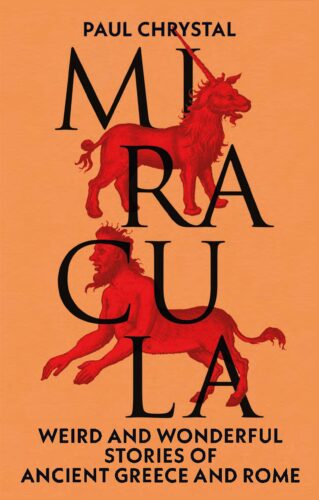
In the second of his two blogs, author of Miracula: Weird and Wonderful Stories of Ancient Greece and Rome, Paul Chrystal, takes you through the monstrous world of the ancients.
***
Last time, I introduced you to Miracula – my new, unconventional book on the classical world where the strange and wonderful aspects of Greek and Roman life are exposed and take centre stage for your delight and astonishment. The response has been phenomenal which shows how we all enjoy the miraculous, the absurd, the barely credible and anything remotely bizarre or tabloid.
This time round we cover ‘the monstrous’. The Greeks and Romans loved a good monster, the more fabulous, the uglier and terrifying the better. But you’ll know that already because Greek and Roman mythology is full of monstrous, intimidating characters; here are just a few who are sure to scare you half to death and repel you with their oddness, their repulsiveness and their ‘other worldliness…’
We start with The Polyphagus: your own personal cannibal? Such was Nero’s reputation for brutality depicted in the stories that surrounded his cruelty, that a mythical monster was born – an embodiment of all that was vile about the craziest of emperors. Tabloid biographer Suetonius reports on the Polyphagus, an all-consuming monster of a man from Alexandria that ripped apart and ate the raw flesh of those condemned to die by order of Nero (Nero 37, 2). The Chronology of 354 (Chron. Min. sv Nero) confirms this, adding his name, Arprocras, and what he routinely ate each day:
‘a cooked boar, a live hen complete with feathers, 100 eggs, 100 pine nuts, hobnails, broken glass, the witchy brush from a broomstick, four table napkins, a suckling pig and a handful of hay – after which it was still hungry.’
Nero’s sick plan was to turn him into a cannibal for his own perverted, voyeuristic pleasure.
The Graeae: The Oldest Triplets the World Has Ever Seen
Many of us have heard of the Three Graces, the Furies, the Sirens and the Gorgons, but Greek mythology boasts another set of sisters that are equally fascinating, and disturbing. The three sisters Graeae were born with grey hair, which stayed with them forever; they are defined by the worrying fact that they all three share one detachable eye and one detachable tooth.
So ancient were they that any memories of their childhoods were lost in the mists of time. Aeschylus’ description of them is as ‘siren-shaped monsters with the head and arms of old women’ which perhaps explains why they are also called ‘sea hags who personified the foam of the sea’.
The Graeae were sisters to the Gorgons, including, of course, the petrifying Medusa. The shared eye symbolizes their knowledge and power, and the shared tooth their age and wisdom – all of which were central to their ability to not only foresee but to dictate events. Perseus, son of Zeus and Danae, daughter of the king of Argos, spoiled everything for the sisters when he stole their solitary eye while they were passing it among themselves, rendering them inconveniently sightless. Perseus forced them to reveal the whereabouts of the three objects needed to kill the cursed Medusa, ransoming their shared eye for the information. Perseus completed his mission and beheaded Medusa: ‘[Perseus]crept up on tiptoe, his steps soundless, and with holy hand and robber’s fist caught the roving eye of Phorkys’ unsleeping daughter [one of the Graeae] then lopped off the snaky swathe of Medousa’
- (Nonnus, Dionysiaca 270ff, trans. William Henry Denham Rouse).
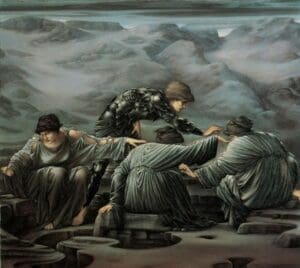
The Graeae were usually depicted as old crones. Edward Burne-Jones obviously chose to ignore this in his wonderful painting Perseus and the Graiae.
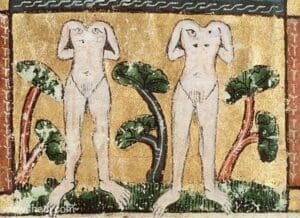
Things start to get even stranger with the Blemmyae – The Blemmyae have heads, but their faces are set in their chests. Pomponius Mela ( fl. 43 CE) was the first to name the ‘Blemyae’ of Africa as being headless with their face buried in their chest. Likewise, Pliny in the Natural History records the Blemmyae tribe of North Africa as ‘[having] no heads, their mouths and eyes being seated in their breasts’. Solinus says that they were believed to be born with their head partly dismembered, their mouth and eyes deposited on the breast. St Augustine swears he saw men with one eye in the middle of their foreheads in lower Aethiopia.
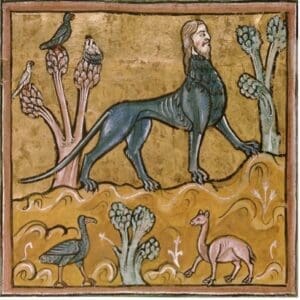
The exact nature of a fabulous beast called the Manticore perplexed the ancients. Pausanias was sceptical:
‘The beast described by Ctesias in his Indian history, which he says is called martichoras by the Indians and ‘man-eater’ [androphagos] by the Greeks, I am inclined to think is the tiger. But that it has three rows of teeth along each jaw and spikes at the tip of its tail with which it defends itself at close quarters, while it hurls them like an archer’s arrows at more distant enemies; all this is, I think, a false story that the Indians pass on from one to another owing to their excessive dread of the beast’. (‘Description of Greece’ 9.21.4).
Monopods
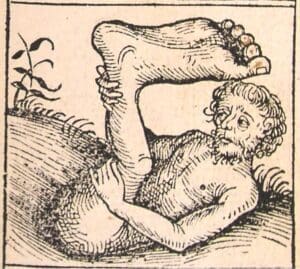
One-legged dwarfish men with one big foot who moved speedily and on hot days lay on their backs using their foot as a parasol. Also known as sciapods, monopods appear in Aristophanes’ The Birds, (414 BCE). St Augustine mentions the ‘Skiopodes’ in The City of God. C. S. Lewis features monopods in The Voyage of the Dawn Treader (1952).
The Machyles were a Libyan tribe of hermaphrodites or androgynes whose bodies were male on one side and female on the other. Herodotus, totally unphased by this oddity (4, 180), says:
‘The Makhlyes wear their hair long at the back. They celebrate an annual festival of Athena, where their maidens are separated into two bands and fight each other with stones and sticks. Maidens who die of their wounds are called ‘false virgins’ because they have been lying about their virginity’.
This is just a small selection: Miracula is full of monsters, shocking in one form or another – for example others are Cerberus the watchdog in the underworld and the Cynocephali, dog-headed men from India: Aelian explains that although they have no speech and howled to communicate, they could nevertheless understand the Indian language.(Characteristics of Animals 4.46).
©PAUL CHRYSTAL www.paulchrystal.com
Paul Chrystal is a contributor to a number of history and archaeology magazines, and TV and radio programmes. He is the author of many books published on a wide range of subjects, including, most recently, The Book in the Ancient World: How the Wisdom of the Ages Was Preserved (2025).