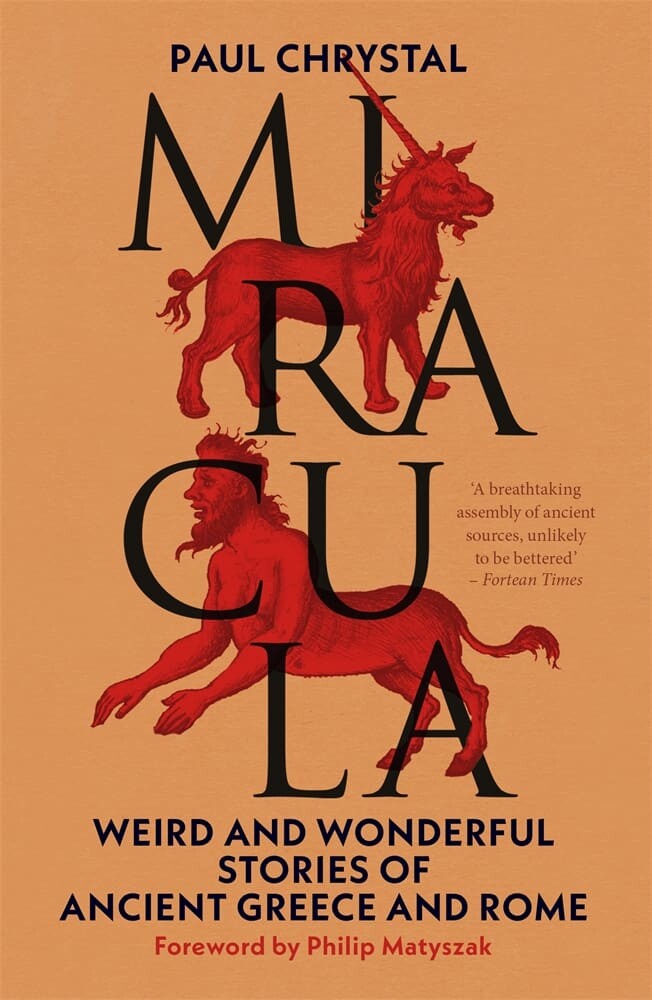
Introducing Miracula
29th July, 2025
In this blog, author Paul Chrystal introduces you to the weird and wonderful world of his new book…
***
Introducing you to a new book on the classical world that isn’t just about that dubious alpha male Julius Caesar, the not so bloody bloodbath Coliseum or fascinating central heating systems and public baths.
My Miracula covers hundreds of weird and wonderful tales from Greece and Rome in nearly 500 pages which are at once hilarious, shocking, unbelievably outrageous or just plain daft. But they were all written down at some point by real life Greeks and Romans – from Aristophanes to Zenobius, from Cicero to Seneca.
Many are by famous authors like Homer and Herodotus, others by obscure, little- known writers like Lucian and Lucan. Some have rarely appeared (if ever) in English before, others are taken from well known works such as Pliny’s Natural History or Ovid’s Metamorphoses but have remained obscure for all that, languishing in the darker corners of the authors’ works.
We include, as if by magic, even those tales which have not survived the 2000 years since they were written. How on earth? you ask. Because other authors who have survived have quoted them in their works! Some are mere fragments.
Some of the entries are little more than one-liners, but they are no less profound for all that; some are longer. Here are some of the shorter variety:
The Ethiopians are old by the age of thirty because their bodies are exposed to excessive heat . . . whereas the Britons live for 120 years because their country is so cold.’
– Pseudo-Plutarch, On the Opinion of Philosophers 911b
And from a sceptical Pliny:
- ‘Some of these facts will seem astonishing and, indeed, incredible to many. Who, for example, could ever believe that the Ethiopians existed if they had not actually seen them?’ (Pliny, Natural History 7, 1) *
- Sexual intercourse has never done anyone any good, and we should be thankful if it does us no harm. (Epicurus, frg. 62)
- People have died of too much pleasure before now. (Galen, Semen 4, 588k)
- Your hand serves as the mistress of your pleasure. (Martial, Epigram 33)
- The people of Miletus are not stupid; they just do the sort of things stupid people do. (Aristotle, Nicomachean Ethics 1151a)
- Why do all animals have an even number of feet? (pseudo-Aristotle, Problems 893b)
- There is also a type of mullet called the grayfish which feeds on its own slime; and the octopus sits through the winter devouring himself. (Plutarch, On the Cleverness of Animals 965a)
- I have heard that there is a tribe in Ethiopia that is ruled by a dog. (Aelian, On Animals 7, 40)
- Cress juice when poured in through the ears cures toothache. (Anon., (Byzantine), Farm Work)
- Anyone who is stung by a scorpion should sit on a donkey, facing backwards towards the tail. For this transfers the pain to the donkey and makes it fart. (Anon., Geoponica 13, 9)
- They say that camels in Arabia do not mate with the females and will not do so even if force is used. A story is told that once when no stallion was available the man charge surreptitiously introduced a colt. The colt completed the mating but soon after bit the camel driver to death. (Pseudo-Aristotle, On Marvellous Things Heard 2)
- Baths, wine, and sex corrupt our bodies; but the baths, wine, and sex are what we live for. (Epitaph for Tiberius Claudius Secundus, CILvi.15258)
- Weasels give birth through their ears, though some say through their mouths. (Timotheus of Gaza, On Animals 39)
- You can remove tattoos by smearing on them a mixture of very sharp vinegar and the stuff that sticks to the insides of a chamber pot. (Paul of Aegina, Medical Compendium 7)
- Only humans can count. (Aristotle, Topics 142b)
- ‘barbara barbaribus barbarant barbara barbis.’
A hexameter line of untranslatable gibberish graffiti scratched in Pompeii playing on the word barbarus, Latin for ‘barbarian’, or anyone not a (so-called) civilised Roman. (Select Latin Inscriptions 351)
- In Libya there is a city called Dionysopolis that can never be located twice by the same person. (Strabo, Geography 7, 3, 6)
- [Coming to the end:] Men ejaculate when they die. (Cassius Iatrosophista, Problems 47)
What’s more, have you ever wondered while sauntering around museums of classical stuff why the men have astonishingly small penises? Wonder no more: the relatively small size of the penises possessed by gods and heroes as reflected on Greek and Roman statues has exercised – obsessed, even – classics and fine art scholars and visitors to museums for centuries. But we have the definitive answer…
And you can forget about chickens and eggs; this book finally answers the eternal question as revealed by an elderly, blind but visionary man (Homer’s and Ovid’s Tiresias): who gets the greater pleasure out of sex, men or women?
The more eagle-eyed amongst you will have noticed some rather strange references: On Semen and Martial’s (veiled) allusion to masturbation; our references include numerous other riveting sounding works of classical literature, including these jewels of obscurity:
- Pseudo-Melampus, On Moles (dermatologically speaking):
Apparently, ‘If a man has a mole close to his nose and a ruddy complexion, he will be sexually insatiable’ (3)
- Alexander of Tralles was the author of the first textbook on parasitology, Letter on Intestinal Worms
- Galen: On Exercise with a Small Ball, 5, 904
- Hippocrates, Haemorrhoids, 2
- Dio Chrysostom, In Praise of Hair
- Pseudo-Aristotle, On Marvellous Things Heard 2
- The Florentine Paradoxographer, 40 Marvellous Things about Water
- On the Nature of the Non-Existent, Gorgias of Leontini ( 427 BCE), the Greek Sophist who claimed that nothing exists and, even if it does, you couldn’t understand it.
- John Chrysostom, The Type of Women Who Ought to be Taken as Wives
If any of this appeals, then Miracula is certainly the book for you.
©PAUL CHRYSTAL www.paulchrystal.com
Paul Chrystal is a contributor to a number of history and archaeology magazines, and TV and radio programmes. He is the author of many books published on a wide range of subjects, including, most recently, The Book in the Ancient World: How the Wisdom of the Ages Was Preserved (2025).
You can get a copy of Miracula: Weird and Wonderful Stories of Ancient Greece and Rome from our online shop now.
*’Ethiopian’ to a Roman denoted a person of dark skin; it never referred specifically to a person from Ethiopia.