Our Nomadic Future
3rd May, 2023
In this blog, author Eluned Summers-Bremner reflects on how our future looks nomadic, and how our lifestyle is changing even today.
***
Not long after finishing Astray, I was researching how nomadic lifeways are threatened by human-introduced climatic changes for a grant application when I noticed something odd. Certain phrases and tropes kept returning in media reports, including those published by the UN. A sentence like ‘time is running out for the nomadic herders of the X region’, would be followed by descriptions of nomads moving to cities to find work. Of course, from one point of view this is merely an account of what is happening in many parts of the world as the planet warms, drought increases, and seasonal animal herders’ traditional grazing grounds come under threat. It is also clearly intended to provoke us to stop ravaging the planet in now familiar ways before it is too late. But it reminded me of something. When white settlers came en masse in the nineteenth century to America, Australia, Aotearoa/NZ and other places, took land on terms that disadvantaged indigenous peoples, built cities out of trading posts and made indigenous lifeways near impossible to sustain, those peoples were similarly described. They were ‘coming in’ to civilization, they were joining the mainstream, because living close to the land was increasingly threatened by the unstoppable forces of industrial ‘progress’ and related social change.
Although the message is different today and the damage set up for decades, even centuries, to come from the world’s burning of fossil fuels for industry is well known, this way of reporting is still, to my mind, very much tied to the past. In Astray I note, as have many others, that in the long historical view it is settlement, and in particular the nation state, that is the anomaly, and nomadic lifeways, in particular hunting and gathering, that is the norm. We have been nomadic for most of our history, and as a stable climate and warm weather made grain cultivation possible around 12 thousand years ago, from which agricultural settlements arose, so now increasingly unstable climates threaten the lives settled humans have built. As a result of the west’s rapid increase in large-scale industry, imperial and colonial plunder and trade in the eighteenth and nineteenth centuries, climatic changes now imperil settled environments worldwide whether through rising sea levels, increasing wildfires, storms, volcanic eruptions, earthquakes or drought.
Let us be clear about what this means. Almost all settled peoples in the future will become increasingly mobile. They will often move against their will, but they will not be able to avoid it. The hunting and gathering lifestyle is likely to become increasingly common, at first temporarily, but then, in many places, as the norm. Farming will probably continue, but will move further north, where farmers will face populational pressures and challenges from northern indigenous and settler residents. And since our experiments with industrial productivity have generated a world in which the nomadic lifeway will be to some extent increasingly enjoined upon us, it is strange that the loss of nomadic habitats is still being talked about as though there is somewhere stable for nomads to go. Although it would take a brave editor to start it, at some point the settled world will have to admit what is really happening: that our settled, industrial and post-industrial lifestyles are moving us back to nomadism again. This also requires a change in the ways settled people think and talk about nomads.
A historical feature of settled civilizations is that they quickly justify themselves as such, in part because settlement requires specialization of activities in order to produce enough food and to practise good governance. Once achieved, the considerable effort required to remain settled tends to morph into the belief that to stay in one place is an inherently superior way to live, instead of what it is: high maintenance, potentially harmful to the continuity of natural environments, and diminished in terms of the chance of lifestyle change. A nomad can choose to settle and then depart again, but the settled quickly lose their nomadic skills, and stay settled not only because of the advantages of a wider array of goods and opportunities for amassing wealth, but because it is the only life they know how to live. The settled also produce written records that justify their way of living, and consult them in order to try and understand the past.
Now, we have advance warning of our increasingly mobile future. So it is more than time to start noticing what nomads, including those now losing their territories and moving, probably temporarily, to camps and cities, can teach us. In the past nomads introduced horse-riding, the compound bow and a form of representative political organizing enabling rapid populational transition to our world. They are historically adaptable and welcome diverse viewpoints (no nomadic people ever fought a religious war). They typically live in harmony with natural environments, preserving conditions to which they will need to return. They are expert at reading changes in the weather and computing their likely impacts on resources. They are good at distance perception and scaling: how to foresee how long a given material might need to last based on a range of factors, how population growth will affect its availability. They shift strategies quickly when trading opportunities arise, and back to hunter-gathering when a trading resource is in short supply. And while these adaptive abilities cannot always enable sustenance in an increasingly drought-ridden world, the skills that underlie them will increasingly be needed. We will all need to learn how to read landscapes, preserve resources, yield and welcome viewpoints. We will all have to become better at living flexibly, closer to seasonal availability—even as seasons move beyond recognition—welcome mobility, manage change.
Our nomadic futures also have bearing on current debates about migration and misnamed refugee ‘crises’, a phrasing that stems from the affluent west’s assumption that migrants, many of whom are fleeing climatic conditions instigated by western historical actions, including imperial plunder, want what they have. In fact, migrants of all kinds mostly want to improve themselves, and they mostly put things in circulation: money through labour—the dignity of work—hope for a better life for oneself and one’s descendants through courageous, concerted action, and, through departure and adaptation, ideas about what constitutes home. The greatest threat to settled futures are the climatic changes that settlement and its industrial development and expansion first put in train. So who better to learn from than those already closely affected by those changes? In a world in which the settled will become increasingly mobile, why are we not asking those who have generations-long expertise or who have been forced, for a time, to become nomadic, how it is done?
– Eluned Summers-Bremner
Eluned Summers-Bremner is a writer and editor. She is the author of Insomnia: A Cultural History (Reaktion, 2007) and Ian McEwan: Sex, Death, and History.
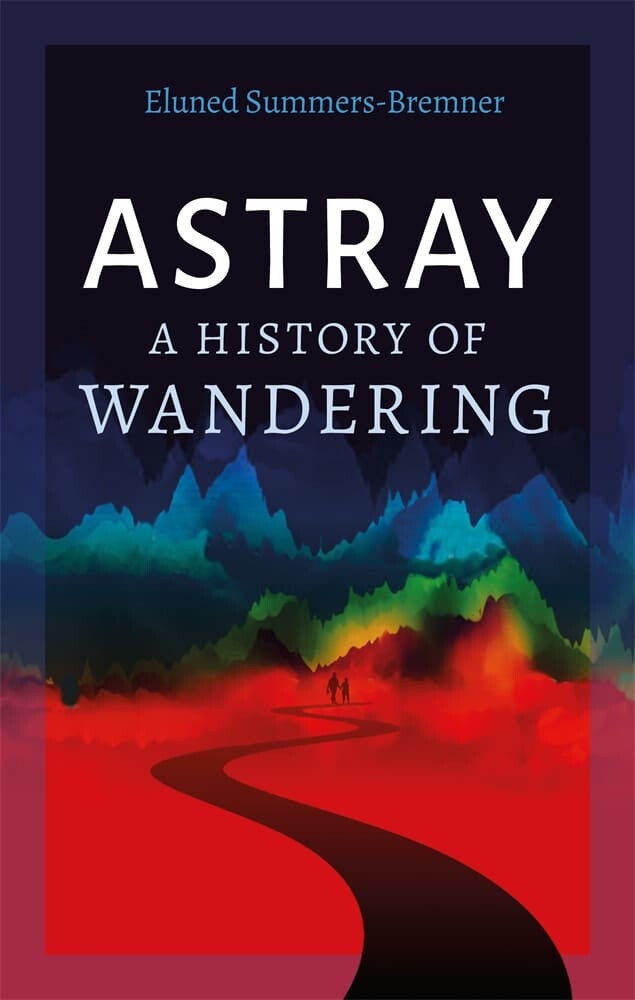
You can buy Astray: A History of Wandering now from our online shop.