Could Sherlock Holmes solve this one? Just how did Sir Arthur Conan Doyle fall for the Cottingley Fairy Photographs?
27th July, 2022
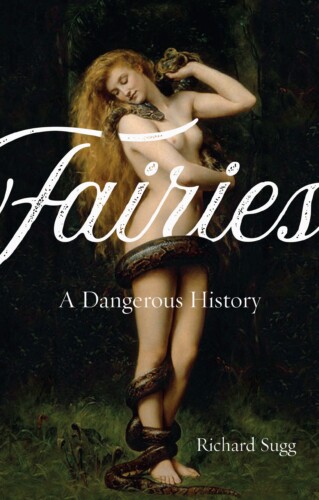
Author of Fairies: A Dangerous History, Richard Sugg, reflects on how Sir Arthur Conan Doyle fell for one of the greatest hoaxes in history.
***
Perhaps no great writer in all of history has suffered the peculiar fate of Sir Arthur Conan Doyle: the man who created one of the most potent myths of the modern age, and went on to fall for another. From the 1887 Study in Scarlet through to the public outcry over Sherlock Holmes’s death in 1893, and onto the screen avatars of Basil Rathbone and Benedict Cumberbatch, Holmes entered that most élite pantheon of literature. Like Jekyll and Hyde, Peter Pan or James Bond, his name alone carries instantly recognisable meaning for millions – including many who might not speak English.
One hundred years ago this September, Doyle published his short book The Coming of the Fairies – a work which would ultimately seal his fate as the man who fell for a hoax perpetrated by two mischievous girls in the Yorkshire village of Cottingley. The story began in 1917. Frances Griffiths, then aged nine, was staying at the home of her cousin Elsie Wright, aged sixteen, and in July and September the girls allegedly took two photographs of fairies and gnomes, using the Midg camera of Elsie’s father, Arthur Wright. Elsie’s mother Polly was interested in Theosophy, and through her the photographs came to the attention of prominent Theosophist Edward Gardner, and presently to that of Doyle, in May 1920.

Decades later, in 1981, Frances would tell Cottingley biographer Joe Cooper, ‘From where I was I could see the hatpins holding up the figures. I’ve always marvelled that anyone ever took it seriously.’ How on earth did Sir Arthur Conan Doyle, creator of the most famous forensic detective in history, fall for the Cottingley Fairy Photographs? In framing this question, we have to remind ourselves that Holmes himself was deeply rooted in Doyle’s own early life and temperament. Doyle studied medicine in Edinburgh from 1876-1881, and was awarded an advanced medical degree (MD) in 1885. In 1880 and 1881 he was first ship’s doctor and then surgeon – the latter often being a role requiring the steadiest nerve and strongest stomach during a crisis at sea.
One answer to this question is that Doyle had always been interested in mysteries. In the Holmes’ era he wanted the mysteries to be solved – and usually by science, logic and cool reason. In the case of Cottingley, his attitude became far more ambivalent.
In spring 1920 Doyle was still sceptical of the first two photographs – as was Sir Oliver Lodge, physicist and prominent member of the Society for Psychical Research. The crucial phase in this whole extraordinary saga came in summer 1920. Doyle’s attraction to this possible Fairy World was strong enough for him to seek further evidence, and Gardner was sent to Cottingley to meet the girls and try and obtain new photographs. Three more resulted, and by Christmas some of these fresh imps were staring boldly at startled Londoners from the pages of The Strand magazine. In summer 1921 Geoffrey Hodson, a psychic who himself claimed to see fairies, visited the girls and heard of new sightings, although no further photographs were forthcoming.
The ensuing myth of the Cottingley Fairy Photographs would become a visual icon arguably as powerful as that of Holmes himself. Saving perhaps Disney versions of Tinkerbell and Peter Pan, Frances’ and Elsie’s five shots are the most famous fairy icons of the past 100 years. But there was more to them than mere luck. In 1917 the girls had been fooling around for private amusement. By 1920 they had made a far more deliberate decision to seek public glory. As scholar Simon Young aptly put it, ‘in 1917 the girls were out to fool their parents; in 1920 they were out to fool the world.’ And they did. Despite much debate and derision about the fairies’ Parisian hairstyles in the 1920s, millions were captivated by this hard evidence of the fairy world for decades, until (ironically enough) the elderly Frances was forced to confess, in 1983, by her own son.
It goes without saying that this myth would never have attained the status it did without the backing of Sir Arthur Conan Doyle. What caused his epic lapse in judgement? The answer is war. Doyle lost a son and a brother to World War One. But we can also reasonably infer that the less personal horrors of so much mechanised slaughter would have been enough to make Doyle yearn for a hidden world of innocence, feminine grace, and defiant mystery. At one point in Coming, he sees modern science producing a world ‘hard and clean and bare, like a landscape in the moon’, and at another hopes that recognition of the fairies’ existence ‘will jolt the material twentieth-century mind out of its heavy ruts in the mud’. In 1922, few could have heard either of those last words without thinking of trench warfare.
In response to his wish, Cottingley offered beauties which he could hardly have written himself. The setting was Yorkshire, one of the wilder English counties, backed up the enduring status of Wuthering Heights. The protagonists were two attractive and humble young girls – agents untainted by either urban mechanism or personal adult experience. In 1917 they shared a bed from which they could hear the rush of the famous fairy beck just down the garden. Tellingly, the pseudonym used for Elsie in early discussions is the floral ‘Iris’, whilst in certain reproductions the black and white images were given pleasing pastel colours.
In reality, Doyle and Gardner actually had written much of this appealing story themselves, by projecting naive male desires onto two girls who were not exactly children. By 1920 the two men were anxious to secure more photos swiftly, because the girls’ relations with the fairies were held to be dependent on their childish innocence: ‘I fear now we are late … [because] one of them will “fall in love” and then – hey presto!’, no more fairies, writes Gardner to Doyle in June 1920. A photo of Elsie from 1921 shows an assured and stylish young woman whose childhood looks a very distant memory. Yet it was arguably the much younger Frances who was the prime mover in this epic game.
For Frances had been brought up in an upper middle class household in South Africa, and over in Cottingley would lament the loss of servants, fine food, fur capes and trips to the opera. She also claimed that Elsie was essentially more childlike than herself: ‘she used to play with my dolls.’ In one crucial sense, then, the Cottingley fairies were a force of unworldly magic, created by the loss of Frances’ worldly glamour. Snobbery also played a role in Doyle’s fall. ‘Two children of the artisan class’, Doyle argued to Lodge, just could not achieve such sophisticated fakery.
Yet they did – albeit with the help of a knight of the realm, and one of the great forensic minds of his age. Ultimately, the Cottingley Fairies were mythic in the most potent sense of that word. Yes, they were faked. But were they simply unreal? Because the secret remained hidden until 1983, the fairies and their story had time to grow a strange organic life of their own. And by then, they were not only real, but eerily alive. As Elsie tellingly put it on hearing of Frances’ public confession: ‘I am sorry somebody has stabbed our fairies to death with a hatpin.’
– Richard Sugg
To read more about this fascinating subject, order Fairies: A Dangerous History from our online shop now.
Richard Sugg is the author of 13 books, including John Donne (2007; 2020), Mummies, Cannibals and Vampires (2011; 3rd edn 2020), The Smoke of the Soul (2013; 2nd edn 2020), and The Real Vampires (Amberley, 2019). His work has appeared in The Guardian, The Lancet, BBC History, Der Spiegel, Smithsonian Magazine, The New Yorker, and on international television and radio. He has previously lectured at the universities of Cardiff and Durham (2001-2017). Mummies, Cannibals and Vampires is currently being pitched for television by Barry KrostMedia in LA.