Witches, Pumpkins and Hallowe’en
20th October, 2026
In the run up to Spooky Season, author Gregory Forth talks about the tradition of Hallowe’en and his forthcoming book, The Wicked Witch: Origins of an Enduring Worldwide Belief.
***
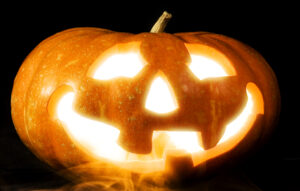
Children love to dress up for Hallowe’en in a great variety of scary costumes, but as popular as ever are witches. Another prominent symbol of Halloween is the jack-o’-lantern, a hollowed-out pumpkin carved with a hideous face and lit with a candle. But what do either of these things have to do with this popular tradition? And are they connected with one another in any way?
To answer any question about witches it’s important to recognise that belief in witches and witchcraft are not just things found in Western lore. As I show in my forthcoming book The Wicked Witch (April 2027), they occur in all historical periods and in the most varied cultures around the world. But let’s start with the originally British celebration of Hallowe’en, each year on October 31st.
Of pre-Christian origin, the celebration is commonly traced to an old Celtic festival named Samhain. This marked the end of the harvest and the warm half of the year and the beginning of the cold, which in those days meant the finish of the old year. At this time, it was believed, spirits of the dead would revisit their living kin, who offered them food and drink so they would ensure that people survived the coming winter. Keeping the theme of honouring dead spirits, the Christian church later chose the following day, November 1st, to honour all the departed saints and martyrs. November 1st became All Saints Day, or All Hallows Day, and the evening before ‘All Hallows Evening’ – hence Hallowe’en. (Later, the less distinguished dead were separately accommodated on November 2nd, named All Souls Day.)
Still, popular celebrations of Hallowe’en retained many features of the old pre-Christian festivals. Marking a major ‘temporal boundary’, or time of transition, such occasions the world over are regarded as intermediate and ambiguous times, when supernatural beings of all sorts become especially active – including witches. As beings credited with supernatural powers of invisibility, an ability to turn into animals, and to fly through the air (with or without a broomstick), witches are as supernaturally endowed as any spirit, ghost, or goblin. The main difference is that witches are also identified as real, living humans – and in places where people accuse others of being witches, usually individuals known to their accusers.
But back to Hallowe’en. Witches around the world are equally drawn to spatial boundaries, including the boundaries of land and buildings as well as crossroads. As the Dinka people of South Sudan say, ‘a witch is born at the boundary’. In Indonesia, Flores Islanders identify witches with boundaries in a number of ways. A striking example occurs at twilight, when day turns to night and witch activity peaks. Entering a house during this time is dangerous, for a witch lurking near a doorway may invisibly grab a person by the leg. And closer to home, one historian has described early modern European witchcraft as ‘often taking place on the boundaries of the victim’s household’.
Doorsteps and doorways are thresholds, the boundaries between the outside and inside of a dwelling or building. So it seems no coincidence that Halloween nowadays involves children dressed as witches or other frightening beings (ghosts, devils, monsters) appearing on people’s doorsteps and requesting – or demanding – candy. Many cultures describe people who are witches as greedy and constantly asking for things, and recalling ‘trick or treat’, supernaturally harming those who fail to comply. Yet as dangerous places, thresholds can also work the other way around: parents can anxiously imagine their little ones begging for treats as risking harm from malicious householders, who for example reputedly hide sharp objects inside apples or poison sweets.
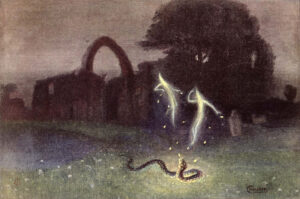
But what about that other hallmark of Halloween, jack-o’-lanterns, objects usually placed on doorsteps or front windows of houses? Here too we find a definite link with witches. The Oxford English dictionary tells us that a jack-o’-lantern is the same thing as a ‘will-o’-the wisp’, that is, mysterious nocturnal lights caused by marsh gas, ignited methane and other chemicals produced by rotting vegetation. Later, apparently in the early nineteenth century, ‘jack-o’-lantern’ became transferred to the illuminated vegetables, which have been interpreted either as representing spirits (those spirits honoured both on All Saints and All Souls Days and during older, pre-Christian festivals) or, in view of the grotesques faces, more likely a means to ward off evil spirits, presumably including witches.
To fully appreciate the connection with witches, we have to cast our net much wider. For the fact is that, across all continents, witches are believed to manifest themselves as nocturnal lights, sometimes described as flames, flares or fires. In some places, witches are even named after these things. Thus on the Indonesian island of Sumba, where I lived for two years, witches – apart from being called ‘the greedy ones’ – are also named ‘those who glow or shine’. Likewise, in the Twi language of Ghana the word for practising witchcraft means ‘to glow’. To be sure, witches are not the only beings that people identify with mysterious lights seen in the night. Ghosts and other spirits are as well, like the ‘ghost lights’ or ‘corpse candles’ sometimes reported from graveyards. So as I explain in The Wicked Witch, though witches are also human beings, they are ultimately a kind of evil spirit, all the more dangerous because of their existence as seemingly ordinary people.
In fact, nocturnal lights can be caused by more than marsh gas. As I show in the book, they can also be explained as instances of the meteorological phenomenon called ‘ball lighting’ and manifestations of ‘bioluminescence’, a property that makes certain animals naturally glow in the dark. Interestingly, in birds, including owls, the phenomenon is caused by a substance aptly named ‘luciferin’ – a word related to one name for the devil, which significantly enough originally meant ‘light-bearer’.
So we see that, although witches are supernatural beings, widespread ideas about them – including, incidentally, their worldwide identification with owls – may ultimately be rooted in nature. Clearly there’s more to the association of Halloween with witches, and of both with jack-o’-lanterns, than may at first meet the eye.
– Gregory Forth
Gregory Forth is Professor Emeritus of Anthropology at the University of Alberta. His books include Between Ape and Human: An Anthropologist on the Trail of a Hidden Hominoid (2022) and A Dog Pissing at the Edge of a Path: Animal Metaphors in an Eastern Indonesian Society (2019).