The Medieval Ages of Woman
1st March, 2023
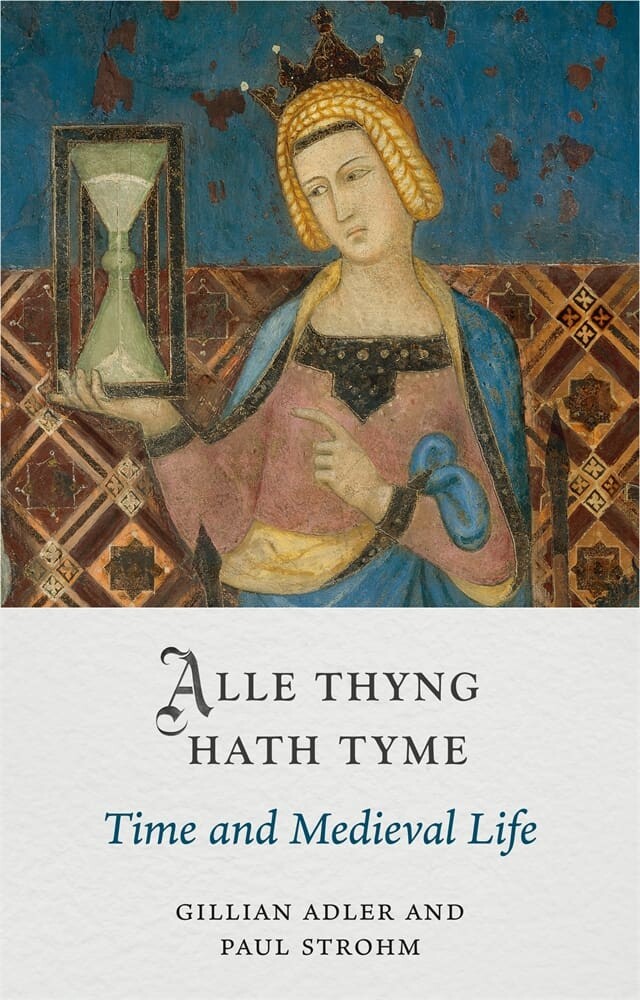
In this blog, author Gillian Adler describes the Ages of Woman …
***
In Shakespeare’s As You Like It, Jacques delivers a soliloquy famed for its opening lines, ‘All the world’s a stage, / And all the men and women merely players’. Not only does the theatre stand for creation; the acts in which actors perform their parts correspond to the Ages of Man, an ancient and medieval paradigm that organized the progression of the human life. According to Jacques, these ages are characterized by the ‘infant’, the ‘whining schoolboy’, ‘the lover’, the ‘soldier’, ‘the justice’, ‘the lean and slippered pantaloon’, and, in a final scene, a ‘second childishness and mere oblivion’. There are thus seven key phases of a man’s life in Shakespeare’s play, but writers of the Middle Ages varied significantly in this supposedly universal number. Three ages were absolutely central—childhood (pueritia), youth (iuuentus), and old age (senectus)—but they could be divided to create paradigms of four, five, six, or more periods. For Dante in the early fourteenth century, a man’s life unfolded as adolescence, maturity, old age, and senility, while the seventh-century cleric Isidore of Seville added the three phases of infancy, boyhood, and youth, and separated old age into the two categories of senectum and senium, or senility.
This scheme, in all its variations, reveals a fascination with measuring the time of a man’s life, but how did women perceive themselves in relation to time? The ‘Ages of Woman’ received considerably less formality of treatment.
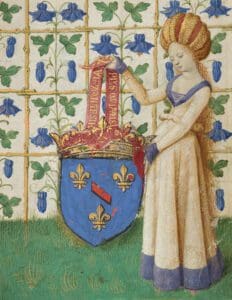
Nevertheless, certain markers of a woman’s life encouraged consideration of her broader life-cycle, for better or worse. A woman’s age proved important to evaluations of her marriageability, for instance, and ‘maidenhood’, or female youth, indicated the potential to conceive children upon marriage. Conduct books addressed to young women, as well as medical and scientific literature, idealize young women for precisely this reason, whereas they demonstrate anxiety about the age at which a woman is no longer fit to reproduce. This perspective influences January in Chaucer’s ‘Merchant’s Tale’, who boasts that his future wife will not be thirty years old. A binary between old women and young women was quite common in literary narratives, as if a ‘middle age’ of life did not exist – at least in the eyes of desiring men. In Sir Gawain and the Green Knight, when Gawain joins a feast at a mysterious castle, he sees at the table a loathsome old woman covered in chalk-white veils, whose features the seemingly ageist narrator describes as unpleasant in contrast to the beauty of the youthful lady beside her. Gawain at the dinner notices the old woman, but it is the narrator who participates in the anti-feminist ridicule by stressing the consequences of time on female beauty. This instance of mockery relies upon a tacit understanding and disabling acceptance of an Ages of Woman paradigm.
A woman’s life was not always understood in such binary terms, however, as a ‘canonical’ model of the female life-cycle stipulated a succession of three roles a secular woman might occupy: beginning with virginity, proceeding to marriage, and concluding with widowhood.
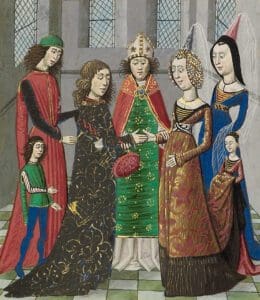
The cycle was launched at around twelve years of age, when a young woman would receive legal status in canon and secular legal codes. She was expected to marry before her mid-twenties. The stage of widowhood was, of course, initiated by the death of the husband, but also required an observance of certain decorums to be fully realized.
However, the linear and uniform progression of the virgin-wife-widow model considerably oversimplifies women’s actual experience of time. In practice, medieval women took frequent advantage of varied avenues of creative escape from restrictive life patterns and age-based role assignments.
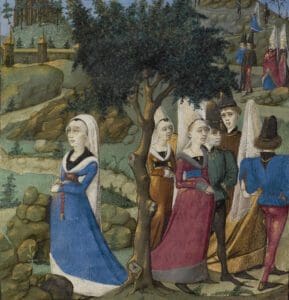
Widowhood in fact offered a potential refuge. So long as chaste behaviour was observed, it offered a possibility not of terminus but of renewal. In London, Barking Abbey presented opportunities for wealthy and aristocratic widows to participate in religious life, including by wearing white as a symbol of virgin purity while taking vows. The prospects of widowhood were not only spiritually and metaphorically meaningful; a widow could also acquire the recognized legal status of femme sole, authorizing her to conduct business independently and to own property, including inherited estates and the former husband’s house, until remarriage. Widowhood thus conferred unprecedented economic freedoms on women (albeit primarily privileged women) in an age when neither women prior to marriage nor most married women enjoyed the right to own and dispose of property.
London- and possibly York-based widows, in particular, were often free to participate in the economic and social worlds of their urban milieu. Elizabeth de Burgh (1294–1360), who chose not to remarry after the death of her third husband, exemplifies the widow’s independence, financial resourcefulness, and cultural influence. Taking a vow of chastity which guaranteed her autonomy, she founded Clare College at Cambridge University, collected and promoted works of art, and not only donated funds to religious houses but, interested in design, decorated chapels with expensive altars and sculptures. Her patronage of goldsmiths and illuminators supported the production of beautiful objects, some of which – such as tableaux of the Annunciation – are described in her will.
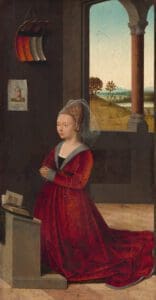
If Elizabeth de Burgh seems an exceptional example due to her tremendous affluence and aristocratic status, an array of wills, testaments, and other documents provide evidence that numerous other widows seized opportunities to become involved in London life. ‘Artisan widows’, such as silkwoman Alice Claver (d. 1489) and skinner Matilda Penne (d. 1392–3), opted to continue running their late husbands’ businesses rather than remarry and thus shift enterprising responsibility to the new husband. The custom of legitim seems to have facilitated Matilda Penne’s inheritance of a half share of the possessions of her husband William Penne, with which she continued to involve herself in the economic life of London by preparing and selling furs and cultivating a range of business relationships. While widows like Matilda Penne occupied a relatively stable, public role, others chose to travel, exercising a liberty they would never have had in or before marriage.
The pattern-breaking acts found in these historical accounts point toward the existence of what might be called ‘women’s time’, a non-linear temporality that rejected the gendered timeline imposed upon women, inviting them to discover more liberating conceptualizations of their life phases. The resistance implicit in this female time is subtly advocated by some of the magnificent early mechanical clocks of the Middle Ages. While such clocks would seem to be citadels of linear and progressive time, they reserve some of their attention for circular patterns. On the Wells Cathedral Clock, for example, the painting of Phoebe, the female representation of the moon, appears on a pivoted disc and emphasizes lunar and circular time. Semper peragrat Phoebe, reads the accompanying inscription. As both clocks and women’s lives demonstrate, circular and linear arrangements of time often compete in medieval culture, subverting the sequence implied by time’s arrow and reminding us of how time-passage can be an opportunity for rejuvenating a prior dimension of the self or challenging the expectations of age-related status quo altogether.
– Gillian Adler
Gillian Adler is Assistant Professor of Literature and Esther Raushenbush Chair in Humanities at Sarah Lawrence College in New York. She is the author of Chaucer and the Ethics of Time (2022).
To find out more about the Medieval women, read Alle Thyng Hath Tyme now!