Ways of Seeing Brunelleschi’s Dome
1st July, 2025
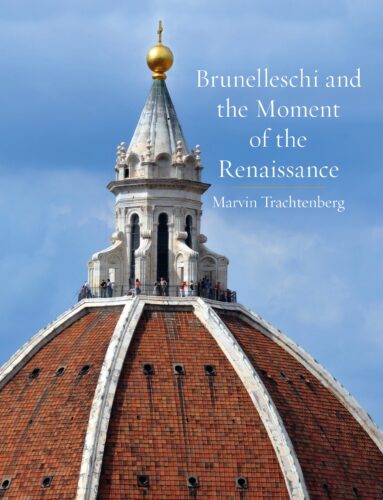
Planning a visit to Florence, Italy? Then you’ll probably be planning to spot Brunelleschi’s Dome. In this blog, author Marvin Trachtenberg discusses the best way to appreciate it…
***
As a scholar of Renaissance architecture I am sometimes asked, what is the best spot from which to see Brunelleschi’s dome, or cupola, a key work of the movement. Let me offer a scenic route as a response.
It is no secret that cultural conditions in Florence are vexing in these leaden days of quasi-apocalyptic over-tourism. Monuments of the city are under duress, our ability to experience them is challenged, while the surrounding streets given over almost entirely to the commerce of tourism. The possibilities of seeing the works are burdened, and sometimes seem virtually lost. And I sometimes have wondered how such challenges to key artworks affect the world-class, superstar cultural status of Florence.
This query seemed perhaps a good occasion to test the capabilities of AI. So I asked ChatGPT, “Would the cultural status of Florence survive without Brunelleschi’s Dome” and similarly regarding arguably the other Florentine work of such superlative status, Michelangelo’s colossal marble statue of David (now in the Accademia Museum). Both are robust creations presumably capable of withstanding any culture of viewership. Both works resulted from superheroic performances of design by exalted artistic figures who personified the Florentine Renaissance.
Somewhat to my surprise, albeit in its typical mealy-mouthed way, the chatbot came down firmly on the side of Brunelleschi. It informed me that, “While it’s impossible to definitively say what Florence’s cultural status would be without Brunelleschi’s Dome, it’s highly likely that the city would still be a significant cultural hub, but arguably not with the same level of global recognition or prominence in the history of art and architecture.” A rather decisive blow, in other words. Conversely, the chatbot advised that, “While Michelangelo’s David is a crucial and iconic symbol—widely recognized worldwide—Florence’s enduring cultural significance would likely persist even without it.”
Such evaluations are at best equivocal even coming from such a technologically acute and sophisticated source (which supposedly compiles and sifts all recorded opinions). Indeed, as I repeatedly fed my question into the ChatGPT site to test its dependability, the response-text varied widely in specifics as well as length. When I returned to check my chosen response the original text was not just modified but long gone…like writing on water.
Brunelleschi was not writing on water in his designs, models, and textual program of 1420 for the dome. His great structure, precariously built in the public eye 1420-36 without needing the temporary so-called “centering” support used in the construction of virtually all vaults and domes of the period, presented a dazzling spectacle of design and execution. And it was staggering success when completed. Through six centuries the cupola has remained so awe-inspiring an architectural accomplishment that sometimes it seems bathed in a quasi-miraculous aura.
Nevertheless, our grasp of the cupola ideally would involve a certain awareness of the intricate structural devices that enabled it to be built. Brunelleschi’s method of construction was such a knotty, singular invention, however, that all knowledge of it was lost within a generation. Astonishingly, understanding how the great vault was built without centering was only recuperated five centuries later in the 1970s by an eminent British specialist of historical structures, the late Roland Mainstone. The resulting picture of the cupola’s structural design and facture is far too complex and entangled to study here, and I direct the reader to the relevant section of my book.
Rather, I would take the opportunity instead to briefly explore the question of visual experience: how the monument was meant to be seen, according to the intent of its makers. Principally this means where ideally to see it from, i.e., where to stand and look. This is far from being a modern concern. Historically it is a highly relevant question since viewpoint construction was a focus of Florentine planning throughout the late medieval and Renaissance period. Although such viewpoints are rarely obvious to the modern observer, they were the focus of a powerful scenographic logic built into not only the monument itself but the shaping of its immediate surroundings, which were adjusted at enormous effort and expense to provide ideal viewpoints, without which the monument would have been considered visually impaired.
In this regard, the cathedral, or duomo, of Florence presented the builders an immense challenge, for its immense size and complex shape meant that there was no practicable way to create a view of the entire sprawling massing, short of tearing down a huge part of the adjacent city to open a “total” perspective. There was no way feasibly to create a counterpart of the nearby Piazza della Signoria with its majestic view of the (much less sprawling) town hall, the Palazzo Vecchio. Indeed, to capture the whole duomo image, modern photographers were forced to assemble a composite print of several shots from discrete perspectives. The ever-pragmatic 14th-century Florentines dealt with this impasse by providing a series of discrete viewpoints on various aspects of the duomo, on its facade, left and right nave walls, etc. These perspectives were largely accommodated by existing or modestly reshaped streets.
For the gigantic cupola and its voluminous surrounding tribunes, however, far more was obviously needed, and thus the Florentines opened a large area opposite, a vast roughly triangular space with no purpose other than to provide a view of the Cupola complex across it – the space is officially called Piazza del’Opera, after the Opera del Duomo offices sited on it. This perspectival space took advantage of the convergence of two important Florentine streets directly opposite the duomo. This corner thereby became the fulcrum of the great view of the colossal duomo east end. By virtue of the two important streets leading to it, the corner was one to which one was naturally led in moving through the city.
Although scarcely noted by most tourists or tour guides (as well as most Florentines) the view – which is the only constructed view of the cupola – is overpowering, providing of course that one stops to take in the astonishing architectural spectacle. And while the Via del Proconsolo perspective is the only deliberately planned view of the Cupola, there exist two other great views on Brunelleschi’s vault, which represent total extremes of perspective.
One, of course, is atop the cupola itself, which one climbs through a labyrinth of 463 stairs to visit, which can be physically and psychologically challenging, especially to those suffering from claustrophobia. Along the way one passes through the double-shelled vault itself, with closeups of the intricate brick-and-stone construction. The final view, however, is obviously not of the cupola itself, except in extreme steep perspective down, but of the surroundings (including in vertiginous reverse perspective, the viewing corner at the Via del Proconsolo).
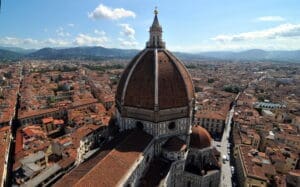
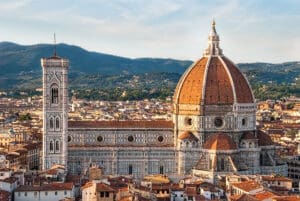
But the definitive view of the cupola is found neither in the piazza or within or atop the giant vault, but rather in the monument standing opposite, the giant trecento campanile begun by Giotto. It is from the several levels of its enormous windows and, above all, the summit of the tower that one experiences a quasi-aerial view of the cupola seen from its own great altitude, its swelling tiled roof soaring above all the tiled rooftops of the city, with the streets and houses of Florence spreading far beyond it, into the luscious green hills of Fiesole and Settignano. I say, pick this one: less oversubscribed, easier on the legs, and more nourishing to the soul.
– Marvin Trachtenberg
Marvin Trachtenberg is Edith Kitzmiller Professor Emeritus at the Institute of Fine Arts, New York University, where he taught Gothic and Renaissance architecture for over fifty years. His books include Building-in-Time: From Giotto to Alberti and Modern Oblivion (2010) and Dominion of the Eye: Urbanism, Art, and Power in Early Modern Florence (2008). He lives in Bellport, New York.
You can buy Brunelleschi and the Moment of the Renaissance from our online shop now.