Thomas Nashe and Insults
5th January, 2023
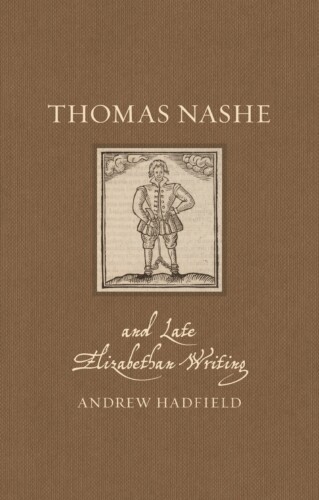
It’s our first blog of the year, and this time we have Andrew Hadfield explaining how Thomas Nashe was the king of insults. So, if you want to discover more about Nashe, or even just to learn a new insult, read on …
***
Has anyone ever been better at insults than Thomas Nashe?
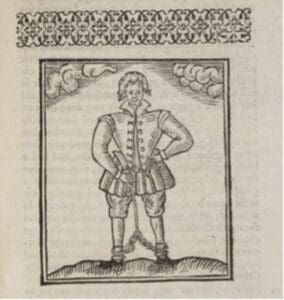
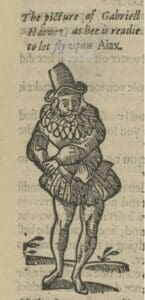
In a long, sustained attack on his bête noir, Gabriel Harvey, Nashe refers to his opponent as Gabriel Jobbernoul, Gamaliel Hobgoblin, Braggadochio Glorioso, Gilgilis Hobberdehoy, Gabriell Hoeilglasse, Gregory Habberdine, Gabriel Hangtelow, Timothy Tiptoes, Infractissime Pistlepragmos, Dragobert Coppenhagen, Domine Dewse-ace, Gobin a grace ap Hannikin, Gregorie Huldricke, among other inventive, derogatory epithets. The work in which these nicknames appear, Have With You To Saffron Walden (1596), even contains a picture of Harvey supposedly off to the toilet (Ajax, a jacques), where, Nashe suggests, he will cover pages with excrement.
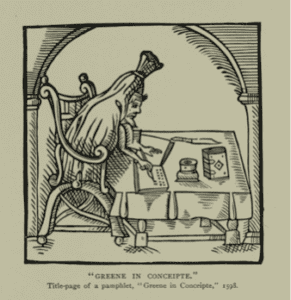
How had a literary quarrel become so vitriolic? The simple answer is that no one really knows. Seven years earlier Nashe had praised Harvey as one of only two or three English poets able to write plausible Latin verse, but clearly things had taken a dramatic turn for the worse. The quarrel may have kicked off in 1590 when Gabriel’s brother, Richard, dismissed Nashe as an arrogant upstart who had no right to criticise his elders and betters in his early polemical writings, and, for good measure, he weighed in against Nashe’s friend and ally, John Lyly. Lyly had criticised Gabriel for writing in absurd ways about the impact of an earthquake on 6 April 1580, which took place in the Dover Straits, the tremors felt throughout Southern England and Northern France. Robert Greene, best known for calling William Shakespeare ’an upstart crow’, and another associate of Nashe and Lyly, hit back at the Harveys, claiming that Richard, a clergyman, lived immorally and that Gabriel’s Latin poetry was awful.
The dispute was escalating at vast speed. Nashe aimed his first serious barbs at the Harveys in Piers Penniless, His Supplication to the Devil, published in 1592, insulting the apparently short Richard as a boastful ‘pigmy braggart’, and reminding readers that he had been extraordinarily gullible when Jupiter and Saturn were conjoined on Sunday 28 April 1583 – a relatively rare astronomical event that last happened on 21 December 2021 and will not happen again for over forty years – making a host of false predictions. Gabriel responded by publishing some personal letters – a favoured literary device of his – which took aim at Nashe, who he saw as the inspiration for a generation of flashy, insubstantial, and vulgar writers:
Our new-new writers, the Loadstones of the Press, are wonderfully beholding to the Ass [i.e., Nashe], in a manner the only Author, which they allege: the world was ever full enough of fools, but never so full of Asses in print: the very Elephant, a great Ass; the Camel, a huge Ass; the Bear, a monstrous Ass; the Horse, an absurd Ass; the Fox himself, a little Ass, or, for variety, an Ape: who not an Ass, or an Ape in good plain English, that chanceth to come in the wise Ass-makers & mighty Ape-dubbers’ way?
Voltaire, Swift or Evelyn Waugh it is certainly not, and Harvey’s satire is invariably leaden and repetitive.
In contrast Nashe responded with a series of inventive attacks on Harvey’s pedantry, pomposity, and lack of wit, imagining ludicrous, carefully drawn scenes from Harvey’s life. In Strange News (1593), his response to Harvey’s published letters, Nashe depicts schoolboys goading Harvey in the street, even at a young age realising that the man who would teach them is a slavish imitator of the great Roman orator Cicero (Tully):

From this day forward shall a whole army of boys come wondering about thee as thou goest in the street, and cry kulleloo, kulleloo, with whip hoo, there goes the Ape of Tully, tih he, steal Tully, steal Tully, away with the Ass in the lion’s skin.
Nay, but in sadness, is it not a sinful thing for a Scholar & a Christian to turn Tully? A Turk would never do it.
Harvey, imagining that he is a grand man, is revealed as the butt of well-directed schoolboy humour.
Nashe’s most effective satirical passages are probably those directed at Harvey’s absurd language. In Have With You To Saffron Walden (Harvey’s home town) Nashe asserts that if anyone spends a quarter of the time they might have spent reading the romances of Barnaby Rich (one of the many second rate authors that Nashe treats with casual disdain), ‘in mumping upon Gabrielism, and I’ll be bound, body and goods, thou wilt not any longer sneakingly come forth with a rich spirit and an admirable capacity, but an enthusiastical spirit & a nimble entelechy [a spirit realized as a body]’. Put another way, Nashe claims that readers who waste too much time reading Harvey and not spending their time profitably reading other authors will end up believing that his Ciceronianisms are, in fact, the natural way to speak English and so they will sound as ridiculous as he does.
Eventually the quarrel became too heated for the authorities to stand and in 1599 the bishops, in charge of licensing books, intervened against what they saw as the worrying proliferation of satire and banned Nashe and Harvey from ever writing again. Nashe died in 1600 or 1601 but Gabriel lived on in silence until 1631.

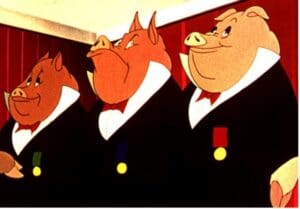
Why might this quarrel matter? The less important answer is that it is hard to understand the literature of the 1590s – a vital decade in English literary history which saw the rise of Shakespeare, a keen reader of Nashe – without appreciating the importance of the Nashe-Harvey dispute. The more important answer is that literature never can – and never should – consist entirely of polite letters. Satire, insult, and polemic have always been central to literature from the Bible, Horace, and Juvenal to George Orwell, Catch-22 and Charlie Hebdo. Few writers in any language are better at sustained polemic than Thomas Nashe and, whether one enjoys or deplores satire, it is vital to understand how it works and what it can do. C. S. Lewis famously asserted that if we were asked what Nashe actually says, we would have to reply ‘Nothing.’ Try telling that to Gabriel Harvey.
– Andrew Hadfield
Andrew Hadfield is Professor of English at the University of Sussex and a fellow of the British Academy. He is the author of a number of works on early modern literature and culture, including Shakespeare and Republicanism (2005), Edmund Spenser: A Life (2012), Lying in Early Modern Culture (2017) and John Donne (Reaktion, 2021).
To find out more about the Thomas Nashe, read Thomas Nashe and Late Elizabethan Writing now!