The Ninth Century: Bishop Æthelwald’s Prayerbook 47
6th June, 2025
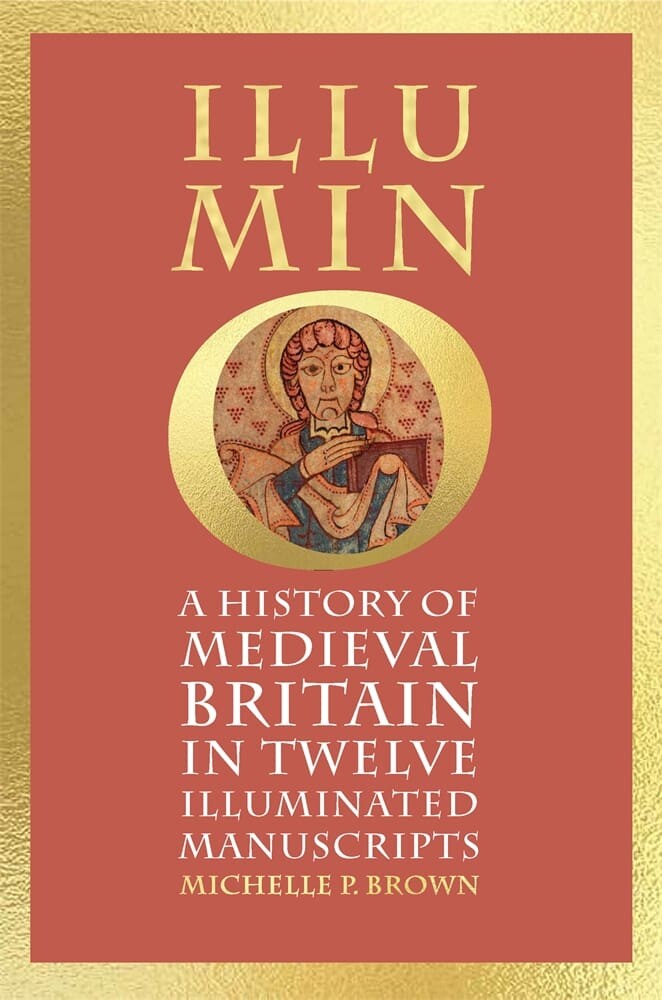
In this, the second of twelve blog posts, author Michelle P. Brown focuses on one illuminated manuscript from the 9th century. You can read more about this, and other manuscripts, in her new book, Illumino.
***
From the mid-8th to mid-9th centuries the political ascendancy in Anglo-Saxon England passed to the kingdom of Mercia, the territories of the Angles of the Marches (borderlands), who had pushed beyond the coastal kingdoms into the interior, what is now the Midlands of England, westwards into the Welsh Marches and northward into the Peak District. Their expansion under three successive strong kings – Æthelbald (reigned 716-757), Offa (reigned 757-796) and Coenwulf (reigned 796-821) – also led to the formation of an hegemony (a kind of ‘Greater Mercia’) extending their overlordship and influence into the neighbouring major kingdoms of Kent, East Anglia, Wessex and Northumbria.
Offa’s attempts to secure the succession for his own son, and the powers he accorded to his queen Cynethryth, led him into conflict with the Archbishop of Canterbury, who refused to consecrate his son as co-ruler during Offa’s lifetime (emulating Charlemagne and his sons) as this was uncanonical. Offa simply created a third archbishopric of his own at Lichfield, near his stronghold at Tamworth, and had the ceremony done there, in the cathedral that had been established a century earlier by St Chad of Lindisfarne. Lichfield received property and power at Canterbury’s expense.
Offa’s plan backfired as his son, Ecgfrith, only survived him by five months and as Offa had wiped out the other immediate contenders his dynasty died out and the kingship passed to Coenwulf from a kingworthy family in western Mercia based in the Worcester / Winchcombe area. Coenwulf relegated Lichfield to a bishopric and restored most of Canterbury’s privileges, whilst installing his daughter, Cwenthryth, as abbess of Minster-in-Thanet in Kent and a Mercian noble, Wulfred, as Archbishop of Canterbury.
Coenwulf also compensated Lichfield for its losses and it may be to his reign that the refurbishment of its shrine of St Chad was undertaken, including the fine stone sculpture excavated beneath the cathedral quite recently, known as the Lichfield Angel, which formed part of a new house-shaped shrine. The angel has the bouffant hair and flying draperies of Byzantine art and has just touched down from Constantinople, presumably to announce the conception of Christ to the Virgin Mary. It retains much of its original pigmentation – a symphony of purples and white, recalling the palette of the mid-8th century St Chad Gospels which probably formed a focal point of the saint’s shrine. This is also echoed in that of the personal prayerbook made for or by Bishop Æthelwald of Lichfield (818-830), known as the Book of Cerne (after Cerne Abbas monastery in Dorset, where it was by at least the 13th century).
Bishop Æthelwald showed signs of sympathising with the reforming agenda of the Frankish bishops who sought to withstand the encroachment of their rights by the Carolingian rulers and their nobles – a problem not unfamiliar in Mercia. His prayerbook takes as its central theme the cohesion of the Communion of Saints and the strength that is accorded by participation in the collective prayer and fellowship of the whole body of the faithful, past, present and future, with Christ as their head and the source of their salvation. The prayers it contains were composed by saintly authors stretching from Ireland to Syria. It also contains extracts from each of the four Gospels relating the Passion of Christ. These are preceded by full-page evangelist miniatures in which the Gospel writers are depicted as half-length human scribes set above their full-length identifying symbols – Matthew the Man (as his Gospel focuses upon Christ’s incarnation), Mark the Lion (symbol of kingship and resurrection), Luke the Bull (the sacrificial victim of the Crucifixion) and John the Eagle (which flies to the throne of God for inspiration and symbolises the Second Coming). These are accompanied by unusual inscriptions designed to trigger intertextual scriptural references in the mind of the viewer, reinforcing the symbolism of the images. The St Luke miniature featuring the bull, the sacrificial victim – the servant king (Christ) – has an appropriately placed acrostic poem written on the other side of the leaf, written formally by the main text hand in coloured inks, the first letter of each line reading vertically down the page ‘AEDELVALD EPISCOPUS’.
The rest of the text, which also includes an abbreviated Psalter for regular recitation, ascribed to Bishop Æthilwald of Lindisfarne (who had the Lindisfarne Gospels bound) and the earliest known example of liturgical drama (a Harrowing of Hell arranged in responsorial parts, thought also to have been composed at Lindisfarne a century earlier), is enlivened by zoomorphic initials composed of animal forms and a menagerie of little biting brontosaurus-like creatures which occasionally munch contentedly upon the letters of the elegant Insular cursive script. This would have been written by a member of the Lichfield Cathedral scriptorium, or perhaps even by the bishop himself as a devotional act. His contemporary and fellow Mercian, Archbishop Wulfred, was a gifted scribe and reformed the Canterbury Cathedral scriptorium, producing impressive looking documents in a similar script to that of the Book of Cerne, which were used by Wulfred as evidence in the first cases of the assertion of the primacy of written evidence in law over custom and the sworn testimony of witnesses.
A preface by this hand, in an early example of Old English prose, gives instructions on how the prayerbook is to be used, part of which is performative and entails the reader (the bishop himself) humbly prostrating himself before the whole company of saints, reciting the prayerbook’s contents and entering into communion with them.
The need for cohesion and common cause, temporally and eternally, was becoming ever more pressing, for within a decade of the bishop of Lichfield’s death in 830 the Vikings, who had raided and sacked Holy Island in 793, were at the cat-flap of Kent and would soon make headway into the interior as well as sailing their longships along the coasts and rivers, causing immense damage to the libraries and cultural monuments of early Anglo-Saxon England and toppling its ruling houses, including that of Mercia, until only an unlikely resistance leader was left standing, the sickly, devout youngest son of King Æthelwulf of Wessex – Alfred, later termed ‘the Great’, king of Wessex (871-866) who fought his way to become king of the Anglo-Saxons (866-899) in a partitioned land also occupied by the Danes.
– Michelle P. Brown
Michelle P. Brown is Professor Emerita of Medieval Manuscript Studies at the School of Advanced Study, University of London, and was formerly Curator of Illuminated Manuscripts at the British Library. Her books include Bede and the Theory of Everything (Reaktion, 2023).
You can buy Illumino and Michelle’s other Reaktion books from our online shop now.