The History of the Swing
26th April, 2023
When writing Arc of Feeling, Javier Moscoso uncovered a world as yet unexplored; the history of the swing. In this blog, Javier considers what the swing has meant for us throughout the ages …
***
The fact that, in very distant regions and at different times, humans have been fond of swinging is perhaps not surprising. After all, it is an activity that humans share with so many other animal species. What is truly astonishing is the way in which the uses of these instruments involve formally identical rituals, often practiced in regions with no known connection, and which also draw on the same mythological elements. Across the globe and throughout history, swinging has been linked to sex and death. And the question we must answer is why?
To write the history of the swing we do not have any great treatises. The philosophers of the ancient world did not write compendia with titles like Peri aioras (in Greek) or De petaurus (in Latin). References to the instrument are scarce, distributed in texts of very different status, whether manuals on education or medicine books. However, we do have a wide variety of sources on its mythological origins. We also have information on swinging ritual practices, ancient and modern. Here and there, we have incomplete commentaries, broken objects, dubious testimonies, images, and references which, despite their fragmentary nature and heterogeneous origins, possess a certain thematic unity. All of them help us to understand the cultural significance of an artefact that, only in recent times, has been associated with childhood. And the question is, why? What has happened so that an instrument of high cultural significance, which maintains a thematic unity throughout the planet and throughout history, has been relegated to the children’s playground? How could it happen that that its ritual uses have been forgotten and marginalized?

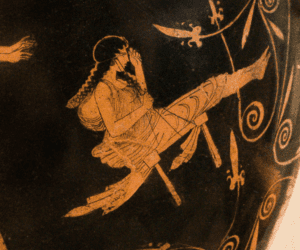
Long ago, the anthropologist James S. Frazer attempted an answer to these questions. This was more than 100 years ago. During the second half of the 19th century and the first decades of the 20th, some other researchers considered the swing worthy of mention in their writings. The neurologist Sigmund Freud included some references in his Three Studies on Sexual Theory. In his view, the dizziness that some adults felt in the means of transport of the time was nothing more than the result of the neurosis produced by the repression, in childhood, of the desire to sway. For Havelock Ellis, the history of the swing was linked to sexuality without sex. It seemed to him, essentially, an instrument of masturbation. Somewhat more poetically, the philosopher Frederic Nietzsche used the image of the swinging gondola, with which young Germans amused themselves, to theorize about the oscillatory movement of life. For the religious scholar Mircea Eliade, the swing was part of the materiality of the eternal return, an idea that will also appear in other authors, such as Walter Benjamin, for example. All these authors, including Frazer himself, who linked the ritual use of the swing to sympathetic magic, overlooked its feminine character. And the question is, again, why? Why has the swing traditionally and pervasively been a female instrument? Why do most of the images that history has bequeathed us of the uses of the swing, whether the Classical Greece red paintings, the Chinese hand scrolls or the European Rococo paintings, have young women as protagonists?
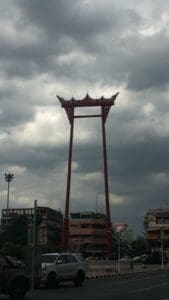
This book is the result of perplexity: the perplexity of finding an erotic Roman coin, from the time of Tiberius, in which a swing was engraved. Or the same surprise that comes from learning that the Great Swing in Bangkok, more than 25 meters high, was erected as part of the recovery of national identity after the Burmese invasion. We are also surprised to find the swing as a therapeutic tool, to cure mania, hysteria or tuberculosis. Similarly, we are struck by the omnipresence of the swing in the painting of the Indian subcontinent, whether it is the Irandati naga or the god Krishna and the shepherdess Rhada. More in particular, it is highly surprising that the the songs that accompany ritual swinging are so similar and comprise the same themes, whether at the Teej festival in India or at the festival of the swings in Ubrique, Spain.
The great obstacle this book has to face is for the reader to understand that the story told here poses a major problem from an apparently trivial object. The same instrument that today serves to entertain children contains metaphysical secrets, as Marx would say, or suprabiological conditions, as the historian of play Johan Huizinga would have called them, that point to a cultural activity anchored in the tyrannies of human physiology. This book takes a forgotten but omnipresent object to answer not only the above questions, but the more general difficulty of how and why human beings produce formally identical mythologies and rituals in the face of the same experiences.
– Javier Moscoso
Javier Moscoso is Research Professor of History at the Spanish National Research Council (CSIC), and his books include Pain: A Cultural History (2012).
You can buy Arc of Feeling now from our online shop.