The Hidden Realm of the Sea
7th August, 2025
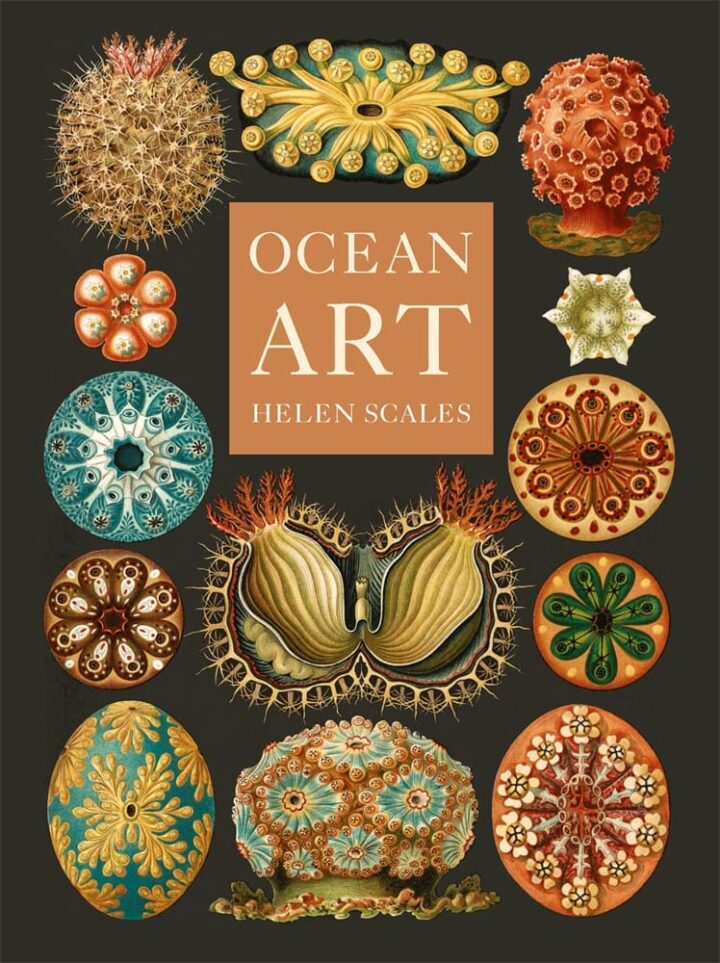
To celebrate National Marine Week, marine biologist and author of Ocean Art, Helen Scales, explores her love of sea life and how artists have long been helping people to care about this hidden realm.
***
I don’t remember a time when I didn’t know about the sea. Even though I grew up in a land-locked British county, my family usually went on holiday to the seaside, to Cornwall or France. I’m quite sure that’s where I picked up some of my earliest, haziest ideas that there must be wonderful creatures living in the sea, right off the beaches we visited — if only I could go and see them for myself.
Some I caught glimpses of, the crabs, gobies and shrimp I found in rockpools at low tide. And I went through phases, as all beach visitors surely do, of being obsessed with finding seashells. For me, it wasn’t about gathering as many shells as possible. I think I was searching for answers to questions that floated around my mind. What was hiding inside the shells? Who made them? And why do they come in so many pleasing shapes and patterns?
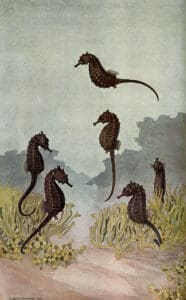
Hashime Murayama, 1920.
By the time I discovered there are such things as marine biologists, it made perfect sense that’s what I would become. I wanted nothing more than to spend all my time exploring the seas and learning everything I could about what lives there.
In high school I was drawn towards the sciences, but I also had an enduring love of art. For some time, I was able to combine the two and unleashed my oceanic inspirations in art classes. Eventually there was a choice to make and I picked science.
But I’ve never left art completely behind, nor my fascination and appreciation for the shapes, colours, forms and patterns of ocean life. Since my early rock pooling days, I’ve witnessed first-hand many more of the seas’ living inhabitants, and they never stop amazing me with their beauty.
Just the other day I was snorkelling off the coast of France (still one of my favourite ocean haunts) and I was stopped in my tracks by the stunning patterns on the back of a crab. The shell was black as the night sky and covered in the spots that looked like a swirling galaxy.
And it’s definitely not just me who feels drawn to the artful elegance of ocean life. For millennia, humans have been enraptured by the ocean’s inhabitants, as shown by the crafts and artworks made all around the world.
Artists have long played a critical role in forging connections between people and sea life. For most people, most of the time, the ocean and its living wonders remain out of sight and out of mind, beneath the impenetrable waves or far out beyond the horizon, where only brave mariners and fishers venture.
What’s more, those animals that are brought back to land for others to see soon lose their beauty. The iridescent colours of fish fade. The intricate forms of jellyfishes collapse. The efficient power of an ocean-crossing shark becomes floppy and unimpressive. It’s all too easy to assume sea life is smelly, slimy and altogether unappealing. Visual art in all its forms has the power to capture and preserve the living beauty of ocean animals that so quickly ebbs away.
In writing Ocean Art, I decided to bring together artworks depicting as many forms of sea life as I could find, from across human history and around the globe. I like to think of the book as an aquarium of images for readers to pour through, as they join me on a journey through the ocean as seen through the eyes of artists and craftspeople. Some were scientists too, some worked alongside scientists. And some had no other ambition in mind other than to present their own view of what lives beneath the waves — what they know to be there or what they imagine might be.
I begin at the familiar shoreline, then strike out for shallow then open seas, and eventually sink into the stranger waters of the deep. In each realm, I’ve sought out the most striking images that capture something of the wild splendour of the living seas. I use them to tell stories of the artists who made them, the creatures they portray and the associations people have had with them.
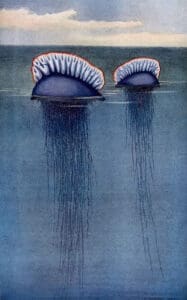
Hashime Murayama, 1919.
My hope is that the book will help more people appreciate this magnificent and important part of our living planet. The ocean faces urgent problems, from destructive fishing and pollution to the worst ravages of the climate crisis. Many of its living wonders are struggling, but it’s not too late to turn things around. The ocean has an amazing capacity to recover and restore, if we give it a chance. Ultimately, I hope these artworks will inspire more people to care and take action — maybe create their own artworks too — and join the fight for a healthier more just ocean, one that’s remains full of vibrant life.
– Helen Scales
For ideas of how to take action visit Helen’s website: https://helenscales.com/take-action-for-the-ocean/
National Marine Week runs from July 26 to August 10 2025
Helen Scales is a marine biologist, acclaimed author and broadcaster who teaches at the University of Cambridge. Her books include What the Wild Sea Can Be (2024), which was longlisted for the Baillie Gifford Prize and Women’s Prize for Non-Fiction.