The Eighth Century: Bishop Eadfrith’s Desert of the Book 11
1st March, 2025
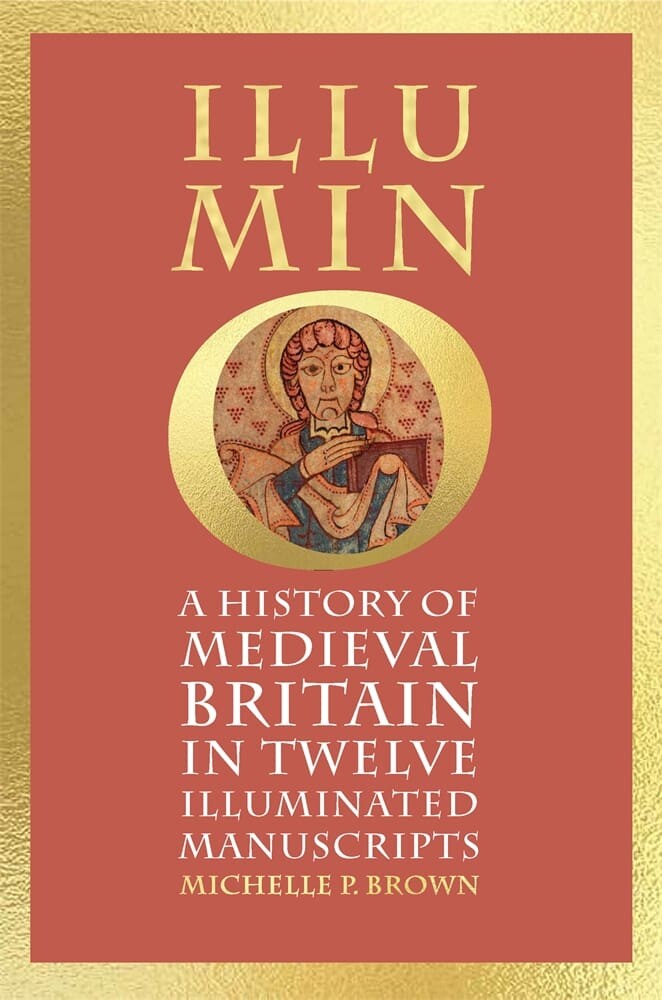
In this, the first of twelve blog posts, author Michelle P. Brown focuses on one illuminated manuscript from the 8th century. You can read more about this, and other manuscripts, in her new book, Illumino.
***
The 8th and 9th centuries were a formative period in the formation of identities in Britain, as the turbulent period following the meltdown of the western Roman Empire and the collapse of the then ‘global’ economy (the 5th-6th century period sometimes characterised as the ‘Age of King Arthur’) gave way to a patchwork of Christianised kingdoms which vied for supremacy and cultivated distinct cultural identities.
The 6th-7th centuries had been one of the hardest times to be alive in the West, with warfare, plague and famine rife. Against this backdrop the newly converted sought to revive and reinforce the flagging Christian faith that had been adopted as its official religion by the Roman Empire in the 380s. Men and women set sail aboard the metaphorical ‘boat with no oars’ to bring faith, care, healing, teaching and hope to areas in need. Among these was the former Roman province of Britannia, where apostasy and paganism were rife, drawing numerous missionaries from Ireland and S. Wales to work there.
The mid-7th to mid-8th centuries witnessed the Northumbrian renaissance, during which the Anglo-Saxon kingdom of Northumbria had achieved ascendancy and sought to reconcile the legacies of the Irish Columban mission from Iona and that dispatched to Canterbury by Pope Gregory the Great.
Northumbrian nobles turned churchmen Benedict Biscop and Wilfrid of York travelled to Gaul and Rome, conceiving an impulse to rebuild Rome on northern ground and built awe-inspiring monasteries of dressed stone, in Roman fashion, with stained glass windows, sculptures, paintings, icons and libraries that preserved the wreckage of late Antique and early Christian thought. Biscop’s twin foundations of Monkwearmouth and Jarrow amassed a library and a school – or proto university – that, along with those at Canterbury and York, were amongst the greatest intellectual and spiritual resources of the early medieval West and produced a scholar of the stature of Bede, who also respected the Irish learning and asceticism of Columban monasteries such as Iona and Lindisfarne. In 731 he completed his Ecclesiastical History of the English People, in which he effectively conceptualised England and sought to integrate it into Eusebius’s 4th-century historical narrative of the international orthodox oecumene of which it formed part.
Bede spent his life, from the age of 7 to 62, at the monastery of Monkwearmouth-Jarrow where he was a priest and monk. There he studied, taught and wrote between 40 and 60 works on biblical exegesis, hagiography, rhetoric, grammar, poetic composition, the nature and calculation of time (popularising a single, unified dating system from the birth of Christ), the physical nature of things, a guide to the biblical holy sites which served as a practical travel guide until the 20th century and the first tide timetables (based on his lunar observations and recognition of the gravitational pull of the moon). Bede also served as an editor and scribe of the Codex Amiatinus, one of three enormous single-volume Bibles and the best early version of St Jerome’s Vulgate (Latin) edition, which abbot Ceolfrith caused to be made at Monkwearmouth-Jarrow. In 716 he departed on retirement to Rome, taking it with him as a gift to the Pope and as an impressive ambassador for the English Church and people.
It was the year before, to judge from textual evidence, that work on the beautiful Lindisfarne Gospels was commenced by a gifted single artist-scribe – Eadfrith, Bishop of Lindisfarne (698-722), and continued until his death in 722. The work was likely undertaken on Cuddy’s Isle just off the tidal island of Lindisfarne (Holy Island), where the busy bishop was allowed to spend Lent and Advent on retreat. The tradition in Columban foundations, of which Lindisfarne was one, only the most senior, spiritually mature members could serve as the scribes of Scripture, writing Gospel books or Psalters as solitary, saintly endeavours in the manner of the eastern desert fathers. On his rocky retreat Eadfrith picked up his quill in the desert of the book, creating an artistic and theological masterpiece as an offering of prayer on behalf of all. His technical innovations included introducing the lead pencil and the lightbox and producing a palette of some 90 colours, emulating that of the silk roads and Constantinople, using six locally available minerals and plants, as an experimental chemist and survivalist used to living in the wild for periods in order to replenish the energy to recommit to communal monastic life and the work in the world.
The physically demanding work may have been undertaken alone, but the supply of exceptionally fine calfskins (vellum) required to enable some 300 unblemished ones to be selected, would have entailed contributions from every monastic, royal and thegnly estate in Northumbria and perhaps beyond. The Lindisfarne Gospels embodied a living act of prayer in its making and using, intended to help transform the world for the good.
Eadfrith had commissioned Bede to write a prose Life of St Cuthbert, bishop of Lindisfarne (died 687) whose cult he was developing as a focus of Christianity in the North. It would become the most visited shrine in Britain until that of Becket arose in the late 12th century. St Cuthbert’s shrine remains a focus of pilgrimage in Durham Cathedral.
Bede may have been the conduit for a copy of the Vulgate Gospels being sent from Monkwearmouth-Jarrow to Lindisfarne as a textual model, but the artwork of the Lindisfarne Gospels is an eloquent cultural, theological and political fusion of styles, motifs and iconographies drawn from the various peoples then residing in Britain and Ireland (Celts, Picts, Britons and Anglo-Saxons), from those living around the Mediterranean and the near East. Its Esperanto of art was a visual language in which all had a place, its ingredients summoning up (like fusion cooking) vast cultural hinterlands and histories, some familiar to the pilgrims who visited the shrine and others exotic. Celtic Iron Age spiralwork merged with Germanic animal interlace, of the sort that had adorned people’s jewellery, weaponry, textiles and tattoos for generations, alongside Greek key and fret patterns and Byzantine and Roman display lettering and figures. The carpet pages, based upon the prayer mats (an early Christian device later adopted by Islam and still employed in western Europe in Bede’s day),used at the time on the Good Friday veneration of the Cross that precede each Gospel each have a different type of cross embedded in their designs – Matthew the Latin cross, Mark the Celtic ring-headed cross, Luke the Greek cross and John the Coptic / Ethiopic tau cross – symbolising the harmony of the various church traditions of East and West, essentially the same but different like the four evangelist’s Gospels themselves. After the various disputes that had threatened the unity of the Church during the preceding centuries, this much visited book is full of symbolic statements of the healing of schisms and presents a vision of an eternal harmony in which all creation is sustained by the Word (Logos), laid out in accordance with classical geometry. It is a finely tuned visualisation in which art, science and faith are brought together in an attempt to depict the beauty of the Divine.
– Michelle P. Brown
Michelle P. Brown is Professor Emerita of Medieval Manuscript Studies at the School of Advanced Study, University of London, and was formerly Curator of Illuminated Manuscripts at the British Library. Her books include Bede and the Theory of Everything (Reaktion, 2023).
You can buy Illumino and Michelle’s other Reaktion books from our online shop now.