The Art of Verbal Warfare: Excerpt
6th July, 2022
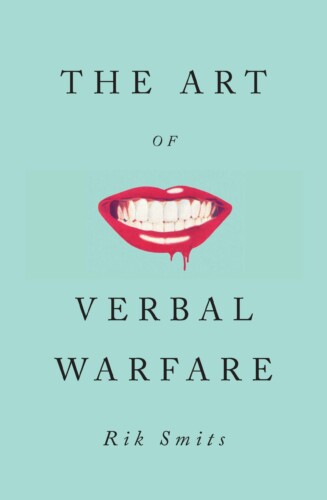
In this exclusive extract from chapter 8 of The Art of Verbal Warfare, Rik Smits ponders on the effect language has with identity.
***
EFFECTIVE INVECTIVE
With these words, on a cold February day in 1546, Martin Luther told his wife he felt death drawing near. It is but one of the many scatological jokes and rants the monk-turned-reformer was renowned and criticized for. This time, the rueful joke was on himself. But although he has been branded a German Rabelais, Luther’s diatribes were often more scathing than scatological, as when he dismissed the English king Henry viii as ein Schwein, einen Esel, einen Misthaufen, ein Otterngezücht, einen Basilisk, einen lügenhaften, mit königlichen Kleidern angethanen Possenreißer, einen tollen Narren mit schaumenden Maul und verhuretem Gesicht (‘a swine, an ass, a dungheap, a brood of vipers, a basilisk, a fraudulent illusionist dressed up in regal attire, a crazy fool with foaming mouth and depraved looks’).
Luther was a man at war with the Pope, Catholic Christianity and his bowels. He was plagued by kidney stones and constipation, and on account of the latter probably suffered from haemorrhoids and other painful anal ailments as well. Perhaps this contributed to the particularly scatological character of much of the verbal abuse he hurled at everyone who stood in his path, even in his sermons. On the other hand, much to do with bodily effluent and the way it is produced that is too smelly for modern taste wasn’t all that offensive in Luther’s day. In an era without any sanitation to speak of, pus, piss, shit and the stench of it were facts of everyday life. In English, for instance, the word shit did not fall out of favour until the eighteenth century, by the end of which it had disappeared from polite conver-sation and even from the dictionaries. The growth of this incipient taboo went hand in hand with the slow emergence of worries about excrement, propriety and ill health, which would not begin to materialize in the shape of serious sewerage systems and water closets until well into the nineteenth century.
Also, Luther lived in a very physical world beset with famine and plague and run by heroes: red-blooded, often coarse men with big voices who dished out their violent virility and machismo with gusto. Men like Henry VIII. Although the Church of Rome still advocated humility, modesty and turning the other cheek, neither it nor secu¬lar authorities practised any of these – which was precisely what put Luther on his dissenter’s path in the first place. Hurling abuse was one way to assert one’s strength, so Luther, who commanded no armies, threw shit as a weapon. It was a weapon of ridicule mainly, for the debilitating effect of associating the high and mighty with demean¬ing activities and vulnerable circumstances – unless you’re Lyndon B. Johnson, who is said to have received people while sitting on the toilet adjoining his office, browbeating them into acquiescence from beyond the wide-open door, you can’t wield power very well with your trousers round your ankles, and it’s a panicky weakling who soils himself – was not lost on Luther’s largely illiterate audience, the ordinary Germans whom the Church had come to despise and exploit.
In his highly successful propaganda campaign against the corrupt Mother Church, Luther had two essential allies. First, the printing press, which had only recently taken root across the German lands when on 31 October 1517 Luther, then professor of moral theology at the University of Wittenberg, first sent his 95 theses off to the Archbishop of Mainz, then posted them on the doors of All Saints’ church in his home town (the customary academic noticeboard) and promptly saw them printed as well. And reprinted, and reprinted. Over the remaining three decades of his life, Luther wrote and pub¬lished no fewer than 544 books, pamphlets and sermons, which on average went through five or six reprints. That’s huge, by any stand¬ard. Especially in the early years, everything that came out of Luther’s hands sold like hot cakes.
Luther’s second highly effective ally was his lifelong friend Lucas Cranach the Elder, who illustrated much of Luther’s work. In a world with an average literacy rate of about 5 per cent, rising to at most 30 per cent in the major cities, this changed a stream of texts into a true media campaign, greatly increasing both sales and the impact of every copy sold. But there were mighty enemies as well. First of all the papacy, which succeeded at the Council of Trent in rejecting most of the repairs and improvements Luther and other reformers had proposed, and making everyone who henceforth disagreed with official Church lore liable to excommunication. In doing so, the Church of Rome slammed the door on every critic and all criticism for centuries to come, thus forcing a definitive breach with Protestantism.
The second powerful enemy was Henry viii, the king of England, who in 1520 wrote Defence of the Seven Sacraments, a fierce treatise against ‘this one little monk weak in strength, but in temper more harmful than all Turks and Saracens, all Infidels anywhere’, who ‘has no charity, swells with vainglory, loses his reason and burns with envy’. This pleased Pope Leo x so much that he awarded Henry the title ‘Defender of the Faith’ – a bit hastily, as it would turn out in 1534, when Henry flew the Catholic coop and set up shop for himself. Luther countered in kind, as quoted above, which inspired Thomas More, Henry’s secretary – masquerading as one Gulielmus Rosseus – to a riposte in which he too gave as good as he got, denouncing ‘a certain rascal whose name was Luther, who because he had out¬stripped the very devils themselves in impiety, surpassed magpies in his garrulousness, pimps in his dishonesty, prostitutes in his obscen¬ity, and all buffoons in his buffoonery so that he might adorn his sect with worthy emblems’. ‘Meanwhile,’ he addresses Luther indig¬nantly, ‘for as long as your reverend paternity will be determined to tell these shameless lies, others will be permitted, on behalf of his English majesty, to throw back into your paternity’s shitty mouth, truly the shit-pool of all shit, all the muck and shit which your damnable rottenness has vomited up, and to empty out all the sewers and privies on to your crown.’
Such crude ranting, whether scatological or not, is no longer considered an effective or acceptable method of public verbal war¬fare – although recently the 45th president of the United States did much to revive such late medieval mores – but similar barrages of abuse continued to be launched until deep in the nineteenth cen¬tury. In September 1864, with the American Union at war and the election campaign for its presidency in full swing, Harper’s Magazine complained that the Democratic candidate, former general George McClellan, had openly made the incumbent, Abraham Lincoln, out to be a ‘Filthy Story-Teller, Despot, Liar, Thief, Braggart, Buffoon, Usurper, Monster, Ignoramus Abe, Old Scoundrel, Perjurer, Robber, Swindler, Tyrant, Field-Butcher’ and ‘Land-Pirate’. McClellan, com¬mander in chief of the Union troops during much of the first half of the Civil War, had an axe to grind with Lincoln ever since the two fell out over McClellan’s military strategy, which consisted mainly of avoiding confrontations with the Confederate enemy. Lincoln had made a mortal enemy of the overly cautious general by sending him a note saying:
My dear McClellan,
If you don’t want to use the army I should like to borrow it for a while.
Yours respectfully,
A. Lincoln
Now this was modern verbal warfare of a kind against which the dutiful but stodgy McClellan had no recourse. Lincoln’s flippant sarcasm was like the new machine guns that fifty years hence, at the start of the First World War, would put paid to the time-honoured cavalry charge in a matter of hours. McClellan was deeply hurt, and after his replace¬ment in November 1862 all he could muster was rancour. Unlike his army, he did not spare himself in campaigning against Lincoln, and promptly bit the dust. Lincoln carried 22 out of 25 states.
And yet, as old-fashionedly Lutheran as McClellan’s nineteenthcentury mud-slinging may seem, there is a difference. Almost all the slurs from Luther’s day are attacks on someone’s character. On what he is: a swine, an ass, a dungheap, a crazy fool. This is also true of King Henry’s assessment of Luther: more garrulous than a magpie, more dishonest than a pimp, more obscene than a prostitute. They are meant to be offensive, but there is no guilt. One cannot really help being crazy, or stupid, or even dishonest or obscene like a prostitute or swine. In contrast, most of the slights McClellan levels at Lincoln are about what his opponent does: he tells malicious stories, lords it over others, lies, steals, brags and so on. The difference is in the presence of personal responsibility. Being called a swine relegates you to a class of creatures; being called a thief is a condemnation of your behaviour as well as an instruction to mend your wicked ways.
This difference mirrors the slow but steady growth in Western culture of the importance of the individual and his or her life. Luther’s insistence that the faith was about and of the believers them¬selves, who were not to be herded any more like a flock of mindless, anonymous sheep, was a formative early expression of this changing view of the world and of what it means to be human. In time, it would affect everything, leading to the slow decline and ultimate marginalization of torture and corporal punishment, the abolition of slavery, the ‘discovery’ of the child, modern democracy and the invention of international law and human rights.
– Rik Smits, The Art of Verbal Warfare, 2022
To read more about this fascinating subject, order The Art of Verbal Warfare from our online shop now.
Rik Smits is a linguist based in Amsterdam, the Netherlands. His books include The Puzzle of Left-handedness (Reaktion, 2011) and Dawn: The Origins of Language and the Modern Human Mind (2016).