The Amazing Solar System
27th February, 2025
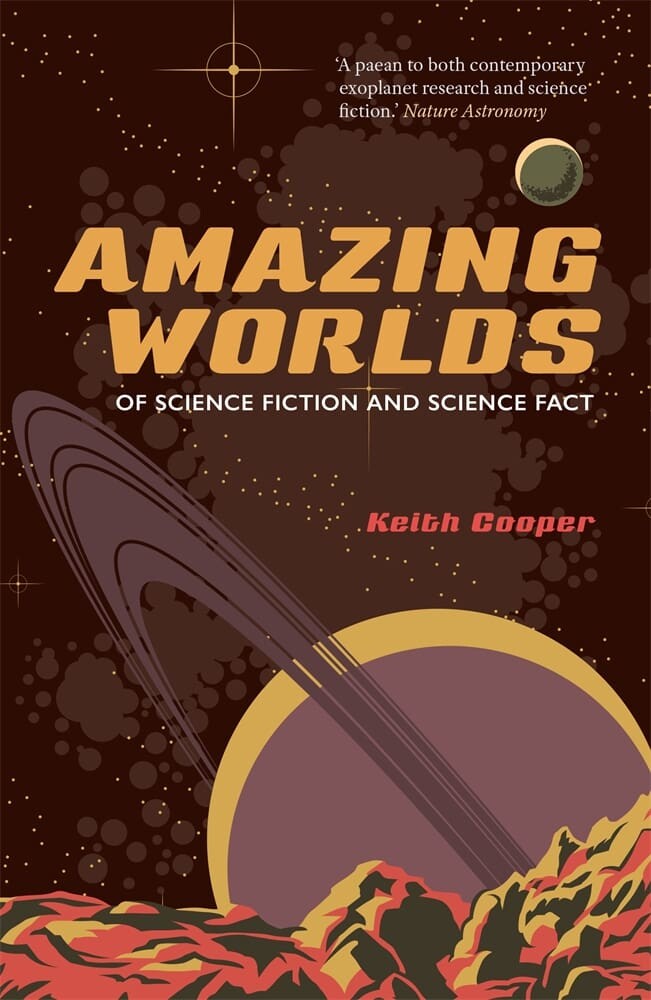
Join author Keith Cooper as he explores the known (and unknown) solar system in this blog, where he explains what inspired him to write his new book: Amazing Worlds of Science Fiction and Science Fact.
***
I first became aware of the idea that planets could exist around other stars, and not just in our Solar System, at a young age. It was probably when watching cartoons such as He-Man and the Masters of the Universe, set on the faraway world of Eternia, or The Transformers, who came from the metal planet of Cybertron. Around that time, aged maybe 4 or 5, I would have been introduced to Star Trek and Star Wars, which made the concept of what we call ’exoplanets’ – planets orbiting other stars – seem almost normal.
As a young space fan, I could recite the names of the planets in our Solar System by heart, spurred on by astronomer Heather Couper’s 1985 Channel 4 television series The Planets, which described our Solar System in accessible, wondrous detail.
But what of beyond our Solar System?
For decades, even centuries, science fiction has largely taught us that exoplanets should be common, and that they’ll be much like Earth. Yet it’s remarkable that even as recently as the 1980s, astronomers had yet to discover a single planet orbiting a star other than our Sun.
I describe this as remarkable because, as I write this on 25 February 2025, astronomers have so far discovered 5,834 confirmed exoplanets, and thousands more are awaiting verification.
As astronomers waited to find those exoplanets, science fiction filled the gap. It imbued in us a sense that the Universe was teeming with planets, many of which looked like our Earth and which we could easily travel to. Many consumers of science fiction back in the 1980s and earlier probably thought astronomers had already discovered exoplanets – science fiction made the concept seem normal.
So there was a collective sigh of relief, and sense of great excitement, when astronomers did finally discover exoplanets. This year, 2025, is an auspicious year in that it is the 30th anniversary of the discovery of planets orbiting Sun-like stars. Pedants will point out that the first exoplanets were discovered three years earlier orbiting dead stars called pulsars, but astronomers generally, and perhaps unfairly, ignore these worlds, possibly because the prospect of life existing on them is negligible indeed. Yet no one had thought that planets could exist around pulsars. Their surprising existence was perhaps a sign of things to come.
Science fiction had given us certain expectations about what exoplanetary systems would be like, but just like in the case of the pulsar planets, reality upended those expectations. The worlds that astronomers began finding were nothing like what we expected. Planets bigger than Jupiter orbiting within touching distance of their star, sweltering in temperatures in excess of a thousand degrees Celsius. Science fiction failed to predict such worlds. Conventional wisdom, and indeed the experience of our own Solar System, said that such worlds should be far from their star. So how did they find themselves so close to their star? After a few more years and more discoveries of these ‘hot jupiters’, astronomers realised that these planets must have formed farther out from their star, but then migrated inwards, pushing other, smaller planets out of the way. Astronomers hadn’t realised that planets could do that, and it changed the way we understood how planetary systems, and indeed our own Solar System, developed.
In the past 30 years, astronomers have discovered worlds hot enough to melt lead, or cold enough to freeze solid. Some planets possess a density that suggests they contain oceans thousands of kilometres deep, while other worlds might be so rich in carbon that graphite mountains form on their surface and their interiors are made of diamond. Rocky planets several times more massive than Earth test our understanding of concepts such as habitability and plate tectonics, and miniature stars called red dwarfs host appropriately tiny planetary systems, in which some planets are not much further apart from each other than the Moon is from Earth.
One very important kind of planet is missing, though. Thirty years after the discovery of exoplanets around Sun-like stars, we still have not yet found another planet like Earth, with a clement temperature, copious surface water, a nitrogen-oxygen atmosphere, and the presence of life.
Prior to the discovery of exoplanets, science fiction had been free to depict whatever worlds the imagination could dream up, but after that watershed discovery, science fiction has scrambled to keep pace with exoplanet research. It’s this intersection of science fiction and fact that my new book, Amazing Worlds of Science Fiction and Science Fact, seeks to explore. It’s still true that most people get their knowledge of exoplanets from science fiction, so how realistic are these fictional worlds? Do we find analogs of fictional worlds in the real exoplanets that we are discovering? Can science fiction inspire scientists, and how has science fiction changed in light of real exoplanet discoveries?
These are the questions that I seek to answer in Amazing Worlds. As you turn its pages you will encounter ocean worlds and desert worlds, and worlds with two suns. You will visit planets that always show the same face to their star where no cycle of day and night exists, and you will explore the potential for habitable moons. As a science-fiction fan, I scoured the films, TV shows and novels of the genre in search of fictional worlds. All your favourites from Avatar, Dune, Star Wars are featured, as well as planets from novels by award-winning sf authors such as Isaac Asimov, Becky Chambers, Ursula K Le Guin, Peter F Hamilton, Larry Niven and others. Amazing Worlds features over a dozen scientists discussing their work on exoplanets, and I also spoke to some of our top current science-fiction authors including Charlie Jane Anders, Stephen Baxter, Arkady Martine, Paul McAuley and Alastair Reynolds about how they go about building plausible fictional worlds.
So, if you’re fascinated by science and the universe around us, you’ll find much to get your teeth into in Amazing Worlds as I explore the science of both the real and imaginary exoplanets. My hope is that if you’re a fan of science fiction, that you might learn some new things about the science of exoplanets, and if you’re fascinated about the cosmos but haven’t really dipped your toe into science fiction, that you then might be introduced to some great stories. And if you like both science and science fiction, then Amazing Worlds will be the best of both worlds!
I had an absolute blast writing Amazing Worlds, and I hope you get a blast out of reading it too.
– Keith Cooper
Keith Cooper is a science journalist who has written for New Scientist, Physics World, Sky & Telescope, Space.com and Supercluster, among others. He has a degree in physics with astrophysics from the University of Manchester and has edited Astronomy Now magazine for nearly 20 years. His books include The Contact Paradox (2019).
You can buy Amazing Worlds of Science Fiction and Science Fact by Keith Cooper from our online shop now.