States of Incarceration
30th November, 2022
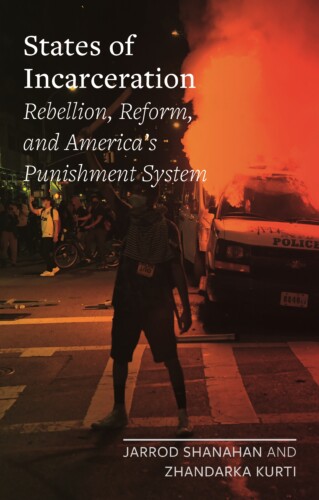
What provoked the Black Lives Matter movement, and how did it reflect what was going on (and still is going on) in America today? Jarrod Shanahan and Zhandarka Kurti explore in this new blog post …
***
In the summer of 2020, amid the desperate and uncertain days of the early Covid-19 pandemic, the whole world beheld the tragic images of a Minneapolis man murdered in slow motion by the cops, followed by the nearly unprecedented scene of a police precinct sacked and set afire. With little central coordination to speak of, tens of millions of Americans almost immediately defied their socialization as passive consumers of news, and opted instead to take the streets. The George Floyd Rebellion was notable for its size, scope, and ferocity. At its peak, one opinion poll found the burning of the Third Precinct more popular than either presidential candidate. A new, strikingly multiracial generation of activists and agitators was christened in the hail of pepper spray, broken glass, spray paint, rubber bullets—and some real ones too. New political sensibilities were forged on the burgeoning left, as well as the reactionary right. The US political landscape would never be the same.
In the two years since, many liberal politicians, business leaders, and activists have attempted to recast the tumult of this hot American summer as a peaceful exercise in speaking truth to power. Corporations and universities have reduced their righteous condemnation of the racial order to opaque commitments to social justice and “diversity and inclusion” training. Democrats have invoked Floyd’s name toward the passage of toothless “police reform” legislation, while distancing themselves from the movement’s foremost articulated demand: defund the police. And even many partisans of the latter movement, born in the fires of Minneapolis, quickly contented themselves with making persuasive arguments in the halls of power, rather than laying siege to them.
While the events of 2020 took many people by surprise, we argue that the George Floyd Rellion was part of a long tradition of struggles against structural racism, austerity, and the disposability of life under capitalist society. In many ways we saw these events as a continuation of struggles we have been around our entire adult lives, from the anti-austerity student movement and Occupy Wall Street encampments, to the movement against black exploitation and disposability originating in Ferguson, to the countless local initiatives and daily resistances which characterize the class struggle in a starkly inegalitarian, white supremacist society like the United States. While we are both today employed as professors, our interest in these topics began many years ago, as activists looking to make sense of the world around us, and figure out how to change it.
We argue that to reduce the grievances of 2020 to piecemeal policy demands, as the self-styled political experts admonish us to do, does little justice to what was ultimately a rebellion against an entire way of life characterized by intensive exploitation, stark inequality, and the disposability of most human lives, especially black ones. Similarly, to consign these events to the past, tempting as it might be from a moment of relative quietude, would be to overlook the ongoing nature of both the social crisis that produced the rebellion, and the precedent it set for future acts of revolt. Unfortunately, the historical amnesia which defines the spectacle of American politics has already set in, consigning the rebellion to a distant memory, rather than a vision from the future.
In writing States of Incarceration, we set out to defy this forgetting, and meet the George Floyd Rebellion on its own terms. Our narrative therefore begins in the streets, where millions of Americans took bold and decisive action in the days following George Floyd’s murder. We draw from news stories, special investigations, dozens of first-hand accounts, discussions with participants from across the US, and our own experiences in multiple cities. We pay attention to the tactics that spread during this time, specifically the attacks on cop infrastructure, and the cops themselves, heralding the rebellion’s coming in the streets of Minneapolis, and soon took root across the US.
We also examine the discourses that permeated the rebellion, and the social divisions that confused its course and sapped its power. The result is a view of 2020 that critic Tobi Haslett calls “perhaps the most synthetic and ambitious look at the George Floyd Rebellion.” But we do not intend our analysis to be the final word, to crowd out all others, or worst of all, downplay their value; instead, we hope to augment and amplify the invaluable sources we draw from, and engage future activists and scholars around the questions they helped us pose.
To situate the rebellion more broadly, States of Incarceration pans back from the heady days of that summer, situating the rebellion within a longer history of structural racism, austerity, and class struggle. Drawing especially on the work of activist-scholar Ruth Wilson Gilmore, we interpret the rebellion as an explicit rebuke of the American state’s increasing deployment of police and prisons to manage a capitalist crisis of global proportions. As scholars of the American punishment system, we give particular attention to the structural conditions that gave rise to the immense apparatus which today ensnares large portions of the lowest tiers of the workforce, disproportionately black and Latino, in its meshes. We examine how criminalization and punishment have emerged as core features of life for millions of poor Americans, a trend that has deepened despite recent attempts to downsize the American penal state. Finally, we explore the various challenges that have arisen to the system of mass incarceration, from the left, center, and even the right.
Our study of the various challenges to mass incarceration leads us to a sustained engagement with one tradition in particular, which captured an outsized role in the rebellion: abolitionism. Claiming lineage to the anti-slavery movement of the nineteenth century, today’s abolitionism combats the use of police and prisons to manage the crisis, and argues for these institutions to be eliminated altogether. The campaign to “defund the police” comes directly from the abolitionist playbook, as do the more militant calls to abolish them altogether. The George Floyd Rebellion gave abolitionists an important political platform and virtually overnight their ideas moved out of academic spaces and that of small activist milieus into the mainstream. A new generation of activists were drawn to their utopian vision of the world. To give proper respect to the great success abolitionism enjoyed in the summer of 2020, States of Incarceration spends its final chapter surveying the history and political possibilities of this tradition—and the limitations it may encounter in bringing its vision of social transformation into being.
States of Incarceration is dedicated “to everyone who walked the walk in the summer of 2020.” We consider it a great honor to have participated in the George Floyd Rebellion, and are infinitely grateful for the courageous actions that made it possible, as millions of otherwise anonymous people drew from a stunning variety of skill sets, testament to the unbridled creativity that blossoms when working people revolt. In return, our book represents an attempt to draw on particular skills we have honed over the years, to assist, however minutely, in the movement advancing its self-understanding, or at least better posing the questions that lay ahead. We were honored when veteran abolitionist and activist-scholar Joy James encouraged readers to: “Share and debate this book.” We only hope to be a part of this debate in the coming months and years, and for our modest contribution to leave the movement a bit better off than we found it.
– Jarrod Shanahan and Zhandarka Kurti
Jarrod Shanahan is Assistant Professor of Criminal Justice at Governors State University in University Park, IL. He is the author of Captives: How Rikers Island Took New York City Hostage and an editor of the magazine Hard Crackers.
Zhandarka Kurti is Assistant Professor of Criminology and Criminal Justice at Loyola University, Chicago, and an editor of the magazine Hard Crackers.
To find out more about the movement and its origins, read States of Incarceration: Rebellion, Reform, and America’s Punishment System now!