Shipwrecks: The Search Goes On
28th September, 2022
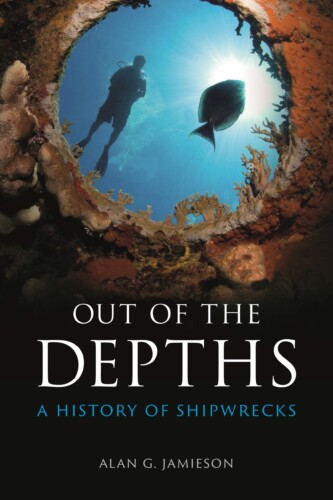
From the Titanic to the Gloucester, what do shipwrecks teach us about our history and our future? In this blog, Alan G. Jamieson discusses the most crucial finds in shipwreck history, and expands on his book, Out of the Depths: A History of Shipwrecks, out now.
***
In choosing which lost vessels to include in a book about shipwrecks one is necessarily drawn to the most famous, such as the Titanic. However, other, less well known wrecks can be important even though they do not make it into the book. One such is the loss of the El Faro in 2015, one of the first wrecks from which a voyage data recorder (VDR), the maritime equivalent of an aircraft’s black box, was recovered.
.jpg)
This 40-year old American roll on/roll off cargo ship sailed regularly between Jacksonville, Florida, and San Juan, Puerto Rico. At the end of September 2015 it left Jacksonville and headed south, only to run into Hurricane Joaquin east of the Bahamas. The ship was overwhelmed by the storm on 1st October and sank with the loss of all 33 people on board. The US Navy was tasked with finding the wreck, which they did at the end of October. The wreck lay 15,000 feet (4,600 metres) down, sitting upright on the seabed. Unfortunately the bridge area, including the mast above it which contained the VDR, had broken off and proved difficult to find. It was not discovered until April 2016 and the VDR was only retrieved in the following August. The VDR had recorded all conversations on the bridge in the last 26 hours of the ship’s life and the transcript of those conversations ran to 500 pages.
It seemed Captain Davidson believed that the hurricane would veer north before reaching the Bahamas and he could slip past it and reach Puerto Rico. Some of the ship’s officers disagreed, but they were unwilling to challenge the captain’s decision. In fact the hurricane only moved north after striking the Bahamas, so Davidson was taking his ship right into the centre of the storm. His gamble led to disaster.
It seems the hunt for shipwrecks is never-ending, and since the book was completed and went to the printer, there have been a number of significant developments. In the book the USS Johnston is given as the world’s deepest wreck at 21,180 feet (6,460 metres), but in June 2022 the team led by Victor Vescovo (who had found the Johnston) announced the discovery of the wreck of the USS Samuel B. Roberts at a depth of 22,621 feet (6,895 metres). (In comparison the wreck of the Titanic lies at 12,500 feet (3,800 metres).) Like the Johnston, the Roberts was sunk in the battle off Samar in the Philippines in 1944. Vescovo intends to continue looking for the other two American warships lost in that battle – the escort carrier USS Gambier Bay and destroyer USS Hoel – so the position of the Roberts as the world’s deepest wreck may yet be challenged.

Also in June 2022 it was announced that the wreck of the warship Gloucester, lost in 1682, had been found off Great Yarmouth, England. Divers actually found it in 2007, but it took some time to positively identify the wreck and some degree of secrecy was needed because the wreck lies in international waters 28 miles east of Yarmouth. In May 1682 the 60-gun Gloucester was carrying James, Duke of York (later King James II), from Portsmouth to Edinburgh when it struck a sandbank off Yarmouth during a gale. The ship was holed and began to sink, but James refused to believe it would be lost. Protocol meant that nobody could leave the ship while a member of the royal family was still on board. James only left at the last moment, so that between 120 and 250 people lost their lives when the ship sank. Many items have already been brought up from the Gloucester and it is being described by some as the most important shipwreck found off the coast of Britain since the Mary Rose.
In August 2022 it was announced that British divers had found the wreck of the American destroyer USS Jacob Jones 40 miles west of the Isles of Scilly and had recovered a number of items, including the ship’s bell. The Jones had been sailing from Brest, France, to Queenstown (now Cobh), Ireland, in December 1917 when it was torpedoed and sunk by the German submarine U-53, with 66 sailors losing their lives. The Jones was the first American destroyer to be lost in combat and lies at a depth of 377 feet (115 metres).
Recently the government of the Bahamas permitted another expedition (the third since the ship was found in the early 1970s) to excavate the Maravillas, a Spanish galleon lost in 1656. It is a measure of how much treasure these ships contained that the new expedition has found many valuable items. The government of Colombia has released further images of the wreck of the Spanish treasure ship San José off Cartagena and for the first time these include large numbers of coins. Nevertheless, when the excavation of this alleged billion-dollar wreck will begin is still unclear.
– Alan G. Jamieson
Alan G. Jamieson is a researcher and writer based in Alberta, Canada. His books include the novel Crossroads of the Years (2008) and Lords of the Sea: A History of the Barbary Corsairs (Reaktion, 2012).
To discover more hidden depths about shipwrecks, grab a copy of Out of the Depths from the online store now.