Restoring Women’s Fairy-Tale Legacies
29th September, 2023

When people think of fairy tales, Charles Perrault, the Brothers Grimm, Hans Christian Andersen, and Walt Disney immediately come to mind. But, as Anne E. Duggan makes distinctly clear, women writers and storytellers, and especially Marie-Catherine d’Aulnoy, impacted the shape of classic fairy tales through the present day.
***
In many fairy-tale anthologies and books about fairy tales, stories like Charles Perrault’s ‘Cinderella’ or the Grimm Brothers’ ‘Rapunzel’ are often described as being ‘timeless’. Such ‘conventional wisdom’ presupposes that these tales were popular for centuries. It also foregrounds the role that male writers and editors played in the development of what we consider today as ‘classic’ or ‘canonical’ fairy tales. Because of this perception of the genre, feminists have contested the patriarchal plot of ‘our’ classic fairy tales, filled with damsels in distress.
But there is another tale that needs to be told, one about the women authors and oral storytellers who produced fairy tales through which they in fact contested patriarchy and empowered their heroines, and they did so as early as the seventeenth century. This other tale about tales reveals a different fairy-tale canon that existed in Italy, France, Germany, and Great Britain throughout the seventeenth, eighteenth, and nineteenth centuries, one largely shaped by women, with many a plucky heroine.
One staple of the fairy-tale canon throughout this pre-Disney period includes the fairy tales of Marie-Catherine d’Aulnoy (1651-1705), contemporary of Perrault, whose tales were at different times and places in fact more popular than those of her male counterpart. D’Aulnoy and other women writers like Charlotte Rose Caumont de la Force (1654-1724), Marie-Jeanne L’Héritier (1664-1734), and Henriette-Julie de Murat (1668-1716) penned tales that questioned arranged marriage as well as the absolute monarchy of Louis XIV, and which legitimated female agency in both the public and private spheres. They contributed to what we now consider the ‘classic’ fairy-tale tradition: without them there would be no ‘Beauty and the Beast’, no ‘Rapunzel’. They also produced tales like d’Aulnoy’s ‘Finette-Cinders’, a version of ‘Cinderella’ that challenged Perrault’s passive heroine and which remained popular for centuries, or tales with swashbuckling heroines like L’Héritier’s ‘Marmoisan’, which emerged amongst several other maiden warrior tales in the 1690s, whose cross-dressed heroines save princes and kingdoms, showing that pre-Disney fairy-tale heroines were a far cry from the stereotypical damsel in distress.
When this group of French women aristocrats began to receive critical attention in the 1980s and 1990s, the idea that their works enjoyed a lively legacy was not dwelled upon, even though d’Aulnoy was the most translated French author—male or female—in England from 1700 to 1740. When I began to trace this legacy, I realized that ‘our’ notion of fairy-tale canons, what we consider to be a ‘classic’ tale, is indeed far from ‘timeless’. What struck me in particular was a moment documented by writer Jennifer Schacker in her book Staging Fairyland (2018) where she cites newspaper coverage of a fancy-dress ball in Victorian England at the Marlborough House. While couples came attired as characters from tales familiar to us today like ‘Beauty and the Beast’ and ‘Cinderella’, several took inspiration from tales by d’Aulnoy such as ‘Princess Fair Star and the Prince Cheri’, ‘The White Cat’ (White Cat and the Prince), and ‘Beauty with the Golden Locks’ (accompanied by Avenant). Such characters were clearly common currency in Victorian England, meaning that the Victorian fairy-tale canon is not that of the twentieth- or twenty-first century, and d’Aulnoy’s tales figured prominently within it. And what is true for Victorian England is also true for nineteenth-century Germany and France, as The Lost Princess reveals.
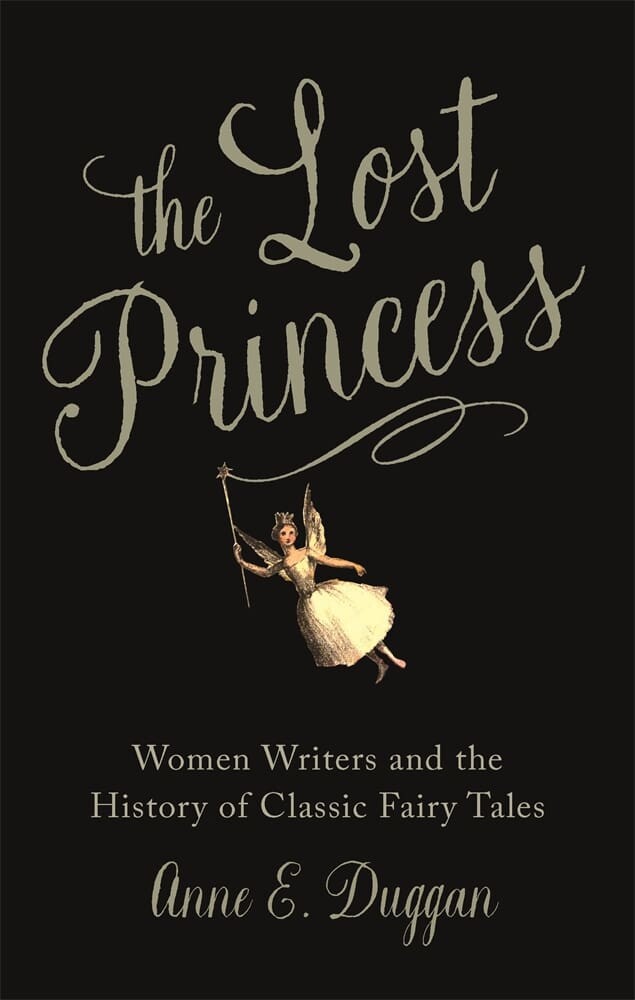
The Lost Princess attempts to follow the threads, the ashes, the paths that d’Aulnoy’s and other women’s tales took, often moving from Paris to rural France, from France to German-speaking and Czech lands, from the French salon to the British nursery and London stage to a Mexican comic book. Traces of d’Aulnoy’s tales can be found in the works of Honoré de Balzac and Gustave Flaubert, even in the music of Maurice Ravel. They found new form in the hands of the Grimms’ female oral sources, including Jeannette Hassenpflug and Ludowine von Haxthausen, who adapted d’Aulnoy’s courtly tales to their nineteenth-century German context. Particularly evident in the popularity of d’Aulnoy’s tales on the London stage, d’Aulnoy indeed was the Walt Disney of the nineteenth century, a legacy that has yet to be fully taken into account. The Lost Princess seeks to restore the voices of these female writers and storytellers, who shaped and contributed to fairy-tale canons, both past and present.
– Anne E. Duggan
Anne E. Duggan is Professor of French and Fairy-Tale Studies at Wayne State University, Michigan. She is the author, editor or translator of many books, including A Cultural History of Fairy Tales (2021).
You can buy The Lost Princess from our online shop now.