Pity the common cuckoo
9th October, 2024
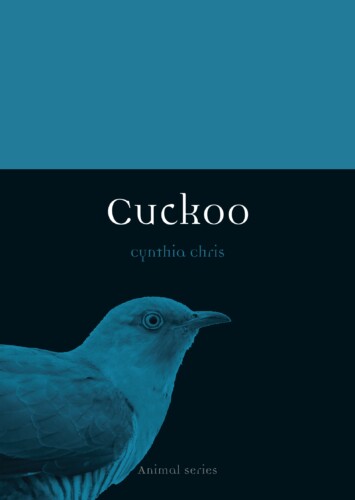
In this blog, author Cynthia Chris ponders the unfortunate reputation of the humble cuckoo.
***
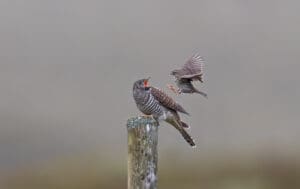
Pity the common cuckoo (Cuculus canorus), onto whom humans project some of our most elaborate fantasies. The cuckoo’s annual arrival in the United Kingdom and Northern Europe has long been regarded as a benevolent harbinger of springtime. Its timing is so renown that when 18th century Black Forest clockmakers began to build birds into their creations, they chose the cuckoo. (It didn’t hurt that the male’s two-note song was easier to reproduce mechanically than the voices of crowing cocks or calling quails.) On boxes of a General Mills product known as Coco Puffs, Sonny the cuckoo grins maniacally. He doesn’t look much like a common cuckoo, what with his orange coloring and a beak worthy of a toucan. But he certainly acts cuckoo, if we use the word to mean silly, or a bit mad. In adverts that feature Sonny, he goes to ridiculous lengths to get a taste of his favorite food: his exuberance tilts toward inanity.
If the cuckoo’s reputation is partly one of harmless, hopeful daffiness, the flipside unsettles otherwise dispassionate observers of nature. Charles Darwin impugned their reproductive behaviors as ‘strange and odious’.[i] Science journalist Ed Yong once called cuckoos ‘murderous slackers’.[ii] Bethan Rogers, author of Nightingale in Reaktion’s Animal series, struck a more ambivalent stance upon hearing a cuckoo call in spring: ‘Exciting until you remember what bastards they are’.[iii] Clearly, the cuckoo has been made to do hard work on the symbolic level, occupying an odd mix of disparate roles in our very human imaginary.
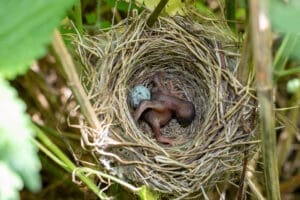
The cuckoo’s bad rap follows from our reflexive sneer at obligate brood parasitism. The male plays no role in family life other than a fertilizing tryst, inspiring the derivative term ‘cuckold’—but that’s another story.[iv] The female lays her eggs in nests built by birds of other, smaller species, such as the reed warbler. Upon hatching, the cuckoo rids itself of competition by pushing the hosts’ own offspring out of the nest. Nevertheless, the hosts act as devoted parents to the cuckoo nestling, responding to its incessant demand to be fed. There may be many other animal species who do not engage in parental care, but none seems to bother us humans half as much as the common cuckoo.
The horror film Vivarium (2019), directed by Lorcan Finnegan, puts the maligned bird in its very first scenes. In tight close-ups, a cuckoo hatchling forces an egg and a smaller hatching out of its host’s nest. The fast-growing cuckoo shrieks and looms over its foster parent. When a schoolchild finds baby birds—the offspring of the host, expelled by the cuckoo—dead on the ground, her teacher Gemma (Imogen Poots), calmly explains, ‘that’s nature, that’s just the way things are’. One can imagine that her rational response might change after she and her boyfriend (Jesse Eisenberg) find themselves trapped in a bizarre, unpopulated housing development by a mysterious estate agent. The stakes are raised when suddenly an infant appears. The boy is screeching, voracious, and inscrutable—an unwanted, fast-growing child foisted onto surrogate parents who find themselves unable to resist his demands. Although the bird itself never re-appears after the early synechdochical scenes, Vivarium spins brood parasitism into a trauma likely not shared by the meadow pipit or dunnock or warbler.
Cuckoo (2024) leaves the actual bird out of the picture but one-ups Vivarium in its infliction of brood parasitism on humans. The protagonist, Gretchen (Hunter Schafer), a teenager grieving her mother’s death, joins her father, stepmother, and young half-sister at a resort in the Bavarian Alps, where she discovers that women are forcibly impregnated by a hooded, slime-carrying woman, as a female cuckoo might lay her egg in another bird’s nest without its knowledge. The result is a new species, Homo cuculidae. The film’s writer and director Tilman Singer acknowledges that the film was inspired by what he knew of the cuckoo’s behaviour: ‘there was something beautiful in the horror … that’s a family story about to happen’.[v] The cuckoo thinks nothing of the kind. Instead, she lays again, and then heads south to wintering grounds in Central Africa, unaware of the drama that we create in her wake.
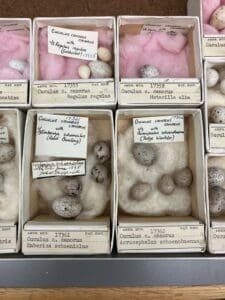
Claude Levi-Strauss declared animals ‘good to think’ or ‘good to think with” (quibbles over the translation being what they are), but we have a very difficult time thinking of animals without putting ourselves first. Our ideals and our fears work hand in hand to map our own stories onto the other animals with whom we share a world. In the case of the cuckoo, it’s hard to watch some of its recent deployments in popular culture, these animal horrors, their unwanted pregnancies, fraught surrogacies, violence (psychological and otherwise), without recalling that these films are being released into contexts—at least in the United States—where long-established reproductive rights have been undermined and reproductive technologies, such as in vitro fertilization, are threatened in right-wing political rhetorical and court rulings, amd where social ties other than the cis-gendered, heteronormative, monogamous nuclear family are said to ‘go against nature’. But nature doesn’t have time for our legal battles and discursive clashes. Nature has found not one way, but an almost unimaginably diverse number of ways to eke out a living on this fragile planet. Just ask the cuckoo.
***
[i] Charles Darwin, The Origin of the Species [1859] (London: 2013), p. 255.
[ii] Ed Yong, ‘Cuckoos mimic hawks to fool small birds’, Discover 7 May 2008, https://www.discovermagazine.com.
[iii] Rogers, Bethan [@lloydbethanr]. ‘First cuckoo. Exciting until you remember that bastards they are’. Twitter, 28 April 2023, https://twitter.com/lloydbethanr/status/1651837479102689285.
[iv] That story is told in Chapter 2, ‘Dear Cuckold’, of Cuckoo (Reaktion, 2024) by the author.
[v] Jack Dunn, ‘“Cuckoo” Director Tilman Singer on Creating the Hooded Woman and Why Mystery and Horror are the Perfect Pair: “It’s Like Vanilla and Chocolate Ice Cream”,’ Variety, 10 August 2024, https://variety.com.
– Cynthia Chris
Cynthia Chris is Professor in the Department of Media Culture at the College of Staten Island, City University of New York. Her previous books include Watching Wildlife (2006), The Indecent Screen: Regulating Television in the Twenty-First Century (2018) and Crab (‘Animal’ series, Reaktion Books, 2021).
You can buy Cuckoo now from our online shop.