Our Extinct Animal Kin
17th June, 2025

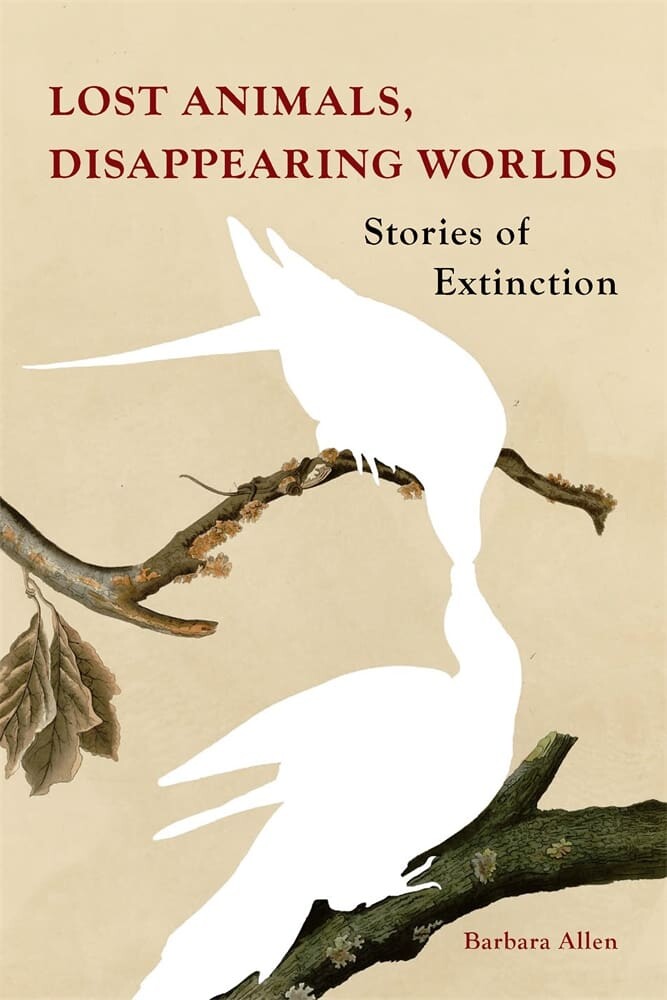
Barbara Allen has written a book about extinct animals (Lost Animals, Disappearing Worlds) and in this blog, she writes about the process of coming to write the book, and how it is a love letter to all those gone before.
***
How do we narrate the lives of extinct animals? Sometimes it is hard enough telling the story of a much-loved deceased pet. If this is the case, how can we possibly eulogize the extinct, the ‘endlings’, the ones who will never again inhabit this planet?
Through the medium of words, and pictures, and in some cases, sculpture and other forms of art. It is all we have, though in some cases there are bones and skin which help us ‘re-member’, as bone and skin ‘enflesh’ a particular creature.
Stories. It is difficult to pen an animal eulogy, there is much that is imagined, or unvoiced. A representative of its species narrating its demise. The last of a species is known as an ‘endling’. In this book each speaks of its ending, the farewelling of its species.
As I chose the creatures, knowing I could not tell the tale of each and every one of our extinct animal brethren, it was interesting to note the similarities concerning their endings. We may utter ‘habitat destruction’ or ‘hunting/predation’ but then to apply these reasons to a solitary being whilst narrating its history, its beginning and then its ending, makes one consider the individual, rather than the collective. Did it have a family? Had it watched them be destroyed? What had happened to this one?
Lost Animals, Disappearing Worlds are love letters to the extinct, not only for the ones that appear on the page, but for all extinct creatures. They are also eulogies. Eulogies are delivered at funerals and at Thanksgiving services. As a member of the clergy, I have had the privilege of writing and delivering several hundred eulogies (two of my ministry placements were in aged care. Each week I conducted a number of funerals). A eulogy is often a brief overview of the decreased one’s life. You are unable to include everything about a person, but a good eulogy tries to capture the essence of that person, highlights his/her uniqueness, raises and then tries to answer questions such as: what did he/she contribute to society, what made him/her tick? What were his/her qualities? What will we miss? Eulogies are not only love letters; they are also photos. They bring to the fore something about that person, or creature. Not everything is in focus, or fits into the frame: there is much that is hidden, hazy, undeveloped, or over-exposed.
Another ministry placement has been as chaplain at an animal hospital. During my time there I held an annual memorial service, and conducted several private services. I too wrote eulogies, listening to grieving owners awash with tears as they told me what they had loved about their pets.
When I set out to write the stories of 31 extinct creatures, I applied the same criteria. What made that animal/bird/insect unique? How did it fit into the fabric of the landscape? What was its purpose? Finally, how and why did it become extinct? Through words, that creature was given a voice which, in some cases, travelled back several hundred years. It was a snap shot, a single photo, containing substance, essence, soul, and story. Sadly, a snapshot, a story, or a eulogy, cannot include everything, things have been left out, or remain hidden, unknown. Mystery.
It was a privilege, indeed, sacred work, to try to enter the world of the extinct creature and tell something of its story, to capture its core, its spirit. It was a balancing act, trying not to fall into the murky pool of anthropomorphism, but risking it because these were important stories to tell. So much grief, including a new type of grief or, if not new, recently aired: that of ecological grief.
Funny. As a child, I thought the dodo was a fictional creature, created by Lewis Carroll for his Alice in Wonderland. If only that had been the case.
I shed many tears while writing this book. These extinctions should not have happened; they were due to human intervention, mainly through deliberate killing, or from the destruction of habitat.
Habitat destruction as a means of extinction. Does altering a landscape, even a few acres, really make a difference? It did for the magnificently coloured Xerces butterfly, thought to be the first American butterfly to become extinct as a loss of habitat caused by urban development. The Dusky Seaside Sparrow became a fatality due to a road built between the ‘happiest place on earth’ (Walt Disney World) and the Kennedy Space Center. This bird had the most restricted habitat of any North American bird. Then there was the Ivory-billed Woodpecker, also known as the ‘Lord God’ bird (seeing its long beak and rich colouring produced this utterance from many viewers). Its habitat disappeared when the old growth forests where it congregated and nested were logged.
Then there is climate change, with the Bramble Cay melomys being the first mammalian species made extinct due to the effects of human-induced climate change. Rising waters destroyed its habitat. Water was home for the baiji dolphin (or the Yangtze River dolphin) in China. Once revered as a river goddess, the baiji dolphin was the first documented global extinction of a cetacean in recent history. Pollution of the water, its habitat, was the main culprit. Its role as a river goddess did not save it, (reverence accorded to the Japanese wolf, once seen as a guardian, did not save it either). Climate change altered the amount of rainfall needed for the Golden Toad for its survival, and the increase of ultraviolet light interfered with the production of healthy toad embryos.
Some of the stories remind us of the fragile web of inter dependency. The Rocky Mountain Locust’s extinction had a role to play in that of the Eskimo Curlew, because when their migratory path took them across the prairies, the Rocky Mountain Locust had been one of their primary food sources.
I weep when considering the Pyrenean Ibex’s fame, which became a doubled-edged sword. The Pyrenean Ibex was the first taxon to become ‘de-extinct’ due to the science of cloning, but this honour was short-lived. This poor creature has the distinction of having become extinct-twice.
I hope this book will ‘enflesh’ these creatures for the reader. As we ‘re-member’ them, reading and imagining their individual stories, resurrecting them in our minds by knowledge of their histories, they may continue to live on in our consciences, prompting us to work to conserve endangered species, holding extinction at bay. If eulogies are viewed as narrated photographs, then we do not need any more images in our photo albums.
– Barbara Allen
Barbara Allen is a minister in the Uniting Church in Australia. Her books include Pigeon (2009), Animals in Religion (2016) and Pelican (2019), all published by Reaktion Books.
You can buy Lost Animals, Disappearing Worlds: Stories of Extinction and her other books from our online shop now.