On Writing About the English Soul
17th December, 2025
In this blog, Peter Ackroyd reflects on his inspiration to write The English Soul.
***
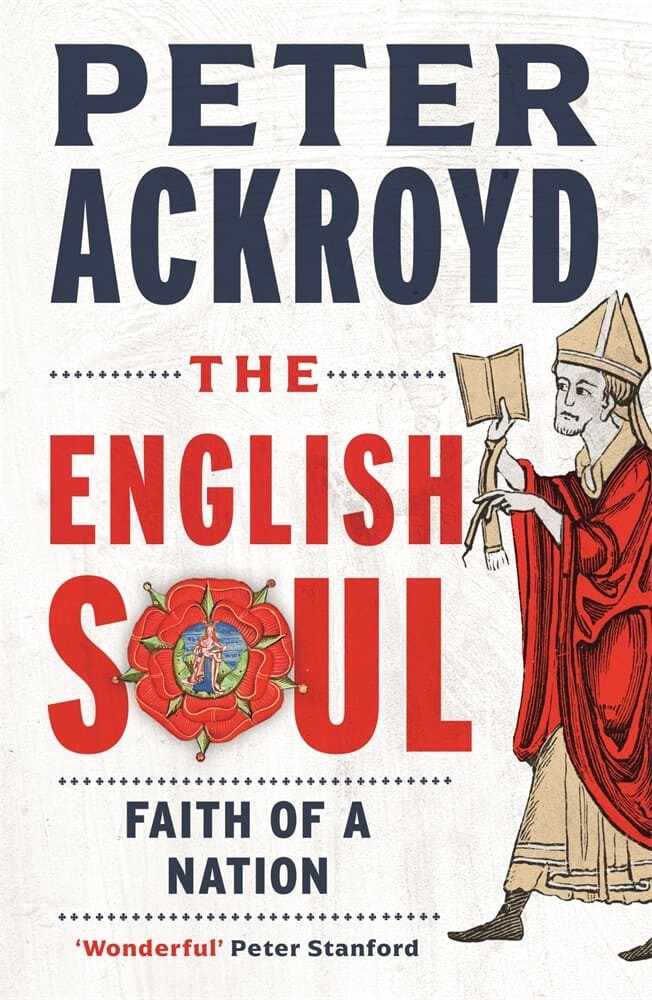
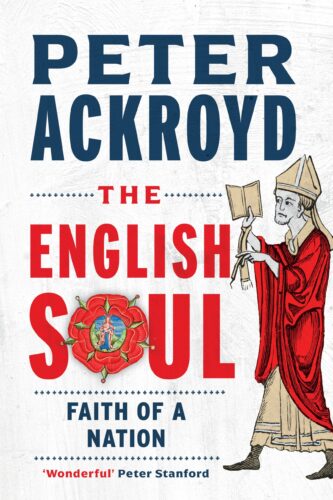
From my early years Christianity has in part created the landscape of my imagination, and so it is no accident that it pervades the both the novels and biographies I have written. Just as Christianity informed my personal history and writing, so it has determined the history of this country. As the presiding faith of England for the last 1400 years, it could be called the embodiment of the English soul. In my recent book of that title, I chart the history of English Christianity, from the conversion of the English in 597 to the exuberant and spectacular culture of medieval England, through the Henrician Reformation and religious Civil Wars of the sixteenth and seventeenth centuries (which were England’s cultural revolutions), to the fervour of its Evangelical and Pentecostal movements today. Christianity has been a motive force as well as a motif throughout English history. Popular political movements – for the abolition of slavery or nuclear disarmament – have been Christian in inspiration.
In The English Soul I extended my acquaintance with English writers who had always intrigued me, but about whom I had never written at length. Ever since I encountered his work at school, the Venerable Bede (c.672-735) has been pre-eminent. The quality and range of his many books on grammar, music, astronomy, theology, are remarkable. In his lifetime, the Northumbrian monk was known to be the greatest scholar in Christendom; he is now widely and justly regarded as the father of English history writing. William Tyndale (c.1494 – 1536), is another exemplar. He is one of the fathers of modern English, together with Chaucer and Shakespeare. His vivid and vigorous translation of the Bible became the cornerstone of King James Version of 1608, a book that went on to influence (for ill as much as good) many generations. Phrases Tyndale coined – “the powers that be”, “the salt of the earth” – still prompt (as well as express) the thoughts and feelings of English speakers; his striking rhythms echo throughout English literature, in the works of Bunyan and Johnson, Byron and Lawrence, Woolf and Wilfred Owen.
Most of all, I relished researching and writing about the female religious writers who have made valuable contributions to English culture. Before embarking on the project, I was familiar with Julian of Norwich (c. 1343 – 1416) and Margery Kempe (c. 1373 – 1438) – the former, the first named female author to write in English, the latter, the writer of the first English autobiography. On the other hand, I knew little about the formidable Catherine Booth, known as the ‘Mother of The Salvation Army’, or the indomitable Annie Besant, a socialist and feminist who turned, with equal ardour and conviction, from Christianity to atheism, and then from atheism to occultism. In The English Soul wanted to introduce contemporary readers to these significant female figures, who have been unjustly neglected in some standard accounts of English Christianity.
Christian observance is declining in England. And yet Christianity lives on in the English language and informs the culture, emotions and ideas of those who speak it. As a result the history of English Christianity is a subject of no mere antiquarian interest, but one of vast contemporary relevance and resonance. As the Anglican poet, T.S. Eliot, remarked in another context, the tradition is not dead, but ‘already living’.
– Peter Ackroyd
Peter Ackroyd is one of Britain’s most respected historians and novelists. His many books include London: The Biography, Hawksmoor and the bestselling History of England series. He is also the author of The English Actor, a fascinating study of the English actor from medieval times to the modern day, also published by Reaktion.
You can buy The English Soul: Faith of a Nation from our online shop now.