On the History of the Gypsy
1st June, 2023
All it took was a look through some Georgian newspapers to inspire Jeremy Harte to write his new book, Travellers Through Time: A Gypsy History. In this blog, Jeremy talks about his research and discoveries as he wrote the book.
***
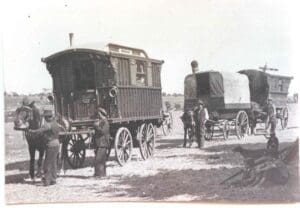
Trawling through Georgian newspapers, I came across ‘a Person who lately kept a Public-House on Norwood-Hill, and goes by the Name of the Secretary to the Gypsies’. In library silence I lifted a phantom glass to my predecessor of 1769. A secretary listens to the words of another and puts them down in the page in a clear and orderly way. Like my Norwood predecessor I am a non-Gypsy, a gorjer (also gaujo, gāje, gorgia – it’s a word from an oral language, and to be honest, not a very polite one). Since I’d spent a lot of time listening to Gypsies, the idea got around that I ought to write what I knew. Gorjers have used their skills to make fiddles, kettle-irons, even living-waggons for Gypsies: why shouldn’t this one do what he was good at and make a book? And so Travellers through Time was born.
It wasn’t so easy, of course. English Gypsy history goes back to 1515, but for most of that time it has been mediated through the voices of others: not, as a rule, sympathetic others. A keeper from Wimbledon Common, interviewed by the Parliamentary committee of 1865, was asked what he did with Gypsies who weren’t a problem. The question floored him: ‘It is generally supposed to be the normal state of a gipsy to make a nuisance of himself’. There was nothing unusual about that response, except its honesty. From the days of Henry VIII to the Criminal Justice Bill, administrators have been tasked with solving the Gypsy problem, so they saw only problems when they looked at Gypsies.
Sources were plentiful for anyone to write a history of what I came to think of as the Gypsy Nuisance. Committees had been formed to tackle it, people spent their lives demanding that Parliament deal with it. There are rich pickings here for historians, who can write chapter after chapter on vocal activists like George Smith of Coalbrook or Reginald Bray of Shere. But the Nuisance was a perception, not a people.
I wanted to do better than that: wanted to write, not on laws and policies, but about what it had been like to be a Gypsy, from the 1510s to the present day. So I set myself three rules. The first was that Gypsies would be the subject of every statement: this was a book about what the community said and did and experienced, not what others thought about them. The second was that when gorjers featured in the book, they would appear as they did to Gypsies, a largely faceless menace or resource. Only those personally known to Gypsies (Charles Leland, Alfred Munnings, Tony Boxall) would earn the right to a name. And the third was that all individuals would be on a level. Gypsies appeared by first name, naturally – in a book with 55 individual Coopers and 53 Smiths, there was no other way. Very well: then Captain Mowbray Lees Sant, Surrey Chief Constable, would be Mowbray.

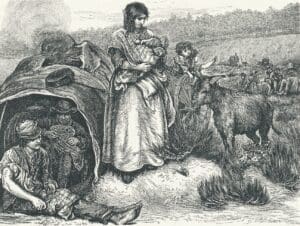
The book is framed around Surrey, where I know the people, and the territory. My local focus left me delving into sources of all kinds – poetry, diaries, exhibition catalogues, school logbooks. Always the same wearisome task of inverting my sources so that Gypsy was subject, not object: it was like turning a sock inside out, again and again. And as I did this, I realised how little the gorjers understood of the Gypsy values and ambitions which played out before them. The girl who gave birth under a woodyard was not a Noble Savage indifferent to pain: she was young, frightened but determined not to bring pollution onto the family’s living-space. The man who threw down golden sovereigns for his fine was not drawing on secret wealth: he was bankrupting himself to keep face before his mates and scorn the common enemy. The family who packed and left when spun a ghost story about their stopping-place may not have been superstitious at all: they were looking for an honourable excuse to move on from confrontation.
Every fragment of agency and identity that I could wrest from my sources was a little triumph. Family tradition enabled me to put names to the subjects of those blandly titled art-gallery pictures – Gypsy Life, The Gyppos. I wanted to immerse the reader in a world where family was also job and home and frequently law, so everyone from the past was introduced as they would be today, with their grandmother the sister-in-law of someone else’s great-aunt. It helped that I was the real-life Secretary of the Romany and Traveller Family History Society, a body committed to these genealogical links. Tracing the seamless web of Gypsy identity from the people I knew back through pedlars’ certificates and settlement examinations took me to the seventeenth century, within memory of the Arrival. These hard-won facts disproved the anthropological canard that English Gypsies are a constructed community, not part of the global Romani diaspora, as well as the smug householder’s notion that Travellers stopping on the local green are nothing to do with ‘real’ (and conveniently vanished) hedgehog-and-crystal-ball Gypsies.
Reliving the past through individual lives is what story-tellers do, and I was writing as the servant, the agent and sometimes the voice of an oral culture. Of course there’s more to my history than that – demography, linguistics, economics – but story always came first. I wrote as if standing in a barn at one of the open days of the Surrey Gypsy Forum, after the step-dancer and before the Gospel singer, with a front row of Lees and Smiths who nod whenever I mention dogs and horses and smile to hear a bit of familiar Romani language. Yes, there are gorjers here too, but the book speaks to them precisely because it is not of them. I did not come to explain or exculpate or celebrate Gypsies but simply to lay down between two covers five centuries of Romany history as experienced from the inside.
If a young Gypsy picks up the book and thinks ‘The dinilo! He did his best, for a gorjer, and some of it’s not far wrong, but I could make a much better job’… then all my efforts will be justified.
– Jeremy Harte
Jeremy Harte is curator of the Bourne Hall Museum at Epsom and Ewell. He is secretary of the Romany and Traveller Family History Society and created the Surrey Gypsy Archive. He is the author of Cloven Country: The Devil and the English Landscape (Reaktion, 2022).
You can buy Travellers Through Time: A Gypsy History through our online shop now.