On Playgrounds
18th October, 2024
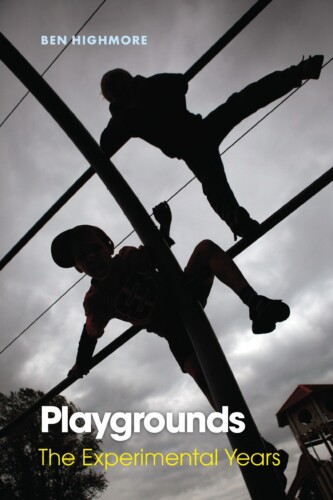
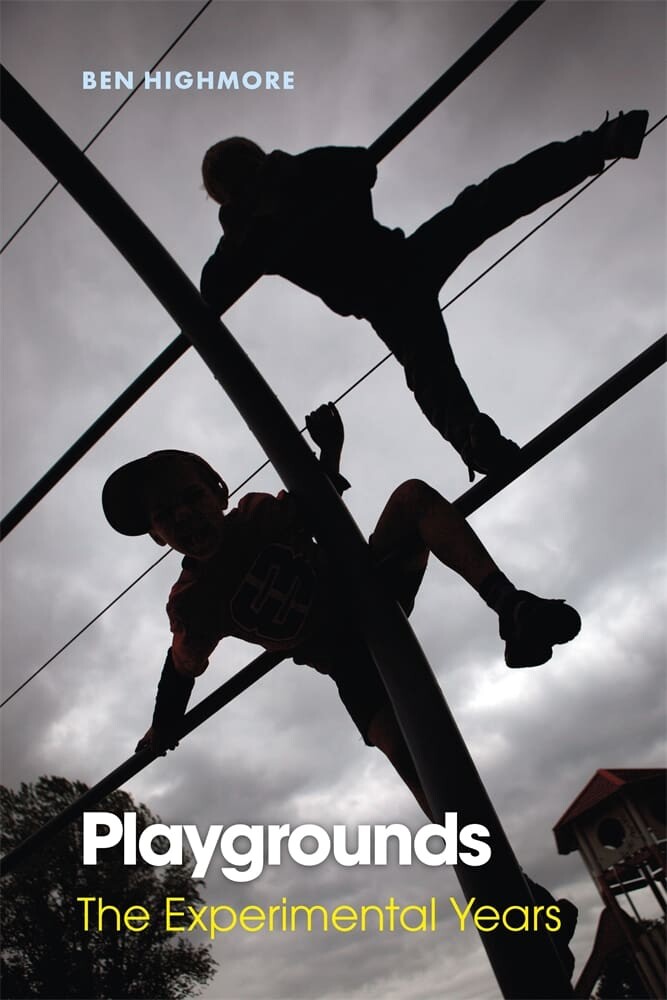
In this blog, author Ben Highmore reflects on his inspiration behind his new book, Playgrounds: The Experimental Years…
***
Books often have long gestation periods and sometimes it is hard to remember precisely when an idea or theme first formed. In the case of my book on Playgrounds I know exactly when the idea came to me: July 2017 while visiting an exhibition called the ‘Brutalist Playground’ by the artist Simon Terrill and the architectural collective Assemble. They had remade in pink and blue foam, playgrounds that had originally been cast out of grey concrete in the 1960s as part of postwar housing estates such as Churchill Gardens in Pimlico, London. The original playgrounds were imaginative and not the usual ‘swings, slide, and sandpit’ affair that populate most villages, towns and cities in Britain. Rendered in concrete they looked totally unforgiving on knees and shins, let alone on heads.
While writing the book, I was amazed by how much material there was on the topic and at the strength of feeling about what made good playgrounds. I was also intrigued by playgrounds that I had never known about, and which have since become obsolete. One such type was the traffic playground, where children rode their bikes or drove hired toy cars on a shrunken version of a road system, with small traffic lights, roundabouts, zebra crossings and all the usual road signage. Kids could pretend to fill up their vehicles with pretend petrol at the pretend petrol pumps. It looked a bit like a training ground for a future dominated by private car ownership – which I guess it was.
While much of the book is focused on Anglophone culture (UK, Canada, and USA), I did manage to include some playgrounds from northern Europe, countries such as Switzerland, Sweden, the Netherlands, and Germany. Switzerland, for instance, built these amazing Robinson Crusoe playgrounds in the 1950s. They were vast and had facilities for adults as well as children. The Netherlands allowed me to write about the extraordinary Aldo van Eyck who designed and built more the seven hundred playgrounds in Amsterdam between 1947-1978.
At the centre of the book is the heroic tale of the adventure playground. These were and still are supervised playgrounds which encourage children and young people to undertake self-directed play. They are places of permissibility: if you just want to chat with your friends or read a book that is fine, but if you want to build an elaborate den or put on a play then that would be great too. The urbanist Colin Ward (author of the book The Child in the City and the companion volume The Child in the Country) saw adventure playgrounds as a parable of anarchism. By that he meant that they were the opposite of an authoritarian society and allowed children to become autonomous citizens. His unsentimental view of childhood and youth, and his insistence that all generations should live side-by-side, in ways that allow everyone to feel involved in producing society, is just the sort of view that is needed today.
By the end of the book, I felt that the adventure playground wasn’t just one type of playground amongst others. What I fell in love with wasn’t the self-built constructions or the precarious zip wires. That was never really my scene, even though I did like building go-karts out of prams as a kid. What I was attracted to was the ambitious social ethos of the adventure playground. Emerging out of the ruins of World War Two it saw its task as a form of reparation. It would help heal a ruined world. And it would do so in a way that would inure a new generation against the lure of fascism. It would be by creating the conditions where children could become involved citizens who had the confidence to question authority that a better world would be possible.
A reparative ethos seems so much more ambitious than endless talk about developmental needs and safety regulations – though there is no reason why these would be mutually exclusive. As people are saying today, let’s make playgrounds as safe as necessary rather than as safe as possible. But let’s also make them as socially ambitious as possible. This might involve risks: singing a song in front of others, climbing to the top of a tower, writing a story. We don’t know what we are capable of if we aren’t allowed and encouraged to take risks.
– Ben Highmore
Ben Highmore is Professor of Cultural Studies at the University of Sussex. He is the author of The Art of Brutalism: Rescuing Hope from Catastrophe in 1950s Britain (2017) and Lifestyle Revolution: How Taste Changed Class in Late 20th-Century Britain (2023).
You can buy Playgrounds from our online shop now.