On Hope
28th August, 2024

In this blog, esteemed philosopher Lars Svendsen, discusses hope, and what it means to us all.
***
To hope is not just to wait, to see what happens, but to be drawn towards the future. Hope must be linked to an outcome that is neither certain nor impossible. The difference between hope and wishful thinking is that I don’t have to deal with any realities as long as I’m in the domain of wishful thinking.
Hope always contains an insight into the limitations of our agency. If we can easily achieve what we want, there is no room for hope. Hope implies awareness that our aims will not necessarily be realized no matter how much effort we put into it. We are limited beings, and in hope we attempt to deal with these limitations. Hope gives us a direction, an experience of a certain measure of control because it gives the future a structure.
A standard argument against hope is that if you don’t hope, you won’t be disappointed if things don’t go well while you can still get full satisfaction if things do go well. By not hoping, you remove the risk of disappointment. This argument is based on the assumption that the probability of achieving something is not affected by whether one hopes for it. It is a dubious assumption because it regards hope as detached from our life of agency, and in many cases a hope for something will promote actions that increase the likelihood of its achievement.
Hope will have reasons. It can be more or less justified. Those who hope can be so out of touch with reality that hope becomes little more than wishful thinking or escapism. Hoping well requires a realistic understanding of the probability that what you wish for can come true. There is a danger of self-deception. Hoping will easily lead us to overestimate the likelihood of a good outcome due to our confirmation bias. In hope, our attention is directed towards the desired outcome, and this leads to a tendency to emphasize everything that speaks for such an outcome and disregard what indicates a bad outcome. Hope can degenerate to wishful thinking, where I do not take sufficient account of the real limitations that the world places on my wishes.
Hope can passivate you by focusing your gaze so clearly on the future that you overlook the present and therefore also what can and should be done right now to improve the situation. Hope can lead one to remain in conditions that should be left behind, such as a woman remaining in a relationship with a violent man based on the hope that he will improve, as he has promised time and time again, instead of realizing that she must leave him. Hope can take attention away from what should be done here and now in favor of a distant goal. If the kitchen is on fire now, your hope of one day succeeding in developing a new type of fire extinguisher is worthless.
Such hope obliges, and it motivates us to make sacrifices now for the sake of future benefits. If you really hope, it will create a framework for your life of action, for what you feel you should or must do, and what you should not do. To hope well, however, you must also have an understanding of what you can do at all, of what is possible.
In hope lies a humility, an acknowledgment that much of what is of importance to us in life is beyond our control. We can do our best, and hope. Justice does not always prevail, and truth does not always overcome lies. Even if we do our best, we will not always succeed. To believe otherwise is to indulge in self-deception. The fact that things do not always go as we wish is of course no argument against doing our utmost. Truth and justice are for us to realize, not just something that is given to us or denied to us. They are tasks for us, and we must hope to succeed in realizing them, knowing that we will often fail.
Hope can make it easier to deal with life’s trials because it gives your gaze a place where you can place these trials within a larger context. You are not as at the mercy of the pain you feel here and now. Hope is not a mental state that magically changes the world, but hope makes you inclined to take action to make it come true. Hope, by definition, gives you no guarantees, but without hope, as you know, everything is hopeless.
– Lars Svendsen
Lars Svendsen is Professor of Philosophy at the University of Bergen, Norway. He has written 14 books, including A Philosophy of Fear (2008), A Philosophy of Loneliness (2017) and A Philosophy of Lying (2022), all published by Reaktion Books.
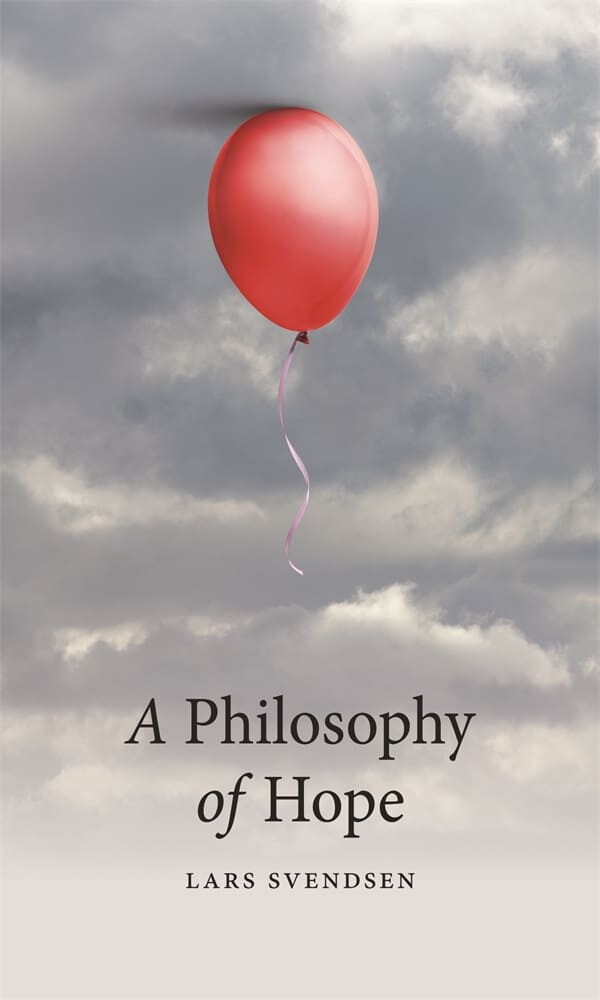
You can buy A Philosophy of Hope from our online shop now.