Not just for Christmas
22nd December, 2022
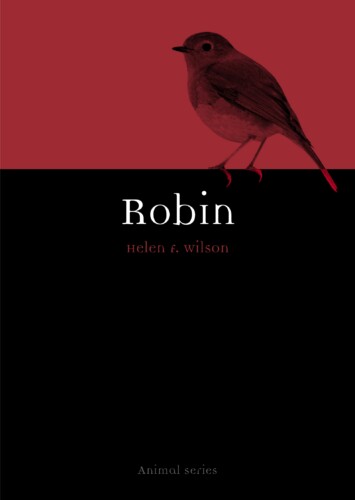
It’s Christmas-time and inevitably our favourite festive feathered friend appears. But Helen F. Wilson explains that the humble robin is not just for Christmas in this new blog piece …
***
Questions about robins inevitably surface around this time of year. What is their link with Christmas? Why did the Victorians have dead robins on their Christmas cards, and why are there so many robins around during winter?
There are multiple answers to these questions.
In Britain, robins tend to occupy a territory all year round, while an influx of robins from Scandinavia further boosts their numbers, which means that you are more likely to see and hear them. But rather than a matter of migration or behaviour, the question about the robin’s festive status will more than likely send you on a journey into the history of the British postal service and the introduction of their scarlet uniforms in the 18th Century.
That’s the thing about robins. One minute, you’re reading about the melanin pigments that give the bird its distinctive breast and the next you’re examining the art of Victorian letter writing, leafing through volumes on the Victorian Christmas, and getting lost in histories of the Christmas card. This line of inquiry leads you to the introduction of the penny black stamp, new forms of mechanisation, and the consumer culture that made Christmas cards ubiquitous. A question about the development of the robin dinner movement will send you in yet another direction.
In many ways, it’s a shame that questions about robins come around only once a year. The robin might loom large in the UK’s Christmas iconography, but it is a regular feature of Easter sermons on the continent, a detail that will point you in the direction of the robin’s Christian origin stories, its links to the blood of Christ, and a multifaceted history of the colour red that spans centuries. In fact, many cultural histories of the robin and its continued popularity seem to point back to the colour red and its ambivalent associations.
In asking about the robin’s Christmas connections, you might miss the bird’s role in scientific developments. Did you know that it was experiments involving the European Robin that established the role of the Earth’s magnetic field in bird migration, or that one of the earliest studies on bird territory focused on the robin? Did you know that there are dozens of different ‘robins’ on world bird lists or that there’s a sea sponge that takes its name?
In archives and editorial comments, a lot is said about the aggressive territorial behaviour of robins. Indeed, there’s almost a perverse delight in their seemingly contradictory character: the gardener’s friend by one account, a deadly, callous combatant by another. Of course, these moral tales say far more about us and our propensity to impose our own ideas on others than they do anything else.
It is undeniable that we see the world through our own lens. As a geographer, I was delighted to find so many geographical themes in the robin’s story: a bird central to understandings of bird migration and territorial practice, but also a bird of national significance that offers up a commentary on national values and imagined community. A purveyor of tobacco and soap powder, it was a bird that travelled with multiple British exports and became an assurance of quality. Beyond these geographical imaginations, there are also a multitude of environmental issues that the robin brings into view: illegal trapping, songbird declines, the turn to wildlife gardening, and the impact of wind turbines on bird communication, to name but a few.
There is so much to say about the robin – and much that has been said. I’m left with a variety of eclectic traces that continue to occupy my desk: a set of Christmas stamps from the Isle of Man, the three-issue mini-series The Untold Legend of the Batman, several biographies of Frances Hodgson Burnett (accounts of her Trans-Atlantic social life are absorbing), a copy of Rachel Carson’s Silent Spring and a remarkably well-preserved packet of Robin Redbreast cigarettes.
There is far more to the robin than Christmas. Behind the Christmas icon is a commentary on our relationship with the natural world, the agency of non-human animals, their impacts on society and culture, and the environmental futures that we share.
– Helen F. Wilson
Helen F. Wilson is Associate Professor of Human Geography at Durham University. She has published widely within social and cultural geography, and lives in Newcastle Upon Tyne.
To find out more about the little robin, read Robin now!