Land, Birds and History
13th September, 2021
The forest preferred in the paintings and poems of European Romantics is one that seems almost primeval yet contains reminders of past grandeur. Besides huge trees are overgrown ruins, usually of a once-imposing structure such as a church, castle or classical temple. Often that will be only a single wall or a supporting column. An artist might show the moonlight gleaming through the bare lattice of what had once been a stained-glass window.
The woods of the American Northeast fit this formula in ways. Here, disintegrating structures may be less imposing but are far more common. From a slight distance, the Eastern forests may look like an untouched wilderness, yet they are filled with reminders of times gone by such as root cellars, foundations of buildings and, above all, stone walls that once separated fields.
Just as the images by European Romantics often contain reminders of human conflict, those in America are touched by human greed. One might like to think they bear witness to a tragic struggle for survival against overwhelming odds, but that is seldom actually the case. In the sixteenth through eighteenth centuries, European colonists claimed the land as their own, driving out the Indians. Then, in the nineteenth and early twentieth centuries, they abandoned their farms to move Westward in search of greater wealth. The forest quickly reclaimed deserted farms. The state where I live, New York, is known for its big city, but it is currently about 63% forested, well over twice the rate in the late nineteenth century.
More history is written in the land than in documents and books. The printed records of my land are very few, though, in publications over 100 years old, I have uncovered a few brief references to a mill on the property in the eighteenth century, no trace of which has survived. Indian artifacts such as arrowheads have been found there, as well as shards of pottery that are impossible to date. Several stone walls wind through it, which show that it was used for farming. The remains of a milk cooler tell me that it was a pasture. This is just enough information to stimulate the imagination.
One thing that stands out in accounts of America by very early settlers is the abundance of life, so rich that it seemed miraculous. You needed only place your hand in a stream and fish would swim into it. Deer and turkey were not only plentiful but seemed to offer themselves to hunters. Flocks of birds were so numerous that a nearly random shot into the air might bring them down.
The bounty was no doubt exaggerated, perhaps out of the American love of hyperbole that still fills our advertisements. But the colorful descriptions had a basis in experience, and much of the credit for it must go how the Indians, intentionally or not, managed the forest. They would systematically start fires, clearing the undergrowth in forests and giving the landscape a park-like appearance. They would clear meadows for agriculture. After a few years, as the soil began to be exhausted, they would more on, and the area might be reforested or taken over by another group. This created a sort of patchwork of uneven-aged forests, meadows, and transitional areas, in which a vast range of animals and vegetation might thrive.
This management may go back to the start of the forest itself after the last Ice Age. The land is on part of the Atlantic Flyway, a migratory path for birds. The routes of the birds were set in part due to the practices of Native Americans over thousands of years. The migration has become far more difficult today, due to many factors including the disorientation from light pollution, noise pollution and electric grids, as well as habitat destruction and climate change.
Conservation organizations are trying to improve the migratory routes. A few miles from my property is the Shawangunk Grasslands, a large area on the site of a former airport, which is designed to provide a resting place for grassland birds such as Eastern meadowlarks on their migratory flights. It is managed using techniques developed by Native Americans. Every year around the start of spring, the grass is burned, so that it may grow back as luxuriously as before. The Audubon Society has worked not simply to promote wildlife in a general way but also to create highly specific forest habitats for a few migratory birds passing over New York State such as the golden-winged warbler.
For a long time, we have thought of nature as outside of history, which has diminished both. The forest is heir to all of these ̶ Indians, settlers, farmers, Communists, golden-winged warblers, Eastern meadowlarks. In remembrance of all the tangled legacies, I would like to make it into a bird and wildlife sanctuary.
– Boria Sax
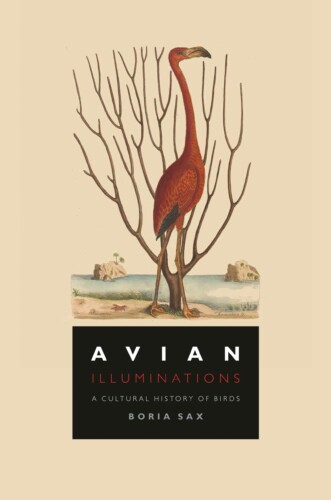
To read more about this fascinating subject, order Avian Illuminations from our online shop now.
Boria Sax teaches at Sing Sing prison and online in the graduate literature program at Mercy College. He has published many books including City of Ravens (2012), Imaginary Animals (Reaktion, 2013) and Dinomania (Reaktion, 2019)..