In Pursuit of the Crab
9th August, 2021
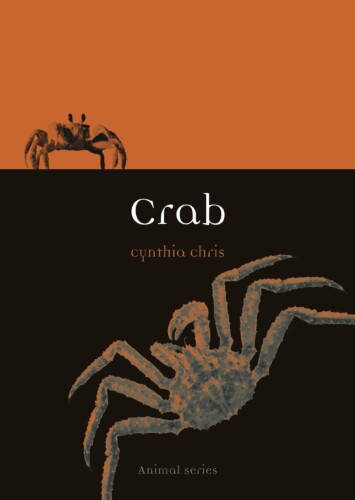
Author Cynthia Chris was inspired to write for the Animal series when in Costa Rica. But what else influenced this seminal book on our hard-shelled friend? In this blog, Cynthia recounts what went in to writing such a book . . .
***
More often than you might think, while I worked on Crab for Reaktion’s series Animal, friends and colleagues who know me as a media historian, asked what the book would be about. ‘Crabs’, I would reply. Had I turned my scholarly attention to children’s television, where one would cross paths with Mr. Krabs, the grouchy restauranteur in Spongebob Squarepants? Was I looking into low-budget horror movies, running across the enormous brain-eating crabs in Roger Corman’s Attack of the Crab Monsters? Or maybe I was diving into reality TV, exploring The Deadliest Catch.
Yes, each of these — SpongeBob’s crabby boss, Corman’s mutants, and the bounty hauled in on The Discovery Channel’s long-running series — appear in the book. But they take up relatively few pages in a book that starts with a deceptively simple question: ‘What is a crab?’
I tell the story that research for this book began by accident, when I literally stumbled over my subject on a beach on Costa Rica’s Osa Peninsula. Just before dusk, I came across a massive number of Pacific hermit crabs leaving the sea and seeking shelter for the night:
They moved with great purpose – until I came within a couple of footsteps. When I knelt to take a closer look, they sought to blend into their surroundings by withdrawing into their scavenged shells. If I stood stock-still, they would emerge and continue their trek across the beach. There weren’t just a few isolated animals, but rather thousands, each and every one headed from the shoreline to the top of the beach at the rainforest’s edge. [1]

The hermits piqued my curiosity, which I could not recall having trained previously on a crustacean. As I began to read up them and their kin, I almost didn’t dare look at Reaktion’s list of Animal titles. Truth is, I had been looking for an opportunity to contribute to the series for years, but every time I imagined an animal subject, I’d find another author had already told its story, from Crow, Cockroach, Tortoise, and Ant, the quartet that launched the series in 2003, to the recent Squid, Jellyfish, Turtle, and Human. No one had yet written Crab. Still, I wondered if I could pull it off. My scholarly training, after all, is in media studies, even if my first book was a history of wildlife films. [2]
But one of the things I admired about the Animal series is its eclecticism, as its authors move deftly from the fossil record to fine art and popular culture. Once the press accepted my proposal, my newfound interest took me to Cape Cod National Seashore, Massachusetts, where fiddler crab burrows throughout salt marshes. The fiddlers wave their major claws charmingly at each other and sometimes, at approaching humans. But I was following a plant biologist in search of the purple marsh crab whose overpopulation, caused by declining populations of their natural predators, has led to dieback of the grasses that hold the salt marsh together, chipping away at its capacity to protect the peninsula from erosion and the force of coastal storms.
Later, on Staten Island, New York, I joined a survey of horseshoe crabs, which are actually arachnids despite our common name for them. During their annual mating escapades, females brave the beach to lay thousands of eggs. Some mature into larvae that slosh back to sea, molting and growing into the next generation; many of them nourish the flocks of red knots stopping for rest on Western Atlantic coasts during their long-haul migration from Tierra del Fuego to the Arctic Circle. I learned about the horseshoe crab’s unusual blue blood, which is harvested by the pharmaceutical industry as the key ingredient in tests used to affirm the absence of endotoxins in batches of injectables and medical devices. In 2020 and 2021, increasing demand for horseshoe crab blood, resulting from the rapid manufacture of vaccines intended to staunch the COVID-19 pandemic, brought new attention to the sluggishness of the U.S. Federal Drug Administration to approve a synthetic test that would eliminate the need to draw blood from animals so integral to a sprawling ecosystem. [3]
,%20Northern%20Territory,%20Australia_%20Photo%20by%20Tanya%20Detto_%20(c)%20Patricia%20Blackwell.JPG)
My research also took me to a rich archive of materials related to the career of legendary carcinologist Mary Jane Rathbun, the first female curator at the Smithsonian Institution. I explored specimen collections at the Scripps Institute of Oceanography in La Jolla, California, and the Smithson’s Museum Support Center in Maryland. I conferred with scientists whose fieldwork has taken them from the mangrove forests of Australia’s Northern Territory to the Gulf of Aqaba, which juts off the northeast tip of the Red Sea, and from the Western Ghats, the mountain range traversing India’s southern states, to the ocean floor. And I discovered the work of artists and illustrators who have for centuries, observed these animals as closely as any biologist, with results just as startling.
So much of academic life favors intense specialization. To its credit, Reaktion’s Animal series is disciplinarily ecumenical, drawing authors from zoology, entomology, geography, sociology, literary studies, and more. Writing Crab as a curious outsider reminded me that scholarship is not simply a practice of publishing in our areas of mastery (although that is what academia rewards us for); it can also be an encounter with the unfamiliar, a journey that invites the author herself as well as readers to tag along.
Crab was followed in June by Raccoon by Daniel Heath Justice, the landmark hundredth volume in the Animal series.
[1] Cynthia Chris, Crab (London, 2021), p. 7.
[2] Cynthia Chris, Watching Wildlife (Minneapolis, 2006).
[3] Chiara Eisner, ‘Vaccine Testing is Changing, Why Is This $13B Lab Still Bleeding SC Horseshoe Crabs?’, https://www.thestate.com, 11 February 2021.
– Cynthia Chris
To read more about crabs, you can order Crab from our online shop now.
Cynthia Chris is Professor of Media Culture at the College of Staten Island, City University of New York. She is the author of Watching Wildlife and The Indecent Screen: Regulating Television in The Twenty-First Century.