Diving In: How I Found the True Story of Swimming
3rd August, 2022
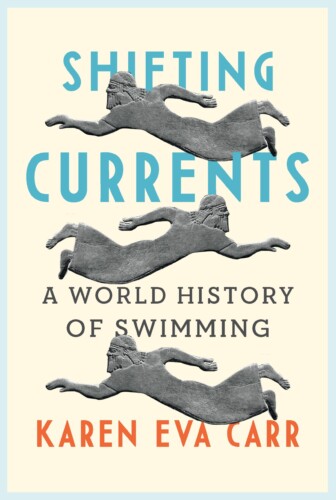
When Karen Eva Carr began writing Shifting Currents, little did she know what she would discover. In this blog, Karen talks about what she uncovered as she wrote, and what she discovered about herself too.
***
Writers often say that you have to write the book in order to know what it’s about, and that was certainly true of Shifting Currents: A World History of Swimming. At first, I thought I would be telling the story I had been told, the one everyone knows. It goes something like this: the Greeks, in classical antiquity, were great swimmers, because they lived near the ocean. Greek vases and tombs show people diving and swimming; the hero Odysseus swims too. The Romans were also great swimmers, because the civilized Greeks taught them to swim. The Roman army taught soldiers to swim, as part of their famous training. This view of ancient swimming has dominated our thoughts since the first swimming books were published in the Renaissance. They presented European swimming as a revival of ancient Greek and Roman swimming, just as Renaissance art and literature and architecture revived ancient styles. Lord Byron was a great swimmer, because he admired the Greeks and Romans. And so did 19th century Britons, and so do we: we all swim because we want to be civilized, like the Greeks and Romans. And the better we swim, the more civilized we are.

I myself learned to swim in exactly this way, as part of my Jewish family’s effort to become fully Americanized. Both my grandmothers learned to swim at summer camp, and my mother learned on vacation at Lake George (The men in my family mostly didn’t swim; assimilation was apparently women’s work.) I learned to swim in vacations at the super-white spaces of Cape Cod and Cape Hattaras and Myrtle Beach. At home in upstate New York, we belonged to a private swim club—not exactly a country club, but close enough. With my friends, I also swam enthusiastically in upstate creeks and lakes, but here, too, I saw mainly white faces. During summers in France, my brothers and sisters and I swam in the Olympic-sized Orsay university pool: immigrant North African and West African families lived nearby, and the pool was open to the public, but the bus system was set up to keep most African-descended people from getting to the pool. Instead, swimming there emphasized how the modern Olympics connected today’s athletes to ancient ones.

It says something about how white my childhood swimming was that my own kids, growing up in Portland, Oregon, saw more Black swimmers than I had. Their lessons were almost entirely white, but a fair number of Black kids swam at our public pool. Nevertheless it was still a basically segregated experience. Even though they shared the pool, Black kids and White kids mostly didn’t play together. And I knew Portlanders who wouldn’t swim at the public pool, but joined expensive private clubs. I felt good that we went to integrated public pools, but I also felt bad about not being able to afford the private club, like I had failed my kids.
When I started to read more about swimming, though, this story slowly collapsed into ruins, and those ruins were soon covered over by the thin green tendrils of new questions. Why, if Black people didn’t swim, were there so many descriptions of their excellent swimming in Africa? Why were there many images of ancient Egyptian swimming but none from the Bronze Age Aegean? A Black scholar, Kevin Dawson, was already writing the story of African-American swimming, and that set me on the right track. His book Undercurrents of Power: Aquatic Culture in the African Diaspora was not yet out when I was pulling together my thoughts about swimming, but he had a great article out about African and African-American swimming, and he was friendly and helpful.

Slowly I realized that the story of swimming didn’t center on Europe. Throughout history, most of the best swimmers in the world were from other places: Africa, the Americas, Southeast Asia, Australia. Europeans came late to swimming, and they swam in imitation of their richer, more sophisticated neighbors to the south. So the book turned from being about how great Europeans were at swimming to being about how great everyone else was at swimming, and how Europeans slowly learned to swim from them. Writing Shifting Currents: A World History of Swimming has been a process of recognizing my own privilege around swimming, while also slowly realizing that through most of human history, it’s been people of color who swam, and White people who were afraid of the water. People from all over the world have a long heritage of swimming. Their swimming was effectively stolen from them by colonialism.

Shifting Currents has been through many drafts. It now explores the centuries in which Europeans and northern Asians learned to swim, forgot how to swim during the Ice Age, learned to swim again from their African neighbors, forgot again in the Late Middle Ages, and then learned to swim again. Shifting Currents shows how this last surge of swimming arose partly as a revival of Classical culture, and partly in admiration of the swimming of Native Americans, West Africans, and Aboriginal Australians. In the process, I have also come to see how marginal Europe really was in world history before 1500. I now see swimming as just one example of how poor and isolated Europe was in antiquity, and how eager Europeans were to emulate their better positioned African neighbors. Classics, as a field, tends to center Greece and Rome as if they were obviously more important than the rest of the world. That’s been used for centuries to justify colonialism and slavery, and so the job of Classicists today is to undo as much of that damage as possible. Shifting Currents is my first gesture in that direction, decentering Europe by showing how Europeans learned to swim from much better swimmers on the other continents.

– Karen Eva Carr
To read more about this fascinating subject, order Shifting Currents: A World History of Swimming from our online shop now.
Karen Eva Carr is Associate Professor (Emerita) in the Department of History at Portland State University, and is the author of Vandals to Visigoths: Rural Settlement Patterns in Early Medieval Spain (2002).