Caravaggio and the Language of Dress
9th October, 2025
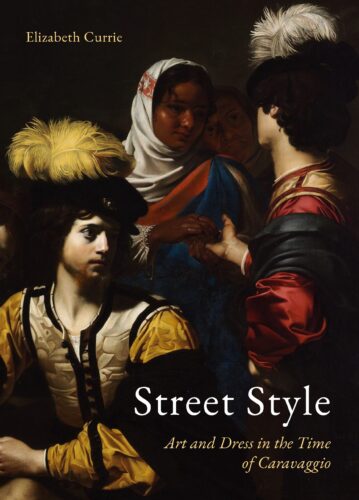
In this blog, author Elizabeth Currie talks about the subject of her new book, Street Style, Caravaggio, and his works in relation to the language of dress.
***
Caravaggio’s appeal goes from strength to strength. He was the subject of a blockbuster exhibition in Rome earlier this year and a film on his life and art will be released in November. There are many reasons why his work resonates so much in the twenty-first century, one of them being his disregard for established artistic conventions, including his ability to interweave religious and secular themes. This innovative approach generated shifts in meaning and ambiguities that encourage active, personal responses from his viewers.
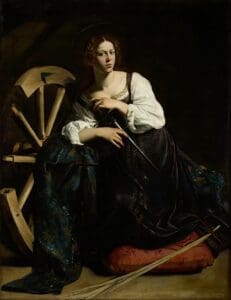
Caravaggio’s depiction of clothing is one of the few overlooked aspects of his paintings. On first reflection, dress might not appear to be a notable feature of his work, particularly in the case of the dark, austere compositions of his later years. Nevertheless, across his career he painted a wide variety of dress, from young men in flamboyant silk doublets and women in silver-gilt lace and intricate embroideries to the well-worn linen caps of servants and pilgrims. He tended to represent figures in the clothing of his own time, whether he was portraying a Romani fortune teller, based on a woman he met on the street according to one of his biographers, or St Catherine of Alexandria. The material and symbolic value of these garments is not immediately apparent to modern eyes. However, by placing them within the wider clothing system of the time and learning more about the people who would have worn them, we can recapture their significance. It emerges that Caravaggio’s close attention to dress adds to the drama of his images and plays with viewers’ expectations.
In both religious and genre scenes, the artist depicted everyday people recognisable from the street life around him. Some of these social groups had already caught the imagination of artists, authors and playwrights, reflected in a surge of depictions of the poor and working classes, ranging from soldiers, sex workers, Romani fortune tellers, to servants and pilgrims, in the second half of the sixteenth century. There are few traces of these individuals in historical archives, although they sometimes feature in trial records or public decrees policing their presence in Rome. Descriptions of their physical appearances and dress in these documents offer a counterpoint to images. They help to identify where Caravaggio replicated authentic clothing, followed stereotypes and literary conventions, or devised imaginary styles for symbolic purposes.
The costliest outfit depicted by Caravaggio is worn by Mary Magdalene in a painting dating from around 1596. He shows her in the garments associated with successful courtesans of the time. What looks like drapery swathed around her knees is in fact an overgown, as one of Caravaggio’s biographers Giovanni Pietro Bellori pointed out. From inventories and the records of second-hand dealers we know that this third, outer layer of dress was something that sex workers aspired to own, to the extent that in Florence they were known as zimarrine, after a particularly fashionable style of overgown. It has often been noted that the Magdalene’s clothing is coming undone, reflecting her spiritual anguish. We can see her undershirt, which would have been interpreted as a state of undress, underlined by the fact that a few years earlier, women were forbidden from appearing outdoors in Rome just in their shirt sleeves.
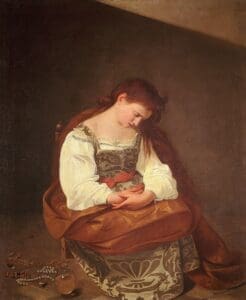
To these very realistic touches, Caravaggio adds a surprising detail in the form of the vase pattern on her skirt. It echoes the glass vessel next to the Magdalene, a reference to the ointment she supposedly used to anoint Christ’s feet in the house of Simon the Pharisee. And yet, vases were not common in fashionable dress, which was usually decorated with designs of flowers, fruit and foliage. Instead they were used to make costly church textiles, such as altarcloths and vestments. So, with a single motif, Caravaggio draws this intimate, domestic scene into the orbit of the ornate places of worship so familiar to a contemporary public and reminds us again of the devotional function of the image.
The artist also perfected the representation of the dress of the poorest inhabitants of Rome. One such painting is the Madonna of Loreto. Small aspects of the clothing in it, including the female pilgrim’s torn head covering, or coif, were criticised by another biographer who considered them to be inappropriate for an altarpiece. This was a misreading of the couple’s appearance. Unlike the negative images of impoverished people circulating widely at the time with bedraggled clothing and lumpen silhouettes, these pilgrims are firmly placed in the category of the deserving poor. Artworks of the period depict different kinds of stitches: slapdash, haphazard ones, for example, suggest the precarious or slovenly nature of the wearer. Here, however, the careful mending visible on the patched breeches of the male pilgrim hints at his worthiness and desire for respectability.
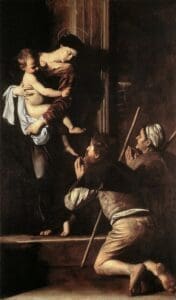
A 1605 inventory of Caravaggio’s studio lists very few items of clothing, just a ragged doublet and hose, an old belt and ‘nasty old’ pair of green breeches. Like some other artists of the time, he appears to have paid little attention to his own appearance, regularly wearing tattered dress. However, his paintings reveal a deep understanding of sartorial nuances both on and off the canvas.
– Elizabeth Currie
Elizabeth Currie teaches at Central Saint Martins, University of the Arts London. She has published widely on the history of fashion and textiles, including the edited volume A Cultural History of Dress and Fashion in the Renaissance (2017).
You can join Elizabeth Currie at the Museum of the Order of St John on Wednesday 22 October 2025, to explore how the vibrant and diverse island of Malta influenced the life and work of Italian artist Mattia Preti. Get your tickets here.