Animal Architecture: Swallows
5th April, 2023
When Paul Dobraszczyk was a child, his mother nursed fledgling swallows. In this blog, Paul explores the many ways in which humans have interacted with, and affected, swallows …
***
When I was a child, a pair of swallows (Hirundo rustica) chose to build their nest on the wall of an outside passageway of my family’s 1950s council house in rural Northamptonshire. For my mother, the return of the swallows in the second half of April was always associated with mine and my brother’s birthdays. However, one year, the nest – brim-full of young birds – fell off the wall, my mother rescuing the almost fledged brood, rearing them by hand until they were ready to fly. But, despite her ministrations, the parents never again returned.
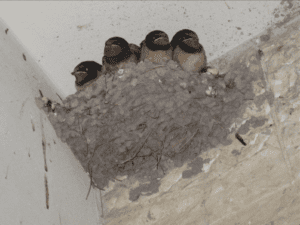
As heralds of spring, swallows have always been associated with the powerful symbolic charge of that season: they have been variously cast as bringers of fertility, love, and new opportunities. Their presence in buildings was, and in places still is, actively courted – the presence of a nest seen as an auspicious omen for the (human) occupants. But equally, the failure of a nest was a sign of bad luck, with some believing that it signalled the imminent collapse of the building on which it was constructed or a death in the family of the human occupants. Looking back on the avian disaster of my own childhood, I cannot recall if it foretold anything of note in the life of my family.
It is likely that swallows began to breed in close association with humans many thousands of years ago, when people first started to practice agriculture and build permanent settlements. The natural nest sites of hirundines are caves, crevices in cliffs, sinkholes, hollow trees and, in the case of sand martins, the mud or sand-banks of rivers. Both swallows and house martins build their cup-shaped nests from thousands of individual pellets of mud, mixed with straw and glued together with their own saliva, on any suitable object projecting from a wall, such as a nail. Martins build right up against the eaves of the roof, the entrances to their nests visible as tiny semicircular holes; swallows’ homes are more open, perhaps the reason why they, rather than martins, have become so associated with human domesticity.
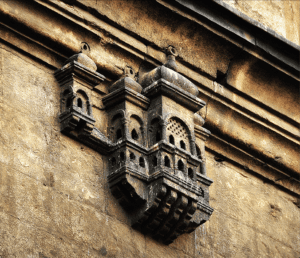
As befits their common name (barn swallows), the birds usually prefer to nest inside barns; but they have been known to build their homes in an extraordinary variety of situations. Ornithologist Angela Turner has recorded swallows’ nests built on a pair of garden shears hanging in an outhouse, another fashioned around the body of a deal owl dangling from a rafter in a barn, even some constructed on moving objects such as a steam-ship that traversed the same route every day or a train that ran 3km between two lakes in British Columbia. In Ottoman Turkey, elaborate bird-houses and baths were regularly erected on the facades of mosques, madrasahs or palaces for swallows and other birds. Fashioned from stone, timber and mud, these ornamental bird-houses flourished from the 14th to the 19th centuries, but only a few remain extant. One exquisite work of craftsmanship in stone still graces an external wall of the Ayazma Mosque (1760-61) in Istanbul. Accommodating swallows, sparrows and pigeons, this bird house is a miniature replica of an Ottoman palace, complete with domes, arched entrances and a curious side building, presumably to accommodate an unsociable occupant.
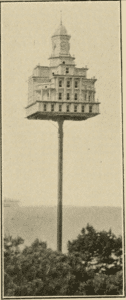
In the USA, summer-visiting purple martins (Progne subis) are cavity nesters that rely almost entirely on human assistance for their survival. More than a million people attract purple martins with nest boxes mounted on tall poles, some in the form of houses, civic buildings or even castles with dozens of rooms for the birds to build their nests. This fashion was started in the early 20th century by J. Warren Jacobs and his Jacob Birdhouse Company, based in Waynesburg, Pennsylvania, and still active today. Jacobs established colonies of purple martins at his home in 1896, building elaborate bird-houses for them, including miniature replicas of iconic buildings such as Independence Hall in Philadelphia and the state capitol in Washington DC. His ornamental bird-houses became immensely popular, particularly after he displayed them at the Chicago World’s Fair in 1933. Today, the tradition continues – ornamental bird-houses supplemented with more utilitarian structures such as the 70-ft high tower built in Griggsville, Illinois in 1962, which contains 562 apartments for individual pairs of purple martins. With another 5,000 birdhouses installed along the city’s streets (one even named Purple Martin Boulevard), Griggsville lays claim to being the Purple Martin Capital of the Nation (a title that is not uncontested by other bird-loving communities).
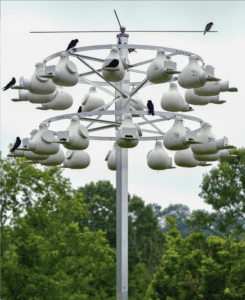
The community of care that has developed in Griggsville and many other places in the USA is a hopeful counter to the human desire to purge nesting birds from their houses, a desire rooted in fear of disorder (and there are several companies that prey on this fear, advertising their services to deter what they term avian ‘pests’). As swallowphiles have known for millennia, it’s in the domestic sphere that human and non-humans meet most directly. For the brief months of the year that they choose to live alongside us, swallows meld their domesticity with our own, marking the passage of both their and our time on this earth.
– Paul Dobraszczyk
Paul Dobraszczyk is a writer and a teaching fellow at the Bartlett School of Architecture, London. He is the author of Future Cities (Reaktion, 2019) and co-editor of Global Undergrounds: Exploring Cities Within (Reaktion, 2016).