Alexander the Great – What is History?
9th August, 2025
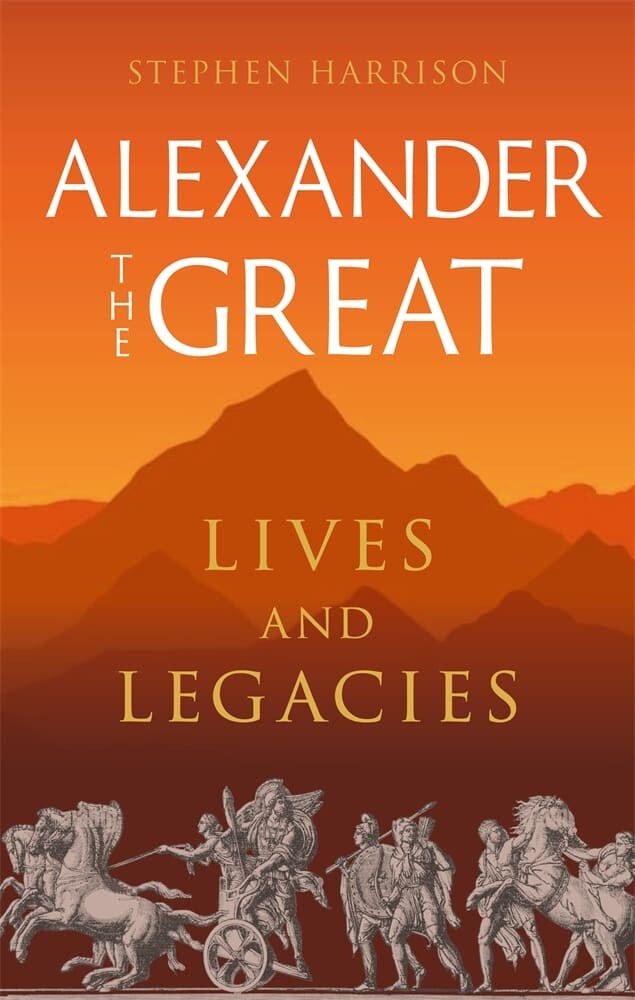
In this blog, author of Alexander the Great: Lives and Legacies, Stephen Harrison ponders what is the significance of a new book on Alexander, and how this one came to be.
***
Sometime in the middle of the second century CE, Lucius Flavius Arrianus – better known today simply as Arrian – sat down to justify writing a new history of Alexander the Great, the Macedonian king famed for conquering the Persian Empire. Why, he mused, should people read his account when so many others already existed. Some two millennia later, and after thousands more attempts, I know how he felt. When the story of Alexander has been told so many times, what more could possibly be left to say?
Arrian’s response was brash: potential readers should look at everything written by everybody else, read his version, and then they would understand why he had taken up the challenge. His talents were such, he implied, that his account would stand the test of time: his history was to be definitive. I don’t pretend that my version will be read in thousands of years, but I do think that there are new ways to narrate Alexander’s life.
Arrian’s is one of five main literary accounts of Alexander which survive from antiquity. All were produced by men who lived within the Roman Empire and who were writing hundreds of years after Alexander’s death. Sure, they were using sources created by people who had accompanied Alexander on his campaigns or were roughly contemporary to events, but the surviving Roman-period authors were operating at a time when Alexander was already the stuff of legend. Their attitudes and interests reflected the time in which they lived.
Persians against whom Alexander fought are often two-dimensional stock figures, their own perspectives largely ignored. Women essentially appear only as mirrors for Alexander’s own morality. Most importantly, as Plutarch put it in his Life of Alexander – one of a series of parallel biographies comparing figures from Greek and Roman history – the authors of our sources wanted to discover what made Alexander tick. That way, they, and their readers, could come to learn how Alexander had achieved what he did, and thus how to emulate his successes.
Hopefully, we no longer look at the past in search of models for world conquest. Of course, Alexander’s personality and aims still fascinate. Did he really think he was a god as some have claimed? Was he a murderous tyrant, as his butchery of thousands might suggest, or a visionary who dreamed of universal peace and brotherhood?
, Today, we are interested in a wider set of questions. We no longer see history as being dictated by ‘great men’, with the ideas that change the world emerging purely from their minds, as the nineteenth-century Scottish writer Thomas Carlyle famously put it. Instead, we try to cast the net wider. Who else contributed to Alexander’s successes? How were his campaigns experienced by those he conquered? How much actually changed?
Alexander the Great: Lives and Legacies grapples with questions like these, weaving them into Alexander’s narrative. One of my favourite examples concerns a woman called Apama. She was born in Bactria or Sogdiana – essentially modern-day Afghanistan and Uzbekistan. Her father, Spitamenes, led the local resistance against the Macedonians until he was killed by his allies – or, in one version, by his own wife. Apama enters the historical record a few years after this when she was married off to a Macedonian general called Seleucus as part of a mass wedding ceremony orchestrated by Alexander in which scores of high-ranking Macedonians took brides from among the Asian elite.
Apama’s is the only one of these matches which we know endured and, during its course, her husband emerged as one of the principal victors in the vicious civil war which broke out after Alexander’s death. Apama became queen of the largest empire in the Mediterranean world. Born into one imperial apparatus, Apama was displaced by another, but then came to new prominence under a third, likely reaching a position inconceivable when she was born. It is too easy to think of historical figures and their actions in terms of stark contrasts, but Apama shows the value of muddying the waters a little. It also gives us scope to think about the role that people other than Alexander played in shaping the events of his reign.
The challenge when we try to ask new questions about the ancient world is working out whether the available evidence actually lets us answer them. This is especially hard for Alexander because the literary sources are so late and problematic, and material culture so limited, that almost every ‘fact’ has been vigorously debated. We usually don’t know exactly where Alexander went, what he did, or why, except in the broadest terms. To echo the nineteenth-century German historian Leopold von Ranke, whose work profoundly influenced the development of history as a discipline, historians are supposed to explain the past and to tell it like it actually was. But studying Alexander invites us to consider what historians should do when this is largely impossible.
Arrian told his readers that his history of Alexander was the best that there could ever be, but these complications mean that I tell my readers something very different. After all, when the facts are so contested, how can anything be definitive? So, I invite readers behind the curtain of historical research. I help them understand the processes that historians go through when making up their mind about what happened in the past. I am upfront about what we know and what we don’t. Of course, I have a view – and I explain that view – but I don’t pretend that mine is the only tenable opinion. Arrian, and most historians who have followed in his wake, tell their readers what happened, but I ask mine a question: what do you think?
– Stephen Harrison
Stephen Harrison is Lecturer in Ancient History at Swansea University.