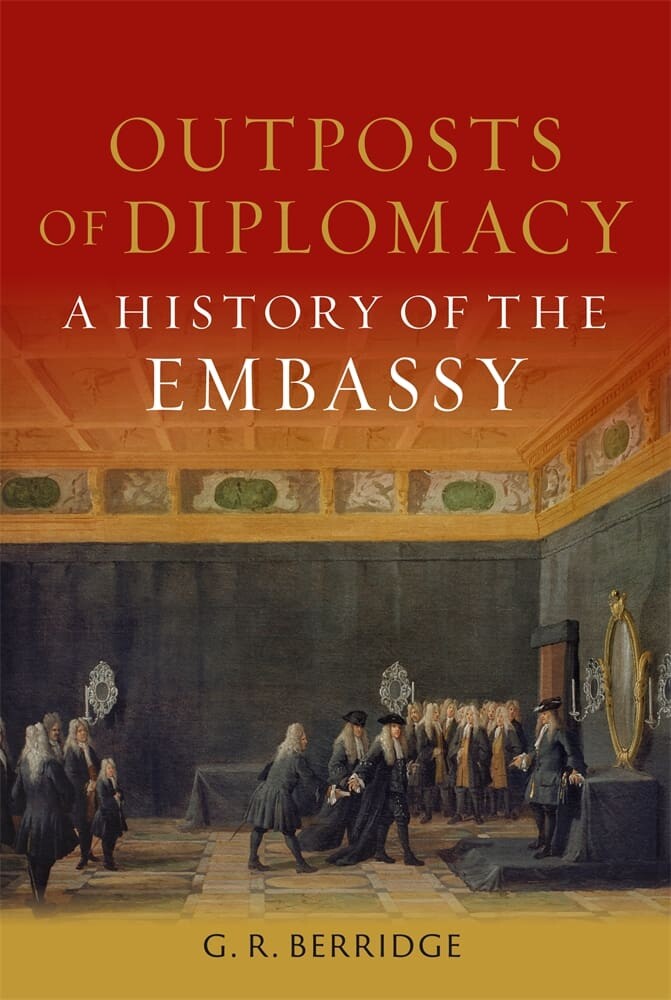
A History of the Embassy
24th April, 2024
In this blog, G.R. Berridge explores the reasons behind his new book, Outposts of Diplomacy, and how he came to write it…
***
Oddly enough, it was well before I became a serious student of the history of diplomacy that I was first struck by the advantages to any entity with overseas operations of having permanent outposts abroad. It happened when I was working on a book on the cartel that controlled freight rates in the shipping trade between Europe and South Africa, published as The Politics of the South Africa Run by Clarendon Press in 1987. I was browsing old Union-Castle Line company minutes in Cayzer House in London when I came across a short discussion of the suggestion that the company might sell off Mount Nelson Hotel in Cape Town. (The Conference Lines already had a secretariat in the city, just off Adderley Street, if I remember correctly.) Certainly not, was the conclusion; it might not have been very profitable but it was invaluable for entertaining and influencing important people. As an instance of a general rule, this perhaps should not have surprised me but seeing it in confidential minutes from the horse’s mouth made a lasting impression.
With the Mount Nelson Hotel always at the back of my mind, I was tempted to write this book because I had long defended the resident embassy and regretted the fact that it lacked a complete history as an institution. The oversight is probably explained by the common view, lingering since the late twentieth century, that it is an expensive anachronism and that other modes of diplomacy – such as direct telecommunications, standing conferences, summitry and ‘public diplomacy’ (despite being an oxymoron) – are more worthy of attention.
Fortunately, however, less is heard to-day of the datedness of the resident embassy, so I am confident that a book that brings its history right up to the present will not be regarded as misconceived; the embassy is not a fossil. Indeed, even fragile states strive to maintain a few missions abroad in key countries, while major powers have embassies almost everywhere and staffed in vastly larger numbers than ever before. Were it not for the strenuous opposition of the Tower Hamlets borough council, right now the Chinese government would be starting work on an even bigger embassy in London than the one it already has in Portland Place. Embassies even survive in more or less recognizable form when diplomatic relations have been severed – or never existed to begin with. I’m thinking here particularly of such missions as the US Office of Palestinian Affairs in Jerusalem, the numerous ‘representations’ of Kurdistan and interests sections such as that of Iran under the protection of the Embassy of Pakistan in Washington. What clearer evidence could there be of the continuing, deep attachment to resident diplomacy?
The resident embassy remains a vigorous institution because its traditional functions, among them confirming sovereign independence, lobbying its host government and helping citizens in distress, continue to be valued. But added to this is the realization that it is also a secure platform for men and women serving government offices in addition to the foreign ministry, not least intelligence agencies, which were insignificant prior to the early twentieth century. In an increasingly dangerous world, the state’s embassies are also its first line of defence at a fraction of the cost of the military, and a vastly smaller fraction still if they are able to nip in the bud a conflict that might otherwise issue in a deadly clash of arms.
Outposts of Diplomacy investigates the numerous roles of the embassy, together with its household and buildings, as they all evolved from the early modern period and spread from Europe to the rest of the world until the present day. It draws heavily on British, French, Venetian, American and Japanese examples, and is informed by my published research on diplomacy in general and the British Embassy in Istanbul in particular. Its length is padded out neither by footnotes nor appendices but it has a lengthy ‘Note on Sources’ and 60 illustrations cleverly woven individually into the text by the publisher’s production team. Something else for which – as a refugee from Palgrave Macmillan/Springer Nature – I am in debt to Reaktion Books is allowing me to create a proper analytical index from the third proofs, even though the task still seemed to take as long as it did when about forty years ago I was doing the same job with longhand entries on index cards in an old shoe box. I hesitate, however, to say that those were the days.
– G.R. Berridge
G. R. Berridge is Emeritus Professor of International Politics at the University of Leicester, and a Senior Fellow of the Geneva-based DiploFoundation. He was an Associate Editor of the Oxford Dictionary of National Biography, to which he still contributes, and his most recent book is Diplomacy: Theory and Practice (6th edn, 2022).
You can buy Outposts of Diplomacy: A History of the Embassy from our online shop now.