A History of Children and Food
21st May, 2026
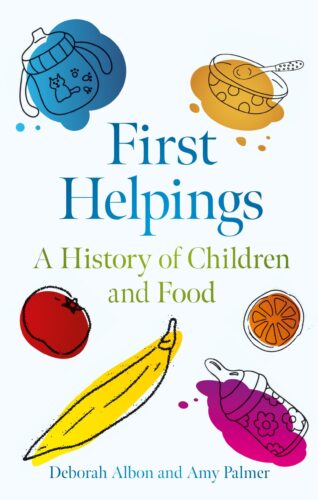
In this blog, authors Deborah Albon and Amy Palmer talk about the subject of their new book, First Helpings: A History of Children and Food.
***
It is our conviction that food matters – it is vital to consider it when we write the social history of any group of people, especially children. It is foundational for their present health but also provides a platform for their future well-being. It is bound up with their relationships with others: new-born children are totally dependent on other people to feed them; as children get older, eating with the family has often been seen as ideal for their development and at school, they inevitably encounter new foods and new ways of eating. Food is also linked to children’s culture and cultural identities and a specific ‘culture of childhood’ can be seen in material objects, such as crockery and cutlery. Special food, such as sweets, has been created with children in mind and children’s literature is rich with stories about eating. Food also relates to wider political questions – how far should the state involve itself in determining what children should consume? How can we, as a society, best address the issue of children going hungry?
One of the challenges in researching this book has been to determine just what we mean by ‘children’ and ‘childhood’. We were very aware that there have been claims by some academics that childhood is a recent invention. This is something we dispute: there has always been an understanding that children are different to adults and parents have, for the most part, always cared about their children. However, what it means to be a child and when childhood ends have been understood very differently in different times – and have varied considerably with respect to class and gender. We made the decision that anyone under eighteen, in other words a child according to current global agreements, fell within our sphere of interest – however they may have been viewed in their own society.
Which topics to include in the book was of course something we considered carefully. We started with the youngest children and began thinking about infant feeding and how this is organised. We then examined which foods and drinks have been considered suitable for children and why. This is an area which has always generated much concern – as parents, teachers and others worry, understandably, about children being malnourished or indeed eating too much. We write about developing ideas about nutrition but also think about the cultural importance of occasionally being allowed to join in with family and community celebrations with special treats. Drinks for children was an interesting area to examine; for example, children drinking alcohol was seen as perfectly normal until at least the early nineteenth century. Concerted and skilful campaigns by various temperance movements were a key reason for a shift in societal attitudes.
We then move to explore children’s experiences of food in the home, the school and nursery and in the wider community. Table manners is an interesting topic: expectations of how children should eat may differ in these various environments and children learn to navigate these complexities. In one of Deb’s research projects, a four-year-old child wanted to play ‘take aways’. She pretended to have Kentucky Fried Chicken, McDonald’s, fish and chips, and Indian and Chinese food. In each case she demonstrated how you should eat the food, be it with a knife and fork, chopsticks, out of a bag or using fingers for (pretend) naan bread to pick up the (pretend) curry. We look at school dinners – a perennial ‘hot topic’ from the later nineteenth century on. As we are writing this blog (April 2026), the government has just announced yet another overhaul of ‘standards’ for these meals. Two of our favourite chapters to write were on children learning to cook and learning about where food comes from. This can happen in school – but also in so many other places: at home with parents, from toys, books, television programmes and apps and in community groups such as the scouts and guides. Cooking was often seen as something suitable mainly for girls, and particularly working-class girls, and the scouts were really important in enthusing boys to take an interest, primarily through giving them experience of cooking while camping.
In our final section, we consider some of the wider social issues around food. First, we look at children working in the food industry. For much of history, children, including very young children, have taken part in farming, fishing, selling on the street and preparing food for others while working as servants. Despite protective legislation, this continues in Britain today and is sometimes not acknowledged when it is seen as simply ‘helping out’ in family businesses. We conclude the book with looking at hunger and take a strong position on the disgraceful fact that children are going hungry today. We believe that the government should be prioritising measures to address this, but we also highlight the attempts of many other people throughout history to make a contribution here – including religious authorities, charities and, not least, disadvantaged families and children themselves.
Writing this book together was a very rewarding experience. Although our backgrounds, as teachers and lecturers, are similar in many ways, we still had our own special areas of interest and experience. We divided out the chapters between us and each took the ‘lead’ for five of them. Nonetheless, every section went through multiple iterations, so that both our fingerprints are on everything. Our individual writing styles were initially a little bit different to each other, but over the process, we managed to meld them into what hopefully seems like one consistent voice. We both feel that this is a better book than either of us could have written by ourselves.
– Deborah Albon and Amy Palmer
Deborah Albon and Amy Palmer have worked with young children in schools and nurseries and have also taught on Early Childhood Studies courses at the University of Roehampton.
You can now buy First Helpings through our online shop.