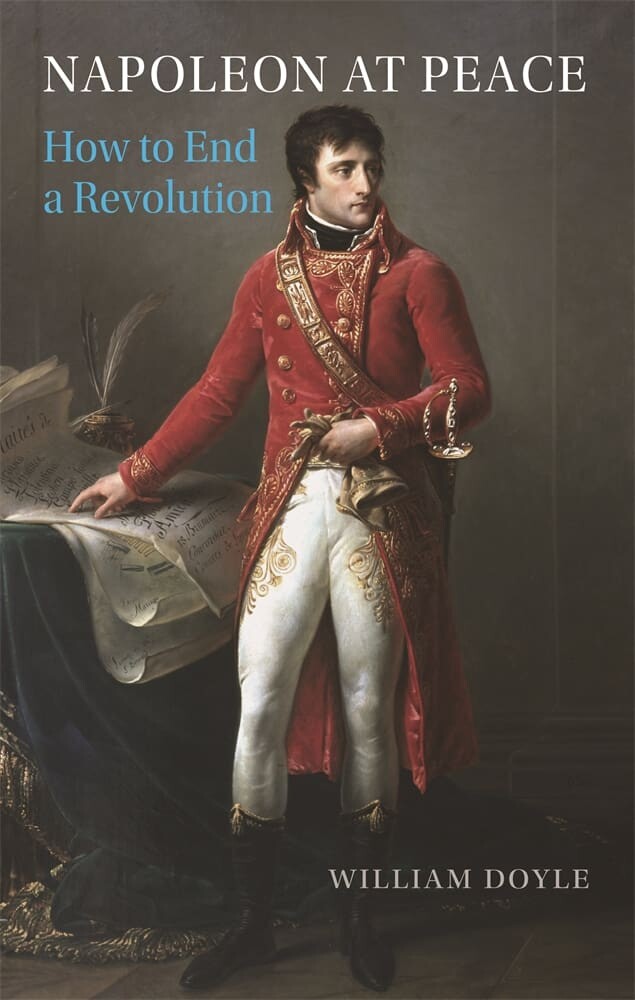
How to End a Revolution
4th March, 2024
Napoleon Bonaparte, perhaps one of the most famous revolutionaries, not only began, but ended the French Revolution. In this blog, author William Doyle examines how the Revolution came to an end…
***
Looking back on his triumphant entry into world history as a young general in 1796, Napoleon recalled saying to himself, ‘ I am the one who will end the Revolution’. Between 1799 and 1804 he did. And yet, though chiefly remembered since for his military exploits, over that time he only fought one battle, which he nearly lost. Ending the French Revolution required more than inspired generalship.
On his providential return from Egypt in 1799, Napoleon saw that the Revolution was still not over. The optimistic dawn of 1789 had given way to a series of intractable problems. The revolutionaries had dispossessed and persecuted the Catholic Church, declared a republic and executed the king, and gone to war with the rest of Europe to sustain these fateful choices. Widespread domestic discontent and lawlessness had barely been contained by violence and terror, and France’s lucrative Caribbean empire had been lost to slave rebellion. Successive revolutionary assemblies had failed to settle any of these issues, and a group of frustrated politicians turned to the republic’s most successful general to support a fresh start. They found themselves outwitted. Within months of the overthrow of the last revolutionary constitution, Napoleon had emerged as First Consul of the republic, a single ruler for the first time since the end of the monarchy.
He knew what he wanted to consolidate his power. First, he had to end the war by defeating France’s two principal enemies, Austria and Britain. Austria looked the easier prey, and his strategy was to repeat his earlier triumphs in Italy. His victory of Marengo (June 1800) was narrow, and it took Moreau’s more decisive win at Hohenlinden six months later to seal Austria’s defeat; but the new head of state took the overall credit for establishing peace on the continent. It left the British isolated and war weary, and a new ministry in London opened negotiations in which Napoleon dictated most of the terms. The Peace of Amiens in March 1802 gave him a victorious end to the wars of the French Revolution.
A lot of this was down to luck, but Napoleon believed in luck. And it continued to favour him when a new pope was elected in 1800. Pius VII had always seen that the church must recognise French power. Napoleon in turn saw that only the papacy could help him solve France’s religious problem, which fuelled residual royalism and much rural disorder. Against the advice of most of his supporters, he opened negotiations with Rome to ‘restore the altars’, offering to pay the clergy as a branch of the state. Negotiations were long and tortuous, but they resulted in a concordat, celebrated at the same time as the Peace of Amiens.
Neither settlement lasted, but the link between religion and royalism had been broken. The way was now clear for Napoleon to restore the most spectacular of all the Revolution’s destructions, a hereditary monarchy. Despite earlier denials, he had probably always dreamed of this, and his supporters welcomed a new imperial dynasty in 1804 as the best guarantee that the Revolution really was over.
All that remained to banish the memory of revolutionary chaos was to rebuild commercial prosperity by restoring the old Atlantic empire of sugar and slaves. As soon as peace with the British reopened the seas, Napoleon assembled a vast military task force to recapture Saint-Domingue, the richest Caribbean colony, from former slave rebels. But when it became clear that the aim was to restore slavery, ferocious black resistance, along with the ravages of disease, decimated the invaders. Napoleon later admitted that this expedition was his greatest mistake. In the year he made himself emperor, the former slaves established the independent black republic of Haiti. The Revolution was over for the French Caribbean too, but this time not as Napoleon had intended.
– William Doyle
William Doyle is Emeritus Professor of History at the University of Bristol, and a Fellow of the British Academy. His many books include The Oxford History of the French Revolution (1989, third edition 2018).
You can order Napoleon at Peace: How to End a Revolution from our online shop now.