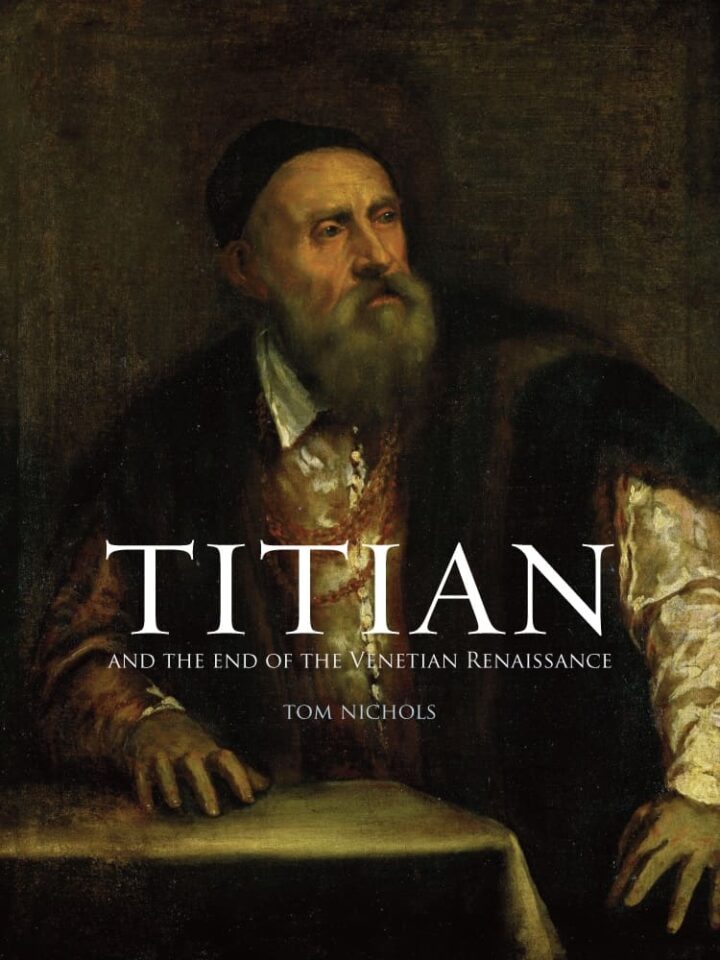
Titian and the End of the Venetian Renaissance
Tom NicholsTitian’s works are often seen as embodying the famous tradition of Venetian Renaissance painting. But how ‘Venetian’ was Titian, and can his unique works be taken as truly representative of his adoptive city? This comprehensive new study, covering Titian’s long career and varied output, highlights the tensions between the individualism of his work and the conservative mores of Venice. Titian and the End of the Venetian Renaissance argues that Titian’s works were self-consciously original, freely and intentionally undermining the traditional, more modest approach to painting in Venice – a position that frequently caused disputes with local artists and patrons.
This book, now available in paperback, charts Titian’s early stylistic independence from his master Giovanni Bellini, his radical innovations to the classical altarpiece and his meteoric break from the normal confines of Venice’s artistic culture. Titian competitively cultivated a professional identity and his dynamic career was epitomized by the development of his ‘late style’, which set him apart from all predecessors and was intended to defy emulation by any followers. It was through this final individualistic departure that Titian effectively brought the Renaissance tradition of painting to an end. This ground-breaking interpretation will be of interest to all scholars and students of Renaissance and Venetian art history.
Titian’s works are often seen as embodying the famous tradition of Venetian Renaissance painting. But how ‘Venetian’ was Titian, and can his unique works be taken as truly representative of his adoptive city? This comprehensive new study, covering Titian’s long career and varied output, highlights the tensions between the individualism of his work and the conservative mores of Venice. Titian and the End of the Venetian Renaissance argues that Titian’s works were self-consciously original, freely and intentionally undermining the traditional, more modest approach to painting in Venice – a position that frequently caused disputes with local artists and patrons.
This book, now available in paperback, charts Titian’s early stylistic independence from his master Giovanni Bellini, his radical innovations to the classical altarpiece and his meteoric break from the normal confines of Venice’s artistic culture. Titian competitively cultivated a professional identity and his dynamic career was epitomized by the development of his ‘late style’, which set him apart from all predecessors and was intended to defy emulation by any followers. It was through this final individualistic departure that Titian effectively brought the Renaissance tradition of painting to an end. This ground-breaking interpretation will be of interest to all scholars and students of Renaissance and Venetian art history.
Titian’s works are often seen as embodying the famous tradition of Venetian Renaissance painting. But how ‘Venetian’ was Titian, and can his unique works be taken as truly representative of his adoptive city? This comprehensive new study, covering Titian’s long career and varied output, highlights the tensions between the individualism of his work and the conservative mores of Venice. Titian and the End of the Venetian Renaissance argues that Titian’s works were self-consciously original, freely and intentionally undermining the traditional, more modest approach to painting in Venice – a position that frequently caused disputes with local artists and patrons.
This book, now available in paperback, charts Titian’s early stylistic independence from his master Giovanni Bellini, his radical innovations to the classical altarpiece and his meteoric break from the normal confines of Venice’s artistic culture. Titian competitively cultivated a professional identity and his dynamic career was epitomized by the development of his ‘late style’, which set him apart from all predecessors and was intended to defy emulation by any followers. It was through this final individualistic departure that Titian effectively brought the Renaissance tradition of painting to an end. This ground-breaking interpretation will be of interest to all scholars and students of Renaissance and Venetian art history.
-
'
This highly original study prises Titian away from the Venetian tradition, arguing that his works rebelled against their local context far more often than they cosied up to it. Nichols discerns the painters strident individualism throughout his career, from his early efforts to break with his master, Giovanni Bellini, to his formal experiments with the classical altarpiece and, ultimately, in his inimitable late style.
'Apollo
-
'
Nicholss book takes readers through Titians career in a chronological and thematic progression. His conclusions are consistently thought-provoking, engaging, and often heterodox, stressing difference, contrast and the uniqueness of Titians work . . . [a] nicely illustrated and well-produced volume . . . offers a challenging alternative view of one of the most important artists of the Italian Renaissance. Recommended.
'Choice
-
'
Nicholss book offers the kind of free-flowing and deeply intelligent analysis of a painters career that can only be produced after long study and intimate familiarity with his subject. It is beautifully written and generously illustrated, and you feel both Nicholss and Titians minds working at every turn
'Canadian Society for Renaissance Studies
-
'
original and provocative
'Charles Hope, Burlington Magazine
-
'
a richly illustrated and beautifully written essay
'Renaissance Studies
-
'
Attractively produced to Reaktion Books usual high standards
'Art Newspaper
-
'
It is a challenging thesis, one that makes this book essential reading by art historians
'Renaissance Quarterly
Introduction
Titian’s Last Painting: The Sight of Death
An Inglorious Passing; or, The Difficult Case of the Pietà
How ‘Venetian’ was Titian?
Surrogate Monuments to the Leader of a Tradition
ONE: Art as Appropriation: The Rise of Titian
Giovanni Bellini: The Model Venetian
Bellini and Titian: Master and Pupil
Titian and the Venetian Istoria
Titian and Giorgione
Giorgione and Titian’s Early Portraiture
The Early Mythologies
Titian Repaints Palma Vecchio
TWO: Remaking Tradition: Icons and Altarpieces
Anachronic Titian
The Modern Icon
The Cultural Dynamics of Space in Two Altarpieces for Venice
Private Values in a Public Picture Type
Altarpiece or Artwork?
THREE: Portraiture and Non-venezianità
Portraiture in Renaissance Venice
Titian’s Portraits to 1530: Accommodation of the Courts
Habsburg and Related Portraits of the 1530s
Historical Portraits
Natura Potentior Ars
FOUR: Sacred Painting, the Poesie and the Late Style
Titian as Tradition
Titian’s Hybrid Poesie
Two Late Mythologies
Early Responses to Titian’s Late Style
The Late Style in Critical and Historical Perspective
FIVE: Titian and Venice: Surviving the Father of Art
Patrons and Prices
Titian versus the Rest: A Literary Self-image
Pictor et eques: Titian’s Self-portraits
Images of Succession
Images of Attachment
The Darker Side of Titian; or, The Anti-image
Venetian Responses to Titian: Veronese and Tintoretto
Conclusion
Titian and the End of the Venetian Renaissance
Titian in Disguise
References
Bibliography
Acknowledgements
Photo Acknowledgements
Index
Tom Nichols is Senior Research Fellow at the University of Glasgow. His previous books include Titian and the End of the Venetian Renaissance (2013) and Giorgione’s Ambiguity (2020), both published by Reaktion.