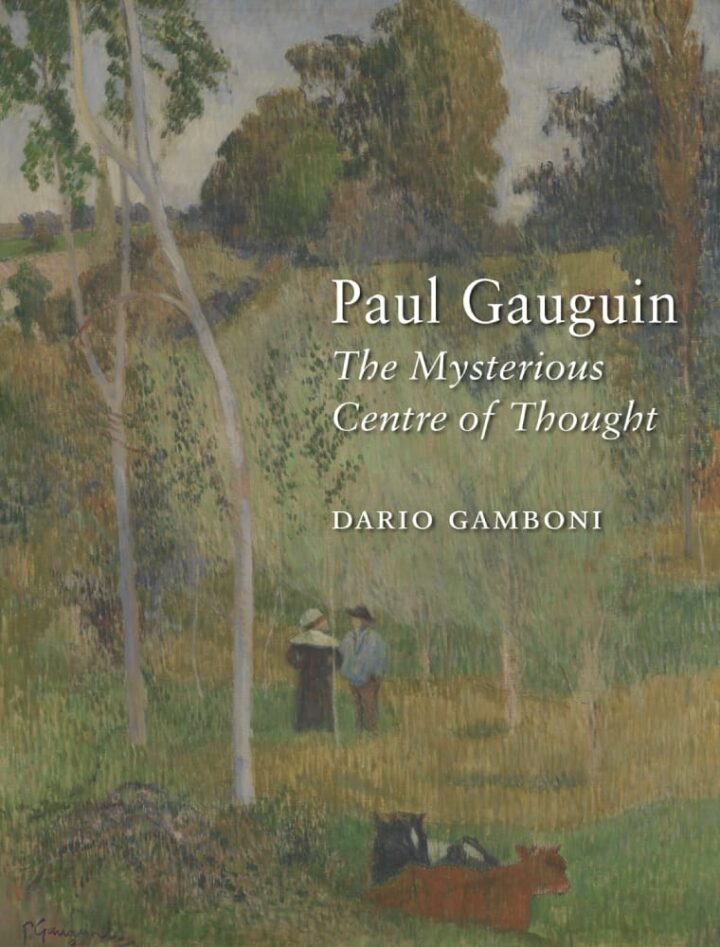
Paul Gauguin
The Mysterious Centre of Thought
Dario GamboniIn Paul Gauguin, Dario Gamboni illuminates the pursuit of a 'mysterious centre,' and takes a fresh look at Gauguin’s output in all media: from ceramics, sculptures, prints, drawings and paintings to his large body of correspondence and writings. This innovative, in-depth investigation provides a new understanding of Gauguin’s art and thought, revealing a coherence and continuity previously overlooked.
‘Gauguin’s crucible is his brain’, wrote the late nineteenth-century art critic Jean Dolent. Gamboni shows that, indeed, the interaction between perception, cognition and imagination was at the core of the artist’s work. Emulating the artist’s curiosity for literature, psychology, philosophy, theology, anthropology, the natural sciences and art, and including close readings of artworks both famous and lesser-known, this richly illustrated, original study gives new insight into a well known yet little understood artist. The book will appeal to students and scholars of Gauguin, as well as those new to his work wishing to learn more about this pivotal post-Impressionist figure.
French artist Eugène Henri Paul Gauguin (1848–1903) reproached the Impressionists for searching ‘around the eye and not at the mysterious centre of thought.’ In his own work, therefore, Gauguin was pursuing a ‘mysterious centre’ – but what does this enigmatic phrase mean?
In Paul Gauguin, Dario Gamboni illuminates this quest, and takes a fresh look at Gauguin’s output in all media: from ceramics, sculptures, prints, drawings and paintings, to his large body of correspondence and writings. This innovative, in-depth investigation provides a new understanding of Gauguin’s art and thought, revealing a coherence and continuity previously overlooked.
‘Gauguin’s crucible is his brain’, wrote the late nineteenth-century art critic Jean Dolent. Gamboni shows that, indeed, the interaction between perception, cognition and imagination was at the core of the artist’s work. Emulating the artist’s curiosity for literature, psychology, philosophy, theology, anthropology, the natural sciences and art, and including close readings of artworks both famous and lesser-known, this richly illustrated, original study gives new insight into a well known yet little understood artist. The book will appeal to students and scholars of Gauguin, as well as those new to his work wishing to learn more about this pivotal post-Impressionist figure.
In Paul Gauguin, Dario Gamboni illuminates the pursuit of a 'mysterious centre,' and takes a fresh look at Gauguin’s output in all media: from ceramics, sculptures, prints, drawings and paintings to his large body of correspondence and writings. This innovative, in-depth investigation provides a new understanding of Gauguin’s art and thought, revealing a coherence and continuity previously overlooked.
‘Gauguin’s crucible is his brain’, wrote the late nineteenth-century art critic Jean Dolent. Gamboni shows that, indeed, the interaction between perception, cognition and imagination was at the core of the artist’s work. Emulating the artist’s curiosity for literature, psychology, philosophy, theology, anthropology, the natural sciences and art, and including close readings of artworks both famous and lesser-known, this richly illustrated, original study gives new insight into a well known yet little understood artist. The book will appeal to students and scholars of Gauguin, as well as those new to his work wishing to learn more about this pivotal post-Impressionist figure.
French artist Eugène Henri Paul Gauguin (1848–1903) reproached the Impressionists for searching ‘around the eye and not at the mysterious centre of thought.’ In his own work, therefore, Gauguin was pursuing a ‘mysterious centre’ – but what does this enigmatic phrase mean?
In Paul Gauguin, Dario Gamboni illuminates this quest, and takes a fresh look at Gauguin’s output in all media: from ceramics, sculptures, prints, drawings and paintings, to his large body of correspondence and writings. This innovative, in-depth investigation provides a new understanding of Gauguin’s art and thought, revealing a coherence and continuity previously overlooked.
‘Gauguin’s crucible is his brain’, wrote the late nineteenth-century art critic Jean Dolent. Gamboni shows that, indeed, the interaction between perception, cognition and imagination was at the core of the artist’s work. Emulating the artist’s curiosity for literature, psychology, philosophy, theology, anthropology, the natural sciences and art, and including close readings of artworks both famous and lesser-known, this richly illustrated, original study gives new insight into a well known yet little understood artist. The book will appeal to students and scholars of Gauguin, as well as those new to his work wishing to learn more about this pivotal post-Impressionist figure.
-
'
Gamboni is highly attuned to the playfulness as well as the mysterious depths of Gauguins art. Making full use of Gauguins writings and examining in great depth the idiosyncracies of his work, he pursues his parti pris of seeking out the unsuspected images (usually hidden faces) that lie in wait for the knowing gaze of a sympathetic viewer . . . Firmly based in earlier scholarship, it is the freshness, perspicacity and comprehensive nature of Gambonis analyses that make his book one of lasting importance.
'Burlington Magazine
-
'
What Gamboni seeks to explore is how Gauguins mind works: the book is a journey into the mysterious centre of his thought . . . The treatment is therefore something of a novelty in art history, in biography, and in the academy more generally. Gamboni takes Gauguin seriously, not only as an artist or a fabulist, but as an intellectual . . . Gamboni is a subtle guide to this sort of intellectual cross-fertilisation, and a shrewd monitor of Gauguins trafficking in ideas . . . a profound book.
'Apollo Magazine
-
'
Paul Gauguin also wanted to lose the shackles of verisimilitude and tried to paint not so much with the eye as with, per the title, Paul Gauguin: The Mysterious Centre of Thought. Author Dario Gamboni plunges deep into Gauguins use of myth, symbol, and the unconscious here.
'Boston Globe
-
'
In this wide-ranging and erudite book Gamboni engages (various branches of) philosophy, theology, linguistics, psychology and aesthetics, among other disciplines, in order to locate, orapproach, what Gauguin somewhat eluvisvely identified as the mysterious centre of thought.
'Print Quarterly
-
'
Another significant attraction of the book is its comprehensive coverage: it takes a holistic approach to Gauguins career without being predominantly biographical . . . Where previous monographs on Gauguin have tended to prioritise his painting, or else to deliver dedicated studies of, say, his sculpture or his prints, Gamboni again, like Gauguin himself extends his focus to a variety of media, and in particular gives fresh attention to the artists fantastical pots and vases, exploring their connections with the themes and forms of the Peruvian pre-Hispanic ceramics that Gauguin associated with his savage childhood in Lima.
'H-France Review
-
'
Beautifully written, Gamboni ranges far and wide in Gauguins oeuvre to offer a sustainedre-reading of his work in all mediums, taking the reader on a series of interlocked journeys. This book will remain on the bookshelves of every scholar of Gauguin for generations to come.
'Richard Brettell, Margaret M. McDermott Distinguished Chair of Art and Aesthetic Studies and Edith O'Donnell Distinguished Chair, The University of Texas at Dallas
-
'
Do we need another book on Gauguin? This is the book we have always needed that Gauguin himself has needed to do justice to the range of the artists mind and his creative vision. Gauguin himself was as adept with words as with images, so the pairing of Gamboni and Gauguin is a particularly fruitful one. Dario Gamboni matches Gauguins range, introducing, as he passes from one aspect of Gauguins creative thought to another, relevant matters of cultural anthropology, perceptual psychology, linguistics, philosophy, and theology. Gambonis writing matches his topic, which makes it all the more engaging and important, not only as prose but as thought. This is an exceptional book.
'Richard Shiff, Effie Marie Cain Regents Chair in Art, The University of Texas at Austin
Introduction: Irritations, Echoes and Parables
1. Seeing Double
2. Dreams and Visions
3. You Are What You See
4. Matter and Material
5. From Puppet to Idol
6. Natura Naturans
Epilogue: The Eyes of the Sunflower
References
List of Illustrations
Bibliography
Acknowledgements
Index
Dario Gamboni is Professor of Art History at the University of Geneva. He has written widely in the field of art history, and his books include The Destruction of Art (1997), Potential Images: Ambiguity and Indeterminacy in Modern Art (2002) and Paul Gaugin: The Mysterious Centre of Thought (2014), all published by Reaktion Books.