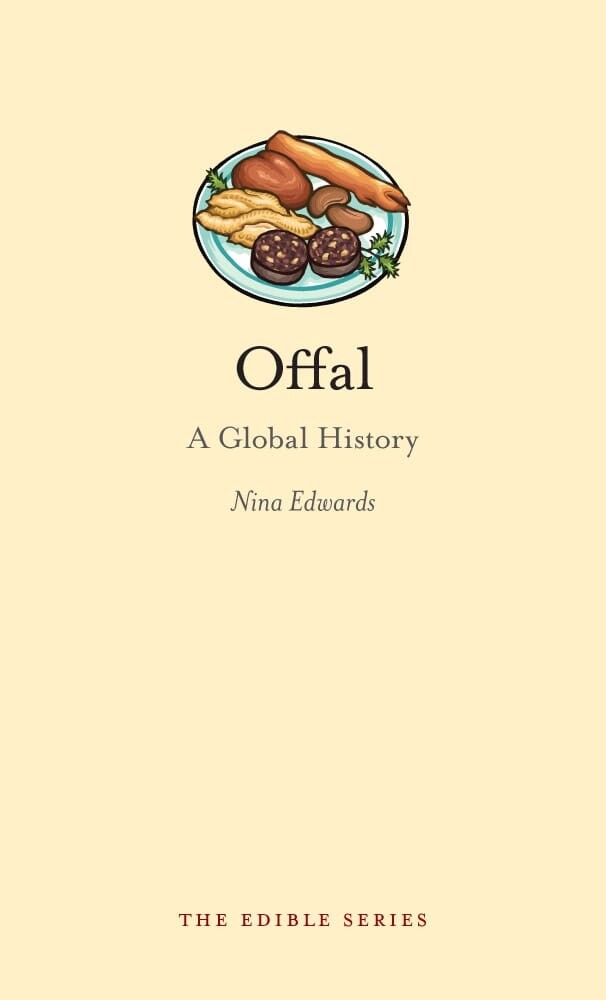
Offal
A Global History
Nina EdwardsWhether you call it offal, variety meat or organ meat, or prefer to eat it unwittingly in burgers and sausages, the whole spectrum of an animal’s glands, essential organs, skin, muscle, guts and every unmentionable in between can be and is eaten across the globe. But can we enjoy a pig’s heart, a cow’s eyes, or a sheep’s brain when it reminds us so viscerally of our own flesh and blood? As Nina Edwards shows in this intriguing history, offal has been consumed and enjoyed across ages and continents, though it is often hidden by the rich variety of terms – like foie gras and sweetbreads – that have evolved to veil its origins.
There are offal dishes that are specific to regional cuisines and holidays, such as Scottish haggis, Jewish chopped liver and Southern states’ chitterlings. Offal is a food of contradictions – it is high in nutrients but also dangerously high in cholesterol, and it can range from expensive haute cuisine to a cheap alternative for the impoverished.
Offal explores our complicated relationship with nose-to-tail eating and the extreme reactions it inspires. From tongue in Sichuan and gizzard stew in Rio de Janeiro to spicy cartilage in Calcutta, Offal sheds new light on the sometimes stomach-churning foods we consume.
Whether you call it offal, variety meat or organ meat, or prefer to eat it unwittingly in burgers and sausages, the whole spectrum of an animal’s glands, essential organs, skin, muscle, guts and every unmentionable in between can be and is eaten across the globe. But can we enjoy a pig’s heart, a cow’s eyes, or a sheep’s brain when it reminds us so viscerally of our own flesh and blood? As Nina Edwards shows in this intriguing history, offal has been consumed and enjoyed across ages and continents, though it is often hidden by the rich variety of terms – like foie gras and sweetbreads – that have evolved to veil its origins.
There are offal dishes that are specific to regional cuisines and holidays, such as Scottish haggis, Jewish chopped liver and Southern states’ chitterlings. Offal is a food of contradictions – it is high in nutrients but also dangerously high in cholesterol, and it can range from expensive haute cuisine to a cheap alternative for the impoverished.
Offal explores our complicated relationship with nose-to-tail eating and the extreme reactions it inspires. From tongue in Sichuan and gizzard stew in Rio de Janeiro to spicy cartilage in Calcutta, Offal sheds new light on the sometimes stomach-churning foods we consume.
-
'
As a vegetarian, owning a book about edible entrails may seem unusual, but nonetheless, Nina Edwards Offal: A Global History rests conspicuously on my bookshelf. This book is hardly a tome at 108 pages, yet it manages to give a very comprehensive history of one of the worlds more controversial cuisines.
'The inquisitiveeater.com
-
'
These are food memoirs, salacious and exotic, colorful, powdered, sweet, greasy and globe-trotting . . . sharp and speedy little reads, spotted with off-kilter illustrations 

'Chicago Tribune
-
'
Embellished with clever illustrations and a nice selection of historical and contemporary recipes . . . [an] outstanding series of food volumes.
'Wall Street Journal
Introduction
1. Definitions and Ideas
2. The Offal Tradition
3. The West
4. Macho Status
5. As Ritual
6. As Medicine
7. Leftovers
Recipes
References
Select Bibliography
Websites and Associations
Acknowledgements
Photo Acknowledgements
Index
Nina Edwards is a freelance writer based in London. Her books include On the Button: The Significance of an Ordinary Item (2011) and Darkness: A Cultural History (Reaktion, 2018).