Art of Death
Visual Culture in the English Death Ritual, c.1500–c.1800
Nigel LlewellynWhereas in our own day the subject of death is usually avoided, in pre-Industrial England the rituals and processes of death were present and immediate. This book explores the meanings behind a range of these artefacts, and describes the attitudes and practices which lay behind their production and use.
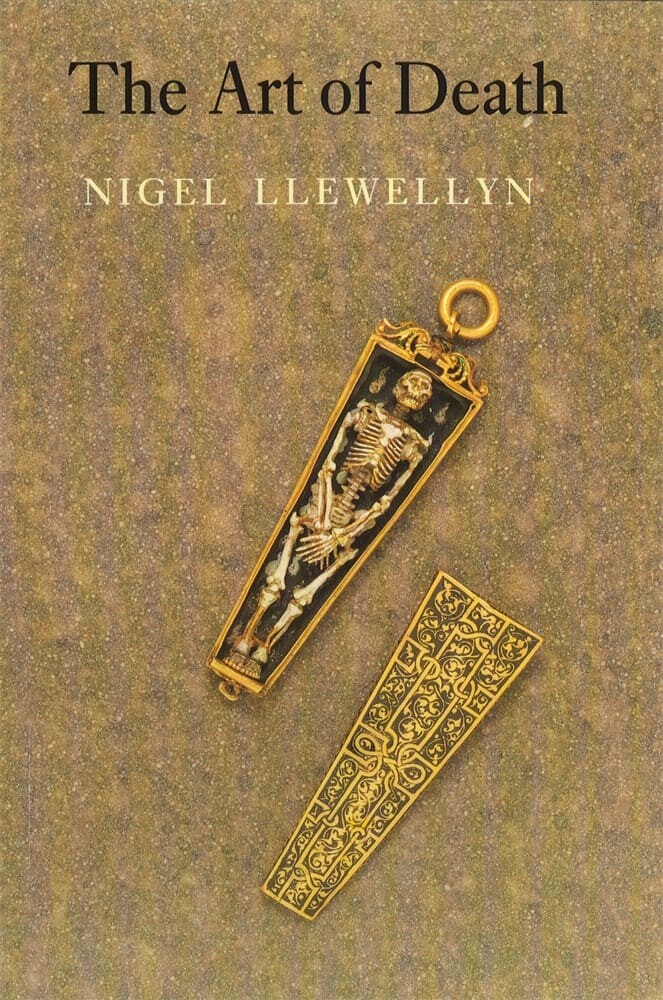
How did our ancestors die? Whereas in our own day the subject of death is usually avoided, in pre-Industrial England the rituals and processes of death were present and immediate. People not only surrounded themselves with memento mori, they also sought to keep alive memories of those who had gone before. This continual confrontation with death was enhanced by a rich culture of visual artefacts. In The Art of Death, Nigel Llewellyn explores the meanings behind an astonishing range of these artefacts, and describes the attitudes and practices which lay behind their production and use.
Illustrated and explained in this book are an array of little-known objects and images such as death’s head spoons, jewels and swords, mourning-rings and fans, wax effigies, church monuments, Dance of Death prints, funeral invitations and ephemera, as well as works by well-known artists, including Holbein, Hogarth and Blake.
Whereas in our own day the subject of death is usually avoided, in pre-Industrial England the rituals and processes of death were present and immediate. This book explores the meanings behind a range of these artefacts, and describes the attitudes and practices which lay behind their production and use.
How did our ancestors die? Whereas in our own day the subject of death is usually avoided, in pre-Industrial England the rituals and processes of death were present and immediate. People not only surrounded themselves with memento mori, they also sought to keep alive memories of those who had gone before. This continual confrontation with death was enhanced by a rich culture of visual artefacts. In The Art of Death, Nigel Llewellyn explores the meanings behind an astonishing range of these artefacts, and describes the attitudes and practices which lay behind their production and use.
Illustrated and explained in this book are an array of little-known objects and images such as death’s head spoons, jewels and swords, mourning-rings and fans, wax effigies, church monuments, Dance of Death prints, funeral invitations and ephemera, as well as works by well-known artists, including Holbein, Hogarth and Blake.
-
'
an enjoyable and interesting book
'London Review of Books
-
'
Nigel Llewellyn’s richly illustrated book is a much-welcomed study on the visual culture made to accompany the English death ritual . . . For the social and cultural historian Llewellyn’s book will be a valuable contribution for the understanding of death rituals as an active mediator between life and death, engaging the living in the preparation for their own death, and preserving the social image of the dead among the living.
'Social History
-
'
The complexity and richness of the materials awaiting the historian of death is made evident in this admirable short study of the English arts of death from 1500-1800. Nigel Llewellyn has gathered a startling array of monuments and images in a variety of media that cumulatively represent early modern cultures attitude to that ubiquitous experience of death.
'American Historical Review
Introduction
I. The Object of Commemoration
II. Rites of Passage
III. Dying, A Process
IV. Dances of Death
V. Examples of Virtue
VI. Death, A Bad Business
VII. Two Bodies
VIII. Body Language
IX. The Natural Body and its Fate
X. Funerals: The Declaration of Difference
XI. Heraldic Displays
XII. Funereal Paraphernalia
XIII. Liturgies
XIV. Worn Out and In
XV. Objects of Mourning
XVI. The Monumental Body
XVII. Kinds of Monument
XVIII. Image Theory
XIX. Epilogue
References
Select Bibliography
List of Illustrations
Acknowledgements
Index
Nigel Llewellyn is a lecturer in the History of Art at the University of Sussex. He has published numerous essays and reviews on English Renaissance art, as well as on Virgil and Ovid.