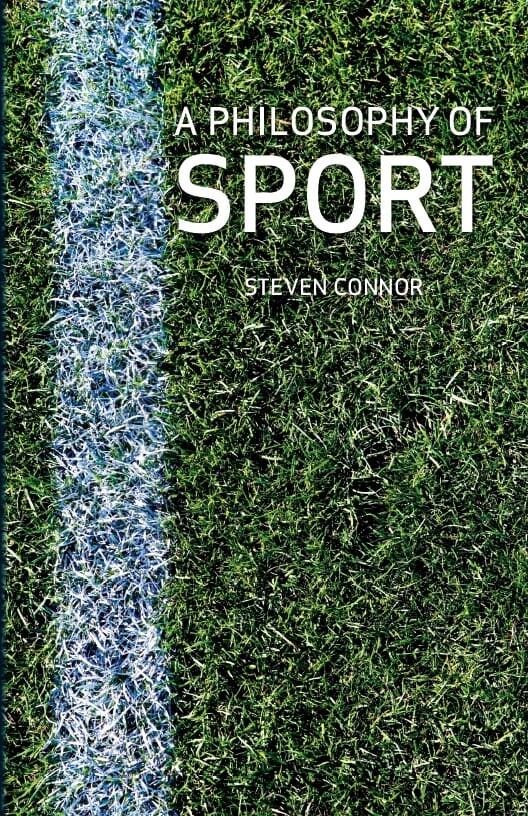
A Philosophy of Sport
Steven ConnorProviding a new philosophical understanding of sport, which defines what sport essentially is and means by setting out a complete grammar of sport, treating in turn its essential elements, A Philosophy of Sport will inform, surprise and delight those who have always thought sport should be taken more seriously.
In A Philosophy of Sport Steven Connor offers a new philosophical understanding of sport in its own terms, in distinction to previous writing on the philosophy of sport that has tended to see sport as a kind of testing ground for philosophical theories devised to deal with other kinds of problems – of ethics, aesthetics or logical categorization. In order to define what sport essentially is and means, Connor presents a complete grammar of sport, isolating and describing its essential elements, including the characteristic spaces of sport, the nature of sporting time, the importance of sporting objects like bats and balls, the methods of movement in sport, the roles of rules and chance, and what it really means to cheat and to win.
Defined as games that involve bodily exertion and exhaustion, sports simultaneously require constraint and the ability to overcome it. Sport, argues Connor, is a fundamental feature of modern humans. It is shown to be one of the most powerful ways in which we negotiate the relationship between the human and natural worlds. Encompassing a huge range of different sports, and enlisting the help of Hegel, Freud, Wittgenstein, Heidegger, Adorno, Sartre, Ayer, Deleuze and Serres, A Philosophy of Sport will inform, surprise and delight thoughtful athletes and sporty philosophers alike.
Providing a new philosophical understanding of sport, which defines what sport essentially is and means by setting out a complete grammar of sport, treating in turn its essential elements, A Philosophy of Sport will inform, surprise and delight those who have always thought sport should be taken more seriously.
In A Philosophy of Sport Steven Connor offers a new philosophical understanding of sport in its own terms, in distinction to previous writing on the philosophy of sport that has tended to see sport as a kind of testing ground for philosophical theories devised to deal with other kinds of problems – of ethics, aesthetics or logical categorization. In order to define what sport essentially is and means, Connor presents a complete grammar of sport, isolating and describing its essential elements, including the characteristic spaces of sport, the nature of sporting time, the importance of sporting objects like bats and balls, the methods of movement in sport, the roles of rules and chance, and what it really means to cheat and to win.
Defined as games that involve bodily exertion and exhaustion, sports simultaneously require constraint and the ability to overcome it. Sport, argues Connor, is a fundamental feature of modern humans. It is shown to be one of the most powerful ways in which we negotiate the relationship between the human and natural worlds. Encompassing a huge range of different sports, and enlisting the help of Hegel, Freud, Wittgenstein, Heidegger, Adorno, Sartre, Ayer, Deleuze and Serres, A Philosophy of Sport will inform, surprise and delight thoughtful athletes and sporty philosophers alike.
-
'
[a] sparkling work . . . what we find in Connors book is a series of historical, sociological, metaphysical and existential reflections on intriguing but often neglected aspects of sport . . . Connor does not, it seems, try to persuade us of any grand thesis about sport, yet he rarely fails to illuminate . . . there is plenty here to fascinate.
'TLS
-
'
Connor muses interestingly on the football pitch as a palimpsest of geometries on why to be in the lead is to have an advantage in time, to have wound the clock forward on the extreme demands made on the too-easily-mocked sports commentator on sprinting as the enraptured attempt to escape the capturing drag of mass on the utility of magical thinking in the follow-through of bat or club and on how one does things with balls.
'The Guardian
-
'
this book will confirm [Connors] reputation as an entertaining and lucid thinker.
'Radical Philosophy
-
'
Connor takes aim at the significance and nature of sport. His purpose is to understand sport and its collective meaning. Rather than examining these issues in terms of traditional philosophical areas such as metaphysics, ethics, or aesthetics, Connor takes a cultural-phenomenological approach. Recommended.
'Choice
Introduction
Chapter One: History
Chapter Two: Space
Chapter Three: Time
Chapter Four: Movement
Chapter Five: Equipment
Chapter Six: Rules
Chapter Seven: Winning
References
Index
Steven Connor is Professor of English and Director of Research at the Digital Futures Institute, King’s College London. He is the author of eighteen books, most recently The Madness of Knowledge: On Wisdom, Ignorance and Fantasies of Knowing (2019).