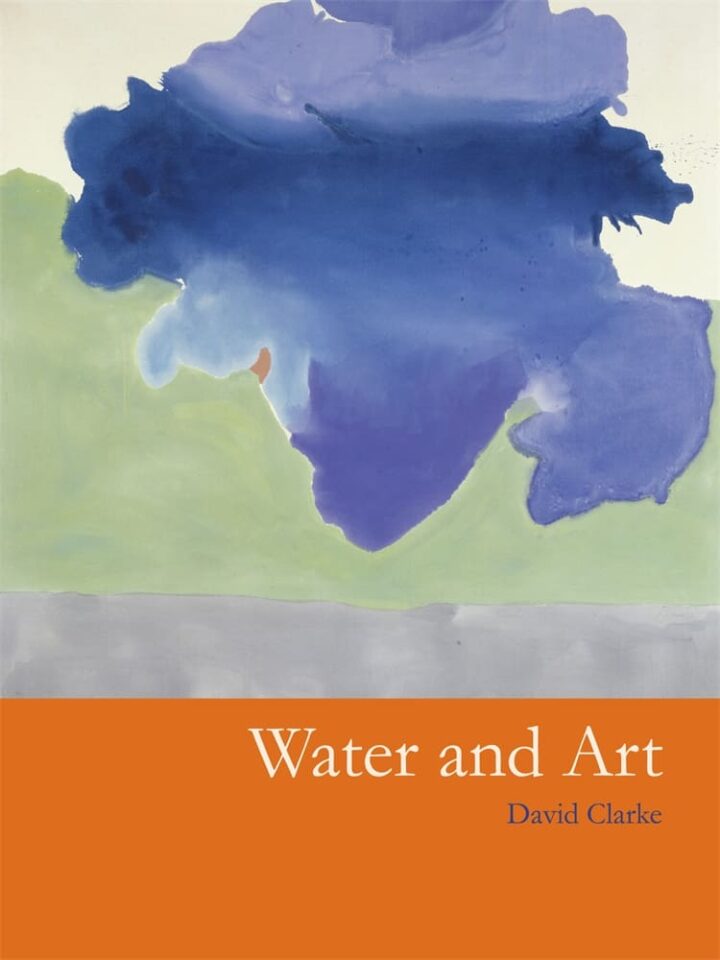
Water and Art
David ClarkeRestless, protean, fluid, evanescent - despite being hugely challenging to represent visually, water has gained a peculiar significance in the art of the twentieth century. This book probes the ways in which water has gained an unprecedented prominence in modern Western art.
Restless, protean, fluid, evanescent – despite being hugely challenging to represent visually, water has gained a peculiar significance in the art of the twentieth century. This may be due to the fact that it allows for a range of metaphorical meanings, many of which are particularly appropriate to the modern age. Not only a subject of contemporary art, but also a material increasingly used in art-making, water’s double presence can be detected as much in the marine-themed watercolours of Turner as in the more recent works of performance and installation art in which it is directly employed as a medium.
Water and Art probes the ways in which water has gained an unprecedented prominence in modern Western art, as well as seeking to illuminate its depiction in earlier periods. David Clarke employs a cross-cultural approach, finding parallels within Chinese art, which draws on a cultural tradition in which water has a marked presence as both subject and medium.
Featuring a wealth of images by artists from East and West including Leonardo da Vinci, Bernini, Turner, Gericault, Klee, Matisse, Monet, Picasso, Mondrian, Kandinsky, Fu Baoshi, Shi Tao, Wei Zixi and Fang Rending, Water and Art helps to promote a new and less culturally narrow approach to the understanding of art. Fast-paced, accessible, and comprehensive, it will appeal to the specialist and the general reader alike, offering fresh perspectives on familiar artists as well as an introduction to others who are much less recognised in the literature of art history.
Restless, protean, fluid, evanescent - despite being hugely challenging to represent visually, water has gained a peculiar significance in the art of the twentieth century. This book probes the ways in which water has gained an unprecedented prominence in modern Western art.
Restless, protean, fluid, evanescent – despite being hugely challenging to represent visually, water has gained a peculiar significance in the art of the twentieth century. This may be due to the fact that it allows for a range of metaphorical meanings, many of which are particularly appropriate to the modern age. Not only a subject of contemporary art, but also a material increasingly used in art-making, water’s double presence can be detected as much in the marine-themed watercolours of Turner as in the more recent works of performance and installation art in which it is directly employed as a medium.
Water and Art probes the ways in which water has gained an unprecedented prominence in modern Western art, as well as seeking to illuminate its depiction in earlier periods. David Clarke employs a cross-cultural approach, finding parallels within Chinese art, which draws on a cultural tradition in which water has a marked presence as both subject and medium.
Featuring a wealth of images by artists from East and West including Leonardo da Vinci, Bernini, Turner, Gericault, Klee, Matisse, Monet, Picasso, Mondrian, Kandinsky, Fu Baoshi, Shi Tao, Wei Zixi and Fang Rending, Water and Art helps to promote a new and less culturally narrow approach to the understanding of art. Fast-paced, accessible, and comprehensive, it will appeal to the specialist and the general reader alike, offering fresh perspectives on familiar artists as well as an introduction to others who are much less recognised in the literature of art history.
-
'
Clarke offers an alternative reading to the traditional narrative of modern and contemporary art by arguing that water has played a profound role in European and Chinese art . . . The ample illustrations and well-written prose support his argument that water’s double presence – the author’s terminology describing the signifier and signified of water – has allowed artists to foreground fluidity and dissolution, and in so doing to reference the unbounded, changing nature of art and the world . . . An insightful new reading that will be of value to advanced students and scholars . . . Highly recommended.
'Choice
-
'
Clarke's focus is on modern and contemporary art, and he demonstrates that our fascination remains fully intact and took on new significance in the modern and post-modern era. From the seascapes of Turner to the geometric abstractions of Mondrian, water offered a provocative challenge to the modern artist.
'Arlis
Introduction
1 The Place of Water in European Art
2 Monet and the Surface of Water
3 Paths to Dissolution: Water and Abstract Art
4 Raining, Drowning and Swimming: Fu Baoshi and Water
5 The Watery Turn in Contemporary Chinese Art
References
Acknowledgements
Photo Acknowledgements
Index
David Clarke is Honorary Professor in the Department of Art History at the University of Hong Kong. He has been active as an art historian (writing on both Western and Asian art) and as an artist (particularly as a photographer). Amongst his many books are Hong Kong Art: Culture and Decolonization (Reaktion Books, 2001), Hong Kong x 24 x 365: A Year in the Life of a City (2007), Water and Art (Reaktion Books, 2010), Chinese Art and its Encounter with the World (2011) and
China – Art – Modernity (2019).