


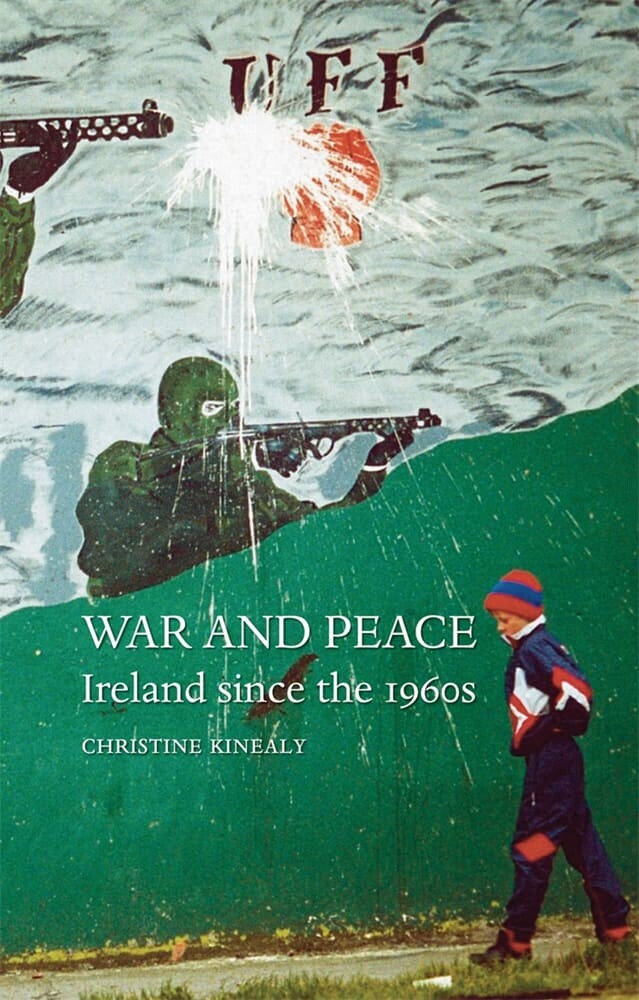
War and Peace
Ireland Since the 1960s
Christine KinealyA comprehensive history of Ireland over the last fifty years which examines many aspects of Irish history, including the effects of the women's movement, Ireland's entry into the European Union, and gives a thorough and up-to-date account of 'The Troubles;' it is essential reading for anyone interested in Ireland's recent past.
Over the past fifty years Ireland has been through a period of intense change, and has experienced both challenges and successes. In War and Peace: Ireland since the 1960s, historian Christine Kinealy explores the political triumphs and travails in Ireland over this period.
Kinealy provides a thorough and up-to-date account of the unfolding of The Troubles, the three decades of violence and social unrest between Catholic nationalists and Protestant unionists. She explores the Republic of Ireland's entry into the European Union in 1973, its often contentious relationship with Britain, and the changes in rates of emigration to the USA and the rest of the world. The women's movement in the 1970s and the successive election of two female presidents proved the Republic's ability to accept and internalize social change, and despite Catholic Church scandals and Northern Ireland's turbulence, this partitioned island has remained a significant presence on the world stage. Ireland's economy has also transformed over the last fifty years: the phenomenon of the ‘Celtic Tiger’, the introduction of the euro, and Ireland’s current struggle with the global recession brings the story up to date.
This book presents a comprehensive panorama of the events that have shaped Ireland's social and political landscape over the last fifty years. It will be essential reading for anyone interested in Ireland's recent past, and how it will continue to develop in the future.
A comprehensive history of Ireland over the last fifty years which examines many aspects of Irish history, including the effects of the women's movement, Ireland's entry into the European Union, and gives a thorough and up-to-date account of 'The Troubles;' it is essential reading for anyone interested in Ireland's recent past.
Over the past fifty years Ireland has been through a period of intense change, and has experienced both challenges and successes. In War and Peace: Ireland since the 1960s, historian Christine Kinealy explores the political triumphs and travails in Ireland over this period.
Kinealy provides a thorough and up-to-date account of the unfolding of The Troubles, the three decades of violence and social unrest between Catholic nationalists and Protestant unionists. She explores the Republic of Ireland's entry into the European Union in 1973, its often contentious relationship with Britain, and the changes in rates of emigration to the USA and the rest of the world. The women's movement in the 1970s and the successive election of two female presidents proved the Republic's ability to accept and internalize social change, and despite Catholic Church scandals and Northern Ireland's turbulence, this partitioned island has remained a significant presence on the world stage. Ireland's economy has also transformed over the last fifty years: the phenomenon of the ‘Celtic Tiger’, the introduction of the euro, and Ireland’s current struggle with the global recession brings the story up to date.
This book presents a comprehensive panorama of the events that have shaped Ireland's social and political landscape over the last fifty years. It will be essential reading for anyone interested in Ireland's recent past, and how it will continue to develop in the future.
-
'
Professor Kinealy has written a detailed examination of the events that shaped Ireland on both sides of the border during the last 50 years. It is one of those essential books that do not come along too frequently . . . [an] excellent work.
'Peter Berresford Ellis, Irish Post
-
'
Kinealy provides a comprehensive examination of the effects of the Troubles in the evolution of the recent history of Ireland and Northern Ireland. Writing from a perspective that focuses on the civil rights aspects of the conflict, the author explores the narrative of events in a well-researched, well-written manner. It is especially enriching to learn from her how the cultural, literary, and musical fields influenced and responded (or sometimes did not respond) to the Troubles. Highly recommended.
'Choice
-
'
Kinealys attention to the history of women and observations of culture, both high and low, is well done and very valuable . . . this is a valuable and elegantly written survey, with much to hold the attention.
'Twentieth Century British History
-
'
Most now know the sorry tale of how suppression of civil rights let to disorder on the streets, how British troops moved from protectors to aggressors, how Bloody Sunday, the hunger strikes, the Anglo-Irish Agreement and then the Good Friday Agreement sent major convulsions then grudging acceptance through large sections of our society. All this Christine Kinealy covers with clarity and energy, and with a quiet authority thats rare . . . If you know someone whose mind needs opening and/or whos in need of an absorbing Christmas read, buy this book. They dont come much better than this.
'South Belfast News
-
'
[Christine Kinealy] provides a deep and detailed examination of Irelands historical ups and downs including the Troubles, and the Republic of Irelands entry into the EU in 1973, whilst also exploring Irelands complicated and complex relationship with Britain . . . This is an invaluable book that gives a comprehensive picture of Ireland's social and political landscape over the past fifty years.
'Irish World
Irish Phrases and Abbreviations
Introduction
1 Fault Lines
2 Troubles
3 War
4 Implosion
5 Stalemate
6 Hunger
7 Overtures
8 Ceasefire
9 Endgame
Epilogue: Aftershock
References
Bibliography
Acknowledgements
Index
Christine Kinealy is Professor of History at the Caspersen Graduate School at Drew University in New Jersey. She is the author of many books, including Repeal and Revolution (2009) and The Great Famine in Ireland (2002).