


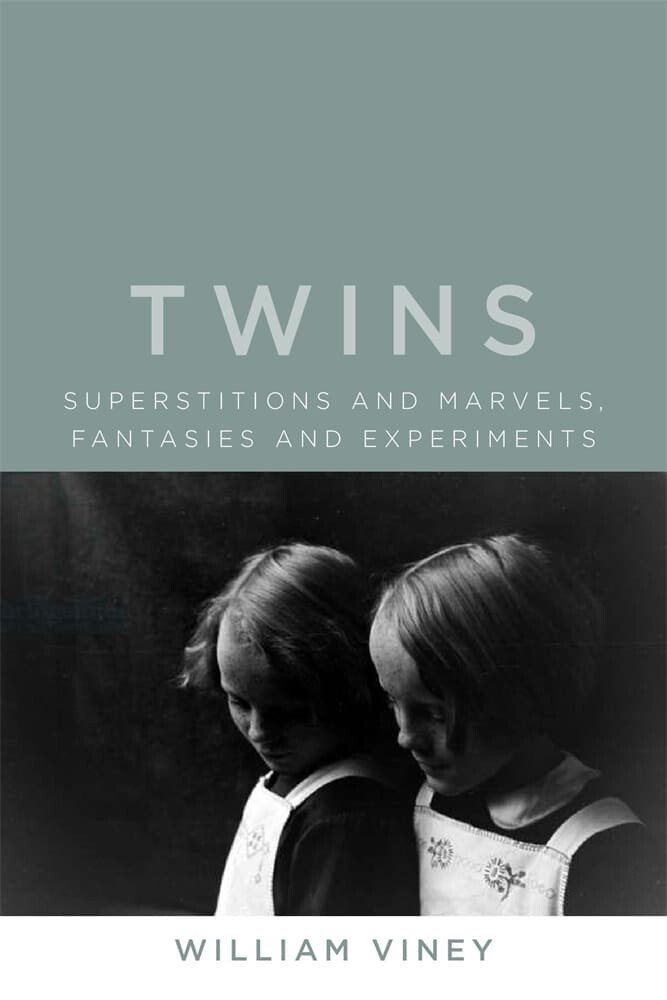
Twins
Superstitions and Marvels, Fantasies and Experiments
William VineyThe superstitions, marvels, fantasies and experiments of twins.
Human twins have many meanings and different histories. They have been seen as gods and monsters, signs of danger, death and sexual deviance. They are taken as objects of wonder and violent repression, the subjects of scientific experiment. Now millions are born through fertility technologies. Their history is often buried in philosophies and medical theories, religious and scientific practices, and countless stories of devotion and tragedy.
In this history of superstitions and marvels, fantasies and experiments William Viney – himself a twin – shows how the use and abuse of twins has helped to shape the world in which we live. This book has been written for twins and for anyone interested in their historical, global and political impact.
The superstitions, marvels, fantasies and experiments of twins.
Human twins have many meanings and different histories. They have been seen as gods and monsters, signs of danger, death and sexual deviance. They are taken as objects of wonder and violent repression, the subjects of scientific experiment. Now millions are born through fertility technologies. Their history is often buried in philosophies and medical theories, religious and scientific practices, and countless stories of devotion and tragedy.
In this history of superstitions and marvels, fantasies and experiments William Viney – himself a twin – shows how the use and abuse of twins has helped to shape the world in which we live. This book has been written for twins and for anyone interested in their historical, global and political impact.
-
'
When William Viney writes about twins, he knows whereof he speaks. The author is himself a twin and his meticulously researched narrative of superstitions, fantasies and experiments reveals the way in which twins have long fascinated us and played a part in shaping our world.
'Geographical Magazine
-
'
An intelligent and brilliant history, from ancient times to the present – a cultural history of twins which is also a collective history of their representations.
'La Repubblica
-
'
The "metamorphic potential" of twins tells us as much about the values of a culture as it does about the mechanics of biology. Viney explores these complexities with style, achieving that rare balance of scholarly rigour and immense readability.
'Fortean Times
-
'
a rich, interdisciplinary study . . . Twins is a carefully researched and clearly written account of how twins have been both feared and revered. Drawing from mythology, philosophy, and medicine, it shows how investigating notions of twins can aid our understanding of what it means to be human.
'Folklore Journal
-
'
This is a book of probing intelligence, curiosity, and wit, of quickened fascination, and sometimes fear. Will Viney takes us on an ever-expanding and ever-more intimate journey through our ways of thinking about and with twins, the poetry, science, and theater of twin-ship. He explores what these help us to know of the human, and what they can make us blind to. Twins shifts the ways you see familiar things, and the ways we name the stranger ones.
'Kenneth Gross, author of 'Puppet: An Essay on Uncanny Life'
-
'
William Viney unfolds what he calls the secret history of wonder attaching to twins, in a book that, in its intelligence and sinuous, intent inquisitiveness, is itself a thing of wonder. Ranging from ancient mythology to contemporary biotechnology, Viney explores the dualities that themselves define twins, as figures both of miracle and of menace. Mirroring with its polymorphous subject, Twins is a positive feat of superfetation.
'Steven Connor, Grace 2 Professor of English, University of Cambridge
INTRODUCTION
1 TWINS ARE MYTHS
2 TWINS ARE MONSTERS
3 TWINS ARE DANGEROUS
4 TWINS ARE GLOBAL
5 TWINS ARE BIRDS
6 TWINS ARE EXPERIMENTS
7 TWINS ARE MADE
8 TWINS ARE PERFORMERS
9 TWINS ARE WORDS
POSTSCRIPT
REFERENCES
FURTHER READING
ACKNOWLEDGEMENTS
PHOTO ACKNOWLEDGEMENTS
INDEX
William Viney is a researcher in the Department of Anthropology, Goldsmiths, University of London. His writing has appeared in Cabinet, Critical Quarterly, frieze, and the Times Literary Supplement. He is the author of Waste: A Philosophy of Things (2014).