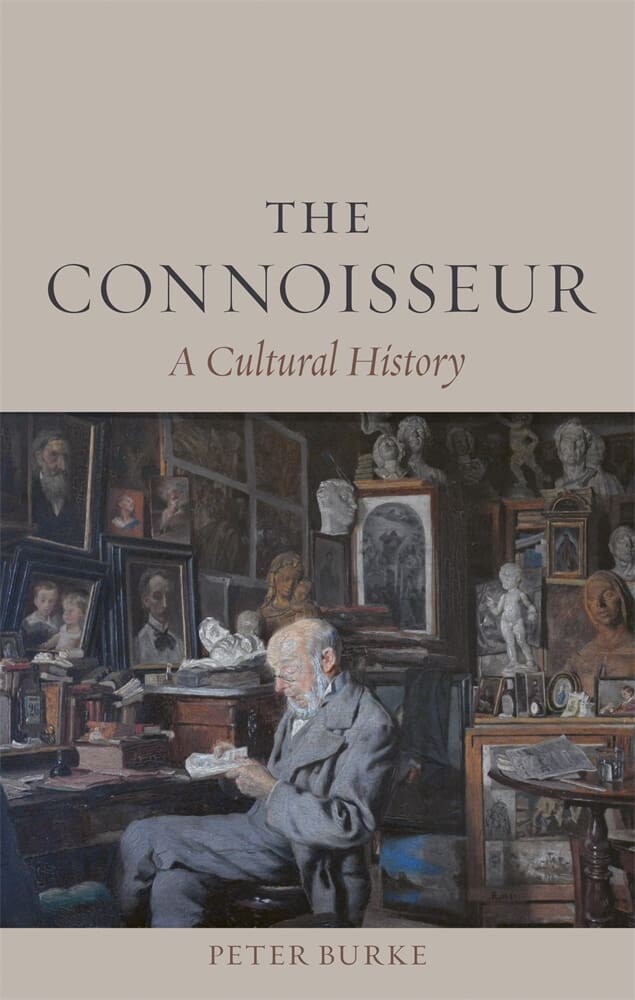
The Connoisseur
A Cultural History
Peter BurkeThe art connoisseur from the Renaissance to the present day.
The connoisseur has been an influential, if somewhat mysterious, figure in the history of art, responsible for making or breaking high-profile collections and reputations and influencing taste, the art market and the field of art history with their pronouncements. But what did it take to become a connoisseur, and how reliable were the great connoisseurs of previous centuries? With the advent of scientific techniques and artificial intelligence, what future is there for expertise based on the trained eye?
This book offers the first history of the art connoisseur, from the Renaissance to the professionalization of the role in the nineteenth century and on to the present day. Featuring portrayals of some of the leading connoisseurs, such as Bernard Berenson, Roberto Longhi and Giovanni Morelli, this is a highly readable history of the extraordinary characters and intellects that shaped the art world through a mixture of intuition, learning and chutzpah.
The art connoisseur from the Renaissance to the present day.
The connoisseur has been an influential, if somewhat mysterious, figure in the history of art, responsible for making or breaking high-profile collections and reputations and influencing taste, the art market and the field of art history with their pronouncements. But what did it take to become a connoisseur, and how reliable were the great connoisseurs of previous centuries? With the advent of scientific techniques and artificial intelligence, what future is there for expertise based on the trained eye?
This book offers the first history of the art connoisseur, from the Renaissance to the professionalization of the role in the nineteenth century and on to the present day. Featuring portrayals of some of the leading connoisseurs, such as Bernard Berenson, Roberto Longhi and Giovanni Morelli, this is a highly readable history of the extraordinary characters and intellects that shaped the art world through a mixture of intuition, learning and chutzpah.
-
'
In The Connoisseur: A Cultural History, the distinguished scholar Peter Burke recounts how he first learned about connoisseurship from Edgar Wind, Oxford's first- ever professor of Art History . . . Burke's aim in The Connoisseur is to examine connoisseurship as it has been practised since the Renaissance, by artists, dealers, collectors, restorers and forgers . . . Burke has always written with great clarity and assurance, and a deceptively light touch despite the awesome quantity of information inside his head. This short, elegant, illuminating volume provides a masterclass in the art of cultural history. Whether aspiring or experienced, all connoisseurs will be grateful for it. Edgar Wind would have been proud of his pupil.
'The Critic
-
'
Burke proves his own connoisseurial skill . . . He concludes that the connoisseur still has a crucial role alongside, and not instead of, documentation.
'Apollo Magazine
-
'
No one can say anything sensible about undocumented artworks without connoisseurship. This practice relies exclusively on judgments based on comparisons informed by feats of visual memory. But those judgments follow rules that do not necessarily capture actuality. It has taken an historian of Peter Burke’s acuity to analyze the development of a form of attention–connoisseurship that relies on questionable rules unacknowledged by those who follow them. Burke’s tour d’horizon is a tour de force.
'Ivan Gaskell, Bard Graduate Center
-
'
Peter Burke sheds light on one of the most enigmatic and captivating aspects of the history of art.
'Paolo Coen, University of Teramo
-
'
This magisterial history of social connoisseurship by a leading cultural historian covers the field in the last five hundred years. Following the codification of the methodology in the 17th and 18th centuries, Peter Burke presents a rich insight and critical assessment of the achievement, as well as the limitations, of the methodology in the development of modern art history over the last two hundred years.
'Jean Michel Massing, King's College, Cambridge
-
'
Peter Burke’s brilliant and entertaining study provides a longue durée history of connoisseurship. From its origins among Renaissance artists judging one another’s work to the era of experts with immense memories, forensic powers of scrutiny, fearless chutzpah and, on occasion, malleable morals, it brings the story right up to date, examining how technical analysis, archival research, and artificial intelligence have joined—but not wholly replaced—the discerning eye. With his usual lucidity and balance, Burke queries the method of connoisseurship but does not deny its successes.
'Paul Taylor, Warburg Institute
Preface
1 What Is Connoisseurship?
2 The Birth of the Connoisseur
3 Codifying Connoisseurship
4 The Age of the Amateurs
5 The Age of the Professionals
6 Globalization and Science
7 Crisis
Conclusion: Can We Trust Connoisseurship?
References
Further Reading
Acknowledgements
Photo Acknowledgements
Index
Peter Burke is a pioneering cultural historian and author of over thirty books, including Eyewitnessing: The Uses of Images as Historical Evidence (Reaktion, 2019). His books have been translated into more than thirty languages. He is a Life Fellow of Emmanuel College, Cambridge, and a Fellow of the British Academy.