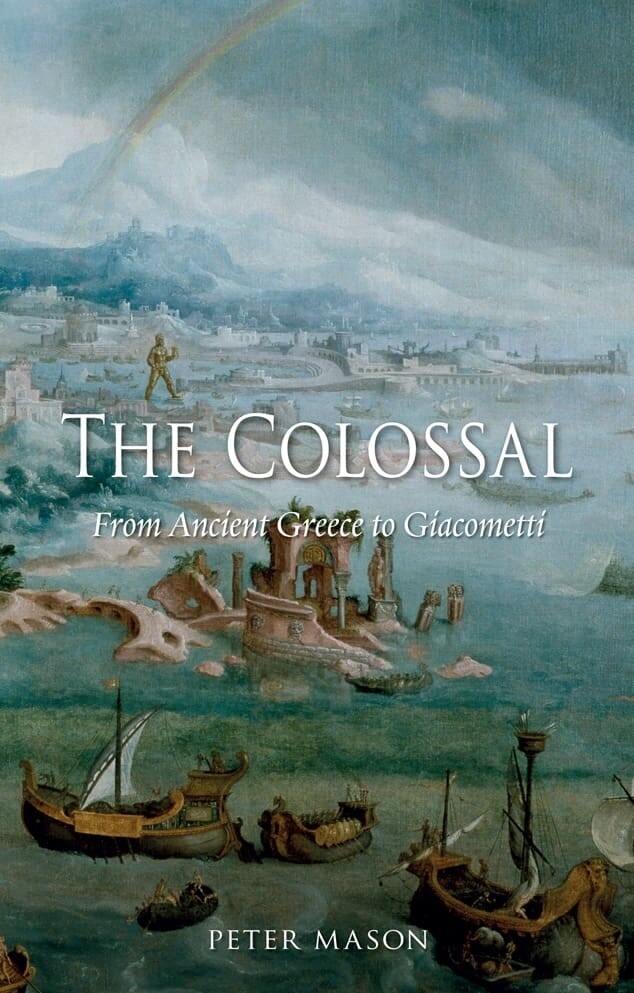
The Colossal
From Ancient Greece to Giacometti
Peter MasonPeter Mason's book is an analysis of the colossal throughout history - the colossal in the sense both of scale and also as symbol, used particularly by European surrealists.
From the obelisks of Egypt, the Colossus of Rhodes and the Roman Colosseum to the gigantic heads of the Olmecs and the moai of Easter Island, the ‘colossal’ designates the immense, the monumental, that which is of overwhelming size. In The Colossal: From Ancient Greece to Giacometti these examples – instances of what we commonly understand to be colossal – are situated in their historical and cultural contexts. But this book also explores an older sense of the word that has little to do with scale: that of the kolossos, a statuette or effigy used in ancient Greek rituals. These small figures, which embodied the dualities of presence and absence, life and death, mobility and immobility, are linked to twentieth-century Europe and the world of the Surrealists, establishing an interpretation of the colossal that is at once archaic and contemporary.
In this book Peter Mason takes a multidisciplinary approach to the history and theory of the colossal, ultimately arguing that the artist who best tapped into the true meaning of ‘colossal’ was Alberto Giacometti. He shows that the artist’s enigmatic work The Cube articulates themes that tie it firmly to the world of the ancients in Greece, Mesoamerica and the Pacific.
Combining archaeological evidence, cultural perspectives and art history, The Colossal is a fascinating look at the idea of the colossal. From the monolithic sculptures of long-dead civilizations to Giacometti’s unsettling sculptures, this is an innovative book that will appeal to all those with an interest in the history and theory of the visual.
Peter Mason's book is an analysis of the colossal throughout history - the colossal in the sense both of scale and also as symbol, used particularly by European surrealists.
From the obelisks of Egypt, the Colossus of Rhodes and the Roman Colosseum to the gigantic heads of the Olmecs and the moai of Easter Island, the ‘colossal’ designates the immense, the monumental, that which is of overwhelming size. In The Colossal: From Ancient Greece to Giacometti these examples – instances of what we commonly understand to be colossal – are situated in their historical and cultural contexts. But this book also explores an older sense of the word that has little to do with scale: that of the kolossos, a statuette or effigy used in ancient Greek rituals. These small figures, which embodied the dualities of presence and absence, life and death, mobility and immobility, are linked to twentieth-century Europe and the world of the Surrealists, establishing an interpretation of the colossal that is at once archaic and contemporary.
In this book Peter Mason takes a multidisciplinary approach to the history and theory of the colossal, ultimately arguing that the artist who best tapped into the true meaning of ‘colossal’ was Alberto Giacometti. He shows that the artist’s enigmatic work The Cube articulates themes that tie it firmly to the world of the ancients in Greece, Mesoamerica and the Pacific.
Combining archaeological evidence, cultural perspectives and art history, The Colossal is a fascinating look at the idea of the colossal. From the monolithic sculptures of long-dead civilizations to Giacometti’s unsettling sculptures, this is an innovative book that will appeal to all those with an interest in the history and theory of the visual.
-
'
This is an attractive book, nicely illustrated, and it covers some fascinating territory . . . Mason explains the role played by Egyptian obelisks in articulating urban space in Rome and elsewhere in Europe, and in characterizing space as metropolitan and European in the colonial New World.
'TLS
-
'
Peter Mason spans the centuries with a broad sweep. Taking the Colossos of Rhodes, the Roman Colosseum, the Easter Island statues, the gigantic heads of the Olmecs and Egyptian obelisks, the author develops a theory of the colossal that goes beyond size . . . Mason convincingly links the ancient world with the 20th century, showing yet again how the past and present are entwined.
'Prospect
Introduction: Inventions of the Colossal
1. Locating the Colossal
2. Obelisks on the Move
3. The Colossal Statues of Easter Island
4. Colossal Heads
5. Collecting Moai
6. Technology and Surrealism
Epilogue
References
List of Illustrations
Acknowledgements
Index
Peter Mason has written and lectured widely in the field of the history of art and visual culture, especially in relation to Latin America. His previous books include The Lives of Images (Reaktion Books, 2001) and Before Disenchantment: Images of Exotic Animals and Plants in the Early Modern World (Reaktion, 2009).