


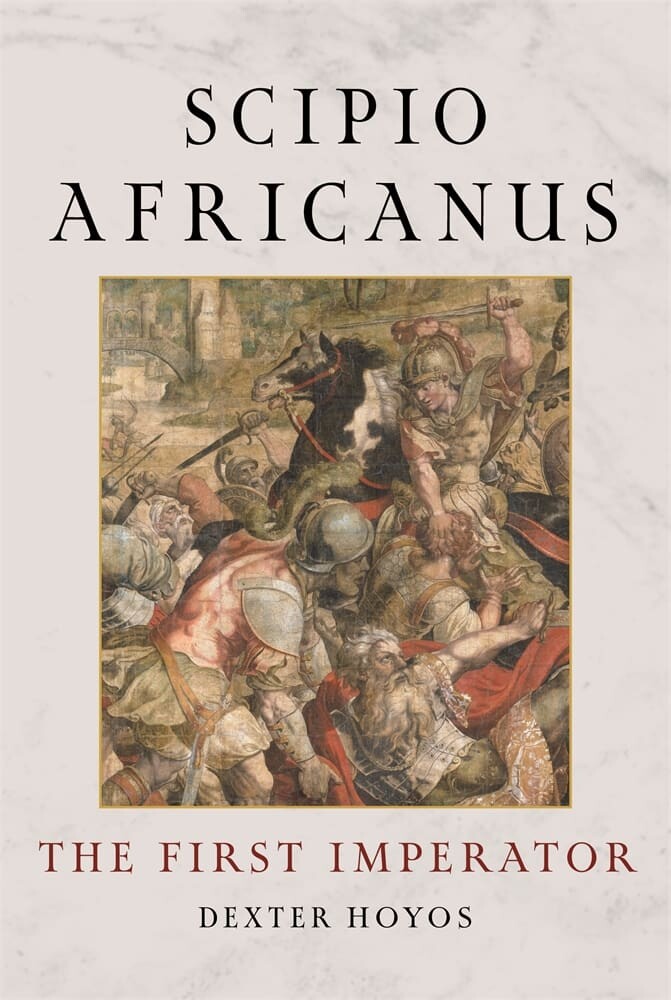
Scipio Africanus
The First Imperator
Dexter HoyosA major new biography of the formidable Roman commander Scipio Africanus.
Scipio Africanus (235–183 BC) commanded his first army at the age of 25, led a daring invasion in Africa to personally defeat Hannibal and secured Rome’s dominance over the Mediterranean. In ten years of command he never lost a battle, employing bold strategies to triumph over six enemy generals. Charismatic, ruthless and self-confident almost to the point of arrogance, Scipio was the first Roman leader hailed as Imperator, ‘victorious commander’, a title later adopted by emperors. He drove Carthage’s forces from Spain and annexed its territories, and later imposed terms on Antiochus III, extending Rome’s reach eastward; yet political jealousy at home led to his bitter exile. This biography explores the fortunes, fame and fate of a leader who outshone Caesar in military genius.
A major new biography of the formidable Roman commander Scipio Africanus.
Scipio Africanus (235–183 BC) commanded his first army at the age of 25, led a daring invasion in Africa to personally defeat Hannibal and secured Rome’s dominance over the Mediterranean. In ten years of command he never lost a battle, employing bold strategies to triumph over six enemy generals. Charismatic, ruthless and self-confident almost to the point of arrogance, Scipio was the first Roman leader hailed as Imperator, ‘victorious commander’, a title later adopted by emperors. He drove Carthage’s forces from Spain and annexed its territories, and later imposed terms on Antiochus III, extending Rome’s reach eastward; yet political jealousy at home led to his bitter exile. This biography explores the fortunes, fame and fate of a leader who outshone Caesar in military genius.
-
'
Dexter Hoyos captivates the reader not only with a narration of the military achievements of an outstanding general, but with the intricate world of Roman republican politics at a crossroads period of its history. This fascinating history, written with erudition and profound skill, covers such themes as aristocratic faction fighting, dubious family affairs, religious controversies and even corruption.
'Toni Ñaco del Hoyo, ICREA Research Professor in Ancient History, University of Girona, Spain, and co-editor of War, Warlords, and Interstate Relations in the Ancient Mediterranean
-
'
Amazingly knowledgeable, delightfully readable: Dexter Hoyos’s book tells of the exceptional life of Scipio Africanus, the great Hannibal’s greater foe.
'Michael Sommer, Professor of Ancient History, Carl von Ossietzky University of Oldenburg
-
'
Dexter Hoyos has combined formidable scholarship with superb narrative skills to create an absorbing study of Scipio Africanus, hero of the Roman war against Hannibal and one of the most intriguing figures of antiquity. This fascinating volume will be welcomed by all devotees of Roman history, whatever their level.
'Anthony Barrett, Professor Emeritus at the University of British Columbia and Visiting Professor at the University of Heidelberg
-
'
Dexter Hoyos’ Scipio Africanus is a deeply scholarly but hugely readable biography of one of the most famous but curiously under-explored figures of the ancient world. Hoyos puts his knowledge of the borderlands of the Roman world to excellent use in this thorough and convincing history of the man, his military success and his eventual fate.
'Steven Hunt, Associate Teaching Professor in Classics Education, University of Cambridge
Abbreviations
Roman First Names
Preface: Scipio and His Narrators
1 The Cornelii and Rome
2 Boyhood, Youth and War
3 The Capture of New Carthage
4 Baecula and Ilipa
5 The Fall of Carthaginian Spain
6 Consul and Proconsul
7 Scipio in Africa: Utica and the Great Plains
8 Zama and Peace
9 Scipio in Peacetime
10 Scipio’s Last War
11 Scipio under Siege
12 Evaluating Scipio
Roman Terms
Special Notes
References
Bibliography
Acknowledgements
Index
Dexter Hoyos is Honorary Associate Professor at Sydney University, Australia. His books include Rome Victorious: The Irresistible Rise of the Roman Empire (2019).