


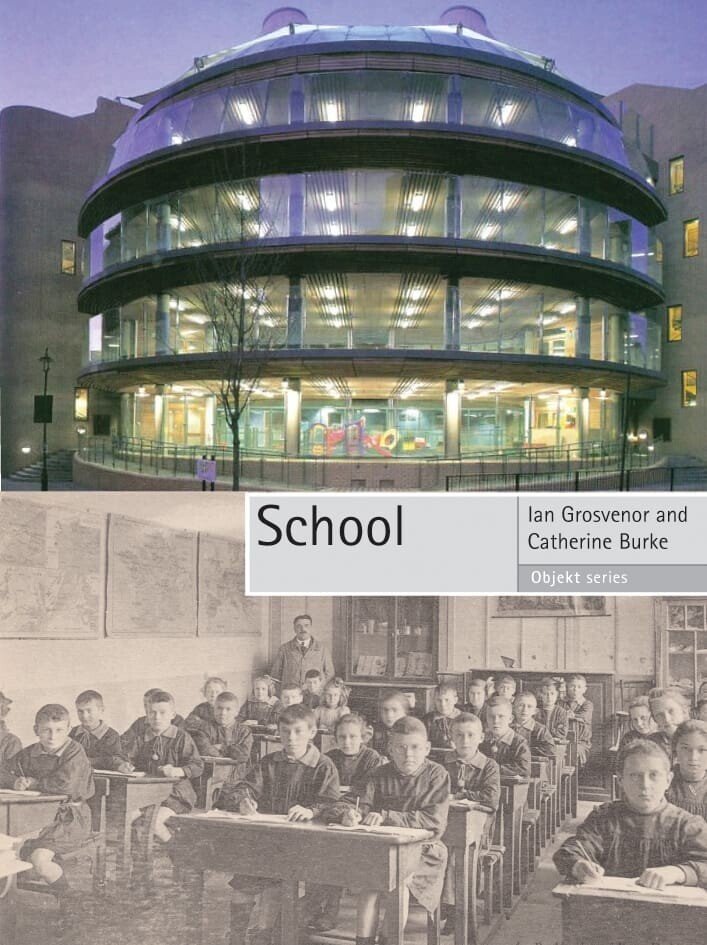
School
Catherine Burke, Ian GrosvenorPart of the "Objekt" series, this book offers an analysis of the forms, operations and meanings of the school. Organized around the themes of time, space and place, it deals with the form and function of schools, and presents a global review of how design and architecture have kept pace with innovation in schools in the modern period.
As a specific form of architecture, the school is an amalgam of its function and its history. Though recognisable across cultures, the schoolhouse nevertheless retains the distinctive markings of different nations and eras. School is the first book to examine this institutional building’s modern growth on a global scale.
Ian Grosvenor and Catherine Burke demonstrate how school buildings help organise and discipline time and space for teachers and students, using methods ranging from bells to lines to lesson plans. They reveal the ways in which schools, by their actual physical situation - surrounded by swathes of green or butting up against other urban structures, in neighbourhoods stratified by class or segregated by race - make clear their place in society as fragmented sites of cultural memory and cultural creation.
The authors further consider how new technologies and continuing globalization will inevitably force us to rethink our notions of school - and school buildings. In the twenty-first century, these shifts represent a radically new context for education.
School provides a thoughtful engagement with this thoroughly modern building type; its structure, operations and architecture. The book will provide stimulating reading for anyone interested in this extraordinary synthesis of form and function.
Part of the "Objekt" series, this book offers an analysis of the forms, operations and meanings of the school. Organized around the themes of time, space and place, it deals with the form and function of schools, and presents a global review of how design and architecture have kept pace with innovation in schools in the modern period.
As a specific form of architecture, the school is an amalgam of its function and its history. Though recognisable across cultures, the schoolhouse nevertheless retains the distinctive markings of different nations and eras. School is the first book to examine this institutional building’s modern growth on a global scale.
Ian Grosvenor and Catherine Burke demonstrate how school buildings help organise and discipline time and space for teachers and students, using methods ranging from bells to lines to lesson plans. They reveal the ways in which schools, by their actual physical situation - surrounded by swathes of green or butting up against other urban structures, in neighbourhoods stratified by class or segregated by race - make clear their place in society as fragmented sites of cultural memory and cultural creation.
The authors further consider how new technologies and continuing globalization will inevitably force us to rethink our notions of school - and school buildings. In the twenty-first century, these shifts represent a radically new context for education.
School provides a thoughtful engagement with this thoroughly modern building type; its structure, operations and architecture. The book will provide stimulating reading for anyone interested in this extraordinary synthesis of form and function.
-
'
Grosvenor and Burke suggest that continually, though silently, a school building can tell students who they are and what they should think about the world. It can help to manufacture rote obedience or independent activity it can create high self-confidence or low self-esteem.
'New York Review of Books
-
'
From mud brick classrooms to interiorstreets, this compact book (part of Reaktions Objekt series) considers the form and function of the school. Remember that fusty old building? The authors ask how new technology and globalisation might affect 21st century notions of school.
'RIBA Journal
Ian Grosvenor is Professor of Urban Educational History at the University of Birmingham.
Catherine Burke is Senior Lecturer in Education at the University of Cambridge.
They co-authored The School I’d Like: Children and Young People’s Reflections on an Education for the 21st Century (2003).