


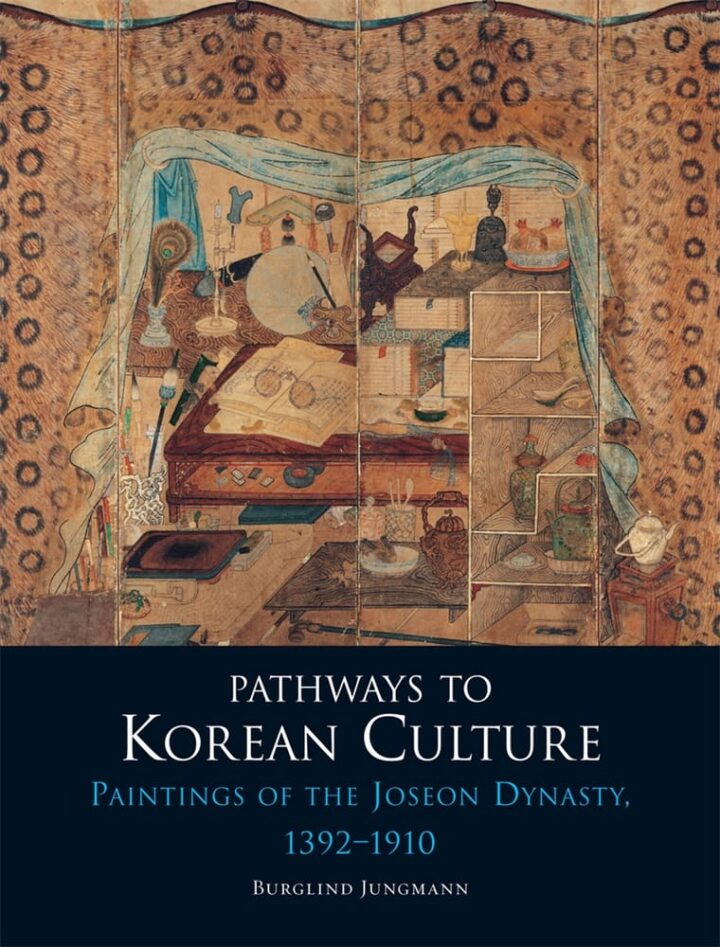
Pathways to Korean Culture
Paintings of the Joseon Dynasty, 1392–1910
Burglind JungmannPathways to Korean Culture explores the various social, cultural and political perspectives of the Joseon era (1392–1910), uncovering the fascinating history of more than 500 years of Korean art and visual culture.
In this book Burglind Jungmann investigates select clusters of objects to shed light on the multiple layers of personal, intellectual, aesthetic, religious, sociopolitical and economic contexts in which they are embedded. From palace decorations to established artworks, this book takes a sweeping, comprehensive look at Korean culture and history, exploring its engagement with the West, its political affiliations with China and its unique range of artists.
Introducing the major works and currents of Joseon painting, Pathways to Korean Culture explores the various social, cultural and political perspectives of this dynamic, dynastic era (1392–1910), uncovering the fascinating history of more than 500 years of Korean art and visual culture.
In this book Burglind Jungmann examines an array of themes and aspects of the art world of the Joseon dynasty, from the ink painting tradition of the literati elite to the role of women as both patrons and artists. She looks at the various roles of paintings in Joseon Korea, where they were as important for foreign exchange as they were as a means of escapism, and explores the dynasty’s overarching Confucian ideology, which was constantly at odds with the culture’s Buddhist projects.
The book investigates select clusters of objects to shed light on the multiple layers of personal, intellectual, aesthetic, religious, sociopolitical and economic contexts in which they are embedded. From palace decorations to established artworks, this book takes a sweeping, comprehensive look at Korean culture and history, exploring its engagement with the West, its political affiliations with China and its unique range of artists.
-
'
This is a valuable, original and accessible overview of a rich and multi-layered artistic tradition that is not well understood outside Korea.
'Bulletin of the School of Oriental and African Studies
-
'
Professor Jungman has done a marvelous job. I believe [the book] will certainly be a great contribution to the field of East Asian studies.
'Hongnam Kim, Professor Emeritus, Department of Art History, Ewha Womans University, Seoul, and former Director of the National Museum of Korea
-
'
[This book] is of great importance in enhancing our understanding of Joseon painting and of Korean painting as a whole.
'Chin-Sung Chang, Associate Professor, Department of Archaeology and Art History, Seoul National University
Introduction
PART I
THE EARLY JOSEON DYNASTY: NEO-CONFUCIAN
IDEALS AND STRATEGIES OF RECLUSION
One Chinese Antiquity as an Ideal of Paradise
Two Court Traditions and Literati Styles
Three Women as Artists and Patrons
Four Strategies of Reclusion
Five Escapism and Diplomatic Exchange: Kim Myeongguk and Han Sigak
PART II
NATIVE THEMES VERSUS FOREIGN STYLE
Six e Korean Reception of the ‘Southern School of Painting’
Seven Between Old and New: Yun Duseo and Jo Yeongseok
Eight e Question of ‘True Scenery’
Nine Facets of Literati Art: Sim Sajeong and Gang Sehwang
Ten Individualist and Eccentric: Yi Insang and Choe Buk
Eleven Orthodoxy and Revival: From Kim Jeonghui to An Jungsik
PART III
DOCUMENTATION, DECORATION AND DISPLAY:
FROM COURT PAINTING TO FOLK ART
Twelve Painting Production at Court
Thirteen e Case of Kim Hongdo
Fourteen Court Painting and Minhwa
References
Bibliography
Index of Characters
Index of Painters
Acknowledgements
Photo Acknowledgements
Index
6
Burglind Jungmann is Professor of Korean Art History in the Department of Art History, UCLA. She has organized many exhibitions and written numerous publications on East Asian art, including Painters as Envyos: Korean Inspiration in Eighteenth Century Japanese Nanga (2004).