


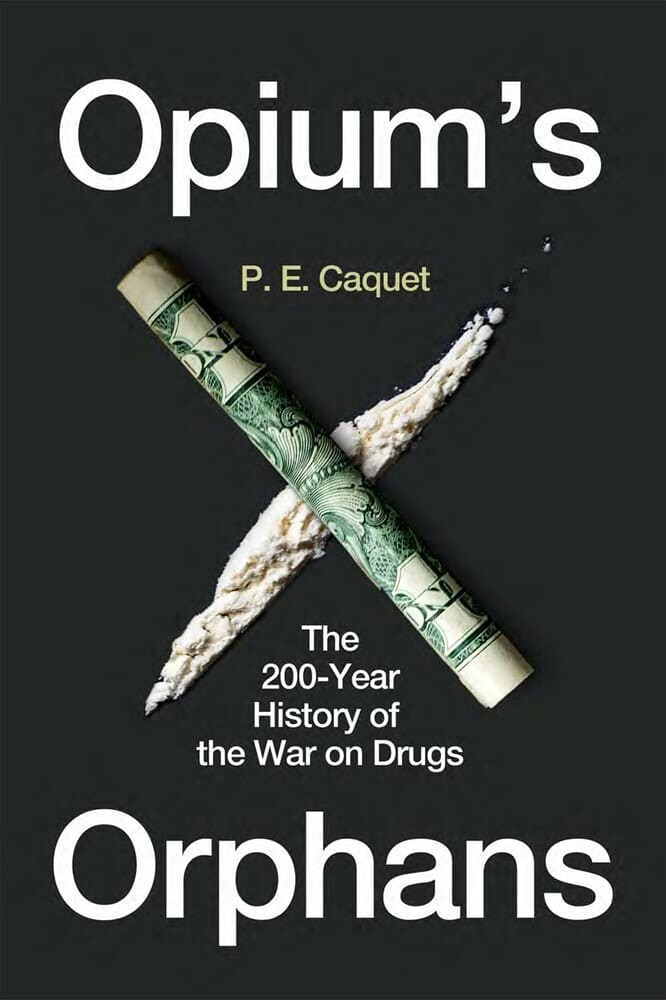
Opium’s Orphans
The 200-Year History of the War on Drugs
P. E. CaquetThe first full account of governments’ attempts to suppress drugs and drug-dealing.
Opium's Orphans is the first full history of drug prohibition and the ‘war on drugs’. A no-holds-barred but balanced account, it shows that drug suppression was born of historical accident, not rational design. The war on drugs did not originate in Europe or the USA, and even less with President Nixon, but in China. Two Opium Wars, followed by Western attempts to atone for them, gave birth to an anti-narcotics order that has come to span the globe. But has the war on drugs succeeded? As opioid deaths and cartel violence run rampant, contestation becomes more vocal and marijuana is slated for legalization in many places, Opium's Orphans proposes that it is time to go back to the drawing board.
The first full account of governments’ attempts to suppress drugs and drug-dealing.
Opium's Orphans is the first full history of drug prohibition and the ‘war on drugs’. A no-holds-barred but balanced account, it shows that drug suppression was born of historical accident, not rational design. The war on drugs did not originate in Europe or the USA, and even less with President Nixon, but in China. Two Opium Wars, followed by Western attempts to atone for them, gave birth to an anti-narcotics order that has come to span the globe. But has the war on drugs succeeded? As opioid deaths and cartel violence run rampant, contestation becomes more vocal and marijuana is slated for legalization in many places, Opium's Orphans proposes that it is time to go back to the drawing board.
-
'
A thought-provoking, often disturbing account of drug prohibition that provides context for current debates.
'Kirkus Reviews
-
'
With the exception of certain synthetic hallucinogens, all prohibited drugs are fallen medicines. Opium’s Orphans is a comprehensive survey of the attempts to make recreational drugs, and the cultures of consumption they have generated, subject to a global law enforcement enterprise.
'Times Literary Supplement
-
'
Opium's Orphans is a fascinating, provocative, and nuanced account of the mess we've gotten ourselves into. Now, we continue the work of trying to get out of that mess.
'Drug War Chronicle
-
'
This global political history of modern recreational drug prohibition begins with Qing China's early nineteenth-century attempt to suppress opium and ends with the US attempt to suppress opioids developed by pharmaceutical firms . . . Among the book’s most interesting challenges to conventional thinking are the estimates of regular opium smokers in China in 1905–06 –15 million people, or 3.3 percent of the population – which are lower than described in nationalist denunciations of the century of humiliation by imperialist powers. One overarching theme is the ultimately futile, often counterproductive policy of suppressing drug sources by interdicting transnational trade, which decision-makers in most countries have pursued for two centuries. Caquet has written an engaging account meriting both scholarly and popular readers. Highly recommended.
'Choice
-
'
Opium’s Orphans is a wide-ranging account of a profoundly consequential history whose origins, rationale, and effects raise difficult questions of the limits of governmental action and the scope of human freedom.
'New Books Network
-
'
For those with little or no prior knowledge of the history of drug control, this book offers a valuable overview of its past and provocative arguments for political criticism in the present . . . [an] impressively wideranging book.
'International Affairs
-
'
Beautifully written. Meticulously researched. P. E. Caquet elegantly weaves together an eclectic range of sources and narratives to produce an edifying and entertaining account of the long and complex rise of prohibition and related endeavours to suppress “narcotics”. Combining breadth and depth of analysis with valuable and timely historical insights, Opium’s Orphans merits a wide and attentive audience.
'David R. Bewley-Taylor, Professor of International Relations and Public Policy, Swansea University, and author of 'International Drug Control: Consensus Fractured' (2012)
-
'
Opium’s Orphans is that rare book which is thoroughly researched, well written and engaging. It asks important questions of the global drug control regime by tracing its history from early Chinese prohibitions of opium to the present day. The final chapter shows how the regime is challenged by current developments, such as the legalization of cannabis, pharmaceutical industry-driven opioid epidemics and extreme violence within some drug markets. Overall, it is a welcome contribution to the growing revisionist literature on the history of drug prohibition.
'James Windle, Lecturer in Criminology, University College Cork, and author of 'Suppressing Illicit Opium Production: Successful Intervention in Asia and the Middle East' (2016)
P. E. Caquet is an Associate at Hughes Hall, University of Cambridge. His books include The Orient, the Liberal Movement, and the Eastern Crisis of 1839–41 (2016) and The Bell of Treason: The 1938 Munich Agreement in Czechoslovakia (2018).